
When “2 Hours of Deep Work” Keeps Failing
You sit down after work, open your laptop, and promise yourself, “Tonight I’ll do two hours of deep work.” Ten minutes later, you are checking messages, browsing tabs, or staring at your notes without really reading them. The evening disappears, and you end up feeling guilty instead of accomplished.
If you are a working adult studying for exams, building skills for your career, or juggling side projects on top of a full-time job, long deep-work sessions often feel too heavy to start and too fragile to maintain. Between meetings, notifications, and mental fatigue, what you really need is a routine that respects your limited attention and still moves your learning forward.
I started using this 15-minute focus block on evenings when I felt too tired for “serious study,” and it was just enough structure to actually finish one small but meaningful task instead of abandoning the whole plan.
Why Four 15-Minute Focus Blocks Work Better Than One 2-Hour Sprint
Many microlearning and productivity guides now recommend short, focused sessions of around 5–20 minutes instead of marathon study blocks. Short bursts let your brain process one idea at a time without cognitive overload, keep engagement higher, and are much easier to fit into a busy day.
Research on attention and study routines also shows that focus naturally drops when you try to concentrate for too long without breaks, while several shorter sessions with small pauses help you reset and stay mentally present. In practice, this means that four short blocks with clear goals often produce more real progress than one heroic “deep work” session you keep postponing.
Self-regulated learning studies further suggest that planning specific blocks of time and monitoring what you do in each block are linked to better time use, less procrastination, and higher academic performance. When you stack four 15-minute focus blocks, you are not just surviving after work; you are deliberately training your planning and self-monitoring skills one small session at a time.
Overview: Four 15-Minute Focus Blocks = One Hour
In this routine, you treat one 15-minute block as a complete mini-cycle:
- 3 minutes: prep your space, your brain, and your tools
- 10 minutes: focused work on one clearly defined task
- 2 minutes: quick wrap-up and next-step note
Four of these blocks add up to roughly one hour of focused work. You can:
- Start with just one block per day as your “minimum routine”
- On better days, add a second, third, or fourth block
- Mix study tasks (reading, practice questions) and work tasks (writing, coding, planning) inside the same structure
If you are new to short, focused sessions, you may also like our guide on 15-Minute Study Routine: How to Make Short, Focused Blocks Actually Work, which explains how to build and chain simple 15-minute sessions across your day.
Step 1 – Prep (3 Minutes): Set Up Your Space, Task, and Timer
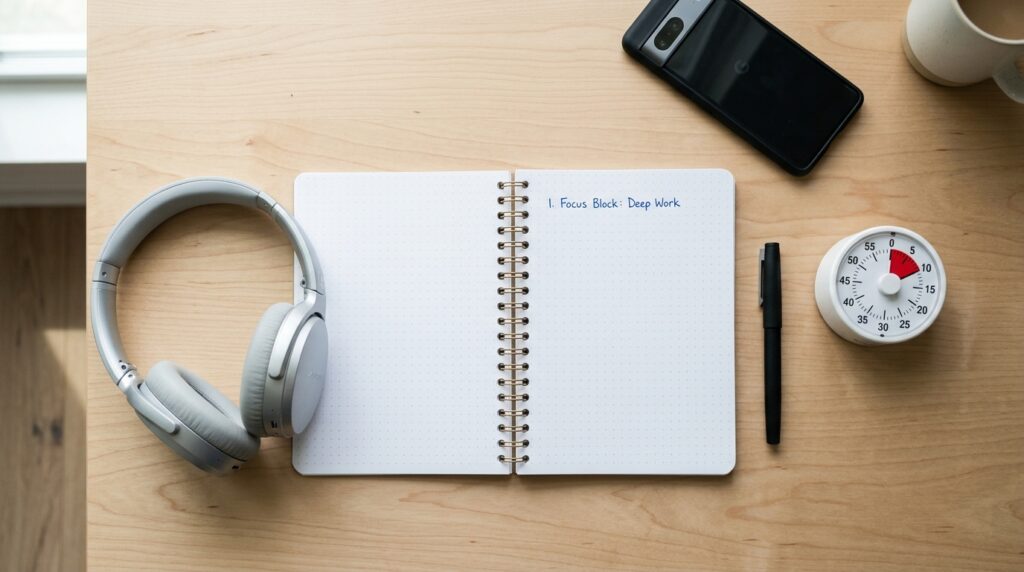
1. Quickly Reset Your Physical and Digital Space (About 1 Minute)
For one minute, act like you are clearing a small launchpad:
- On your desk: keep only today’s book or document, your notebook, and a pen
- Move other books, papers, and random items to the side
- On your screen: close tabs and apps that are not needed for this block
Visual clutter is a decision magnet; the more you see, the more your brain has to decide what to pay attention to. A lightweight reset makes this first block feel less heavy and signals, “For the next 15 minutes, this is the only thing that exists.”
If you want a more permanent way to organize your digital study space, you can also check out our guide on Building a Notion Study Dashboard to create a simple home base where your tasks, notes, and focus blocks live together. (Use your actual Notion dashboard article URL here.)
2. Write One Line for This 10-Minute Block (About 1 Minute)
Next, decide exactly what today’s first 10-minute focus block is for and write it in one line. For example:
- “Review vocabulary pages 10–12 and mark new words.”
- “Read certification textbook section 3.2 and highlight key formulas.”
- “Draft the opening paragraph of my report.”
Keep it tiny and concrete: one subject, one chunk. You can log this in:
- A paper planner
- A simple Notion page called “15-Min Focus Blocks”
- A basic notes app like Apple Notes, Google Keep, or any memo tool
Studies on self-regulated learning emphasize that setting specific, manageable goals and then monitoring what you do helps learners use their time more effectively and procrastinate less. Your one-line goal is a mini version of that: just enough structure to tell your brain what “done” looks like for the next 10 minutes.
3. Set a 10-Minute Timer (About 1 Minute)
Finally, set a timer for 10 minutes:
- Use your phone’s timer in Do Not Disturb or focus mode
- Use a minimalist focus timer app
- Use a browser-based timer on your laptop
Treat this 10-minute window as a small container: “From now until the alarm rings, I will just do this one thing.” Let the timer handle the time so your brain can stay inside the task instead of checking the clock.
Step 2 – Focus (10 Minutes): Protect One Task at a Time
1. Minimize Distractions Before You Press Start
Before you tap “start” on the timer:
- Put your phone face down and slightly out of reach
- Close messaging apps and social media tabs
- If possible, use a separate browser profile just for study/work so only relevant tabs are visible
These may sound simple, but they dramatically reduce how often your attention is pulled away during a short block. Think of this as giving your brain a quiet 10-minute room rather than a noisy open office.
If you find yourself constantly bouncing between apps, you might also like 15-Minute Time Blocking: How to Turn a Scattered Day into Focused Study Blocks, which shows how to schedule your short focus sessions so that meetings, admin tasks, and deep work are not all fighting for the same time.
2. Do Only the One Line You Wrote
Once the timer starts, your only job is:
“Do the one line I wrote. Nothing else.”
That means:
- If you chose vocabulary, you do not “quickly” check email
- If you chose practice questions, you do not switch to a different subject
- If you get stuck, you take one tiny helpful action: reread the question, check one example, or ask an AI assistant a single clarification, then return to the task
If your mind wanders, tell yourself:
“I’ll just come back to this page until the timer rings.”
One of the big advantages of 15-minute focus blocks is psychological: “Just 10 minutes of actual work” feels manageable even when you are tired or distracted. You lower the emotional resistance to starting, which is often the hardest part.
3. Optional Micro-Break Between Blocks
After each block, you can take a 2–5 minute break:
- Stand up, stretch, or walk to another room
- Drink water or make tea
- Look away from screens
Short movement breaks reset attention better than scrolling another app, and they prepare your brain for the next block. After four 15-minute cycles with tiny breaks, you will often have a surprisingly focused hour behind you.
Step 3 – Wrap-Up (2 Minutes): Capture Progress and Prime the Next Block

1. Write One Line About What You Did
When the timer rings, do not instantly grab your phone or open a new app. Spend one minute logging what you actually did. For example:
- “Reviewed vocabulary pages 10–12, marked 9 new words.”
- “Read section 3.2 and highlighted 5 key formulas.”
- “Drafted the opening paragraph, needs one more edit.”
This turns your 10 minutes into visible progress instead of a fuzzy memory. Over time, your notebook, Notion database, or notes app becomes a record of effort, not just a list of intentions. Studies on self-regulated learning note that students who regularly monitor their study activities—what they did and what comes next—tend to be more consistent and strategic in how they learn.
2. Leave One Line for the Next Block
Then write one line for what you will do in the next block:
- “Next: review vocabulary pages 13–14.”
- “Next: solve 3 practice problems from section 3.2.”
- “Next: revise paragraph and outline section 2.”
This removes the “What should I do now?” friction from your next session. Future you just has to show up, open your log, and follow the next instruction.
If you’re curious how to apply this same three-step pattern at different times of day, see 15-Minute Morning Study Routine: How Changing Just 15 Minutes Boosts Your Focus All Day for a version tailored to early hours before work.
Everyday Tips for Using Four 15-Minute Blocks
Fix a Morning or Evening Slot
Most people cannot focus at their best at every hour of the day. But guides on study routines consistently recommend choosing one fixed window when you usually run at least one block, such as:
- Within 30 minutes after waking up
- Right after dinner
- One hour before you normally go to bed
Research on time management and self-regulated learning suggests that consistent, planned study windows are associated with better academic outcomes and lower procrastination. When your brain learns that “around 8 p.m., we always do one 15-minute block,” starting becomes a habit, not a debate.
Define a Minimum Routine for Hard Days
There will be days when you are exhausted, stressed, or unmotivated. For those days, decide in advance:
- “If today is really hard, one 15-minute block still counts as success.”
- “On better days, I can go up to four blocks, but one block is the minimum win.”
Coaching guides on microlearning and habit formation often emphasize that short, repeatable cycles (like 10–20 minutes) are more sustainable and easier to maintain than sporadic marathons. One small block is always better than zero, especially when your alternative is “I failed again.”
Use Simple Tools, Not a Complicated System
To run this routine, you only need:
- Somewhere to write one-line goals and logs (paper planner, Notion page, or notes app)
- A timer (phone, watch, browser, or minimalist focus app)
You can layer more tools later—a Notion dashboard, AI assistants for quick clarifications, or a dedicated “study” browser profile—but the routine itself should work even if you only have a notebook and a phone timer. Start simple; add complexity only when the basic 15-minute cycle feels solid.
Related Routines You Might Like
- 15-Minute Study Routine: How to Make Short, Focused Blocks Actually Work – A detailed guide to building 15-minute blocks you can plug into any part of your day.
- 15-Minute Time Blocking: How to Turn a Scattered Day into Focused Study Blocks – How to map your whole day and place focused blocks for study and work without feeling overwhelmed.
- 15-Minute Evening Study Routine for Busy Office Workers – A realistic evening routine for people who come home tired but still want to move their learning forward.
Frequently Asked Questions
Q1. How many 15-minute blocks should I do in one sitting?
Start with just one 15-minute block and treat it as your minimum success. Once that feels automatic, you can add a second, third, or fourth block in the same sitting or at different times of day. The goal is to build a consistent rhythm, not to max out your capacity from day one.
Q2. What if I only have 5 minutes, not 15?
Use a micro-block: 1 minute to clear your space, 1 minute to write one tiny goal, 3 minutes to do it, then stop. Microlearning research suggests that even 5–10 minute bursts, repeated over time, can improve retention and reduce procrastination, especially when they focus on a single concept or task.
Q3. Can I use this routine for work tasks, not just studying?
Yes. The 3–10–2 structure works well for writing reports, coding, reading research papers, handling email triage, or planning your day. Just write one clear work task for the 10-minute block (“Draft outline for client proposal,” “Review three pull requests”) and follow the same steps: prep, focus, and quick wrap-up.
Q4. Which tools do I need to start this routine?
You only need three things: a place to write your one-line goals, a timer, and somewhere to log what you did. A paper notebook and your phone’s timer are enough. If you like digital tools, a simple Notion page or basic notes app is more than enough—no complex setup required.
Learn More
For more on focus, study habits, and building consistent short routines, see:
- MoreCurricular – The Science Behind Bite-Sized Study Sessions
Explains why short, focused study sessions based on microlearning principles improve engagement and retention compared to long cram sessions.
https://www.morecurricular.co.uk/post/the-science-behind-bite-sized-study-sessions-why-shorter-really-is-better - Seventh Star – The Power of Microlearning: How Small Study Sessions Can Lead to Big Results
Introduces microlearning, shows how 5–15 minute chunks reduce cognitive overload and make it easier to stick with regular study.
https://seventhstar.co.za/the-power-of-microlearning-how-small-study-sessions-can-lead-to-big-results/ - YMEtaConnect – Microlearning vs Marathon Study: The Surprising Winner
Compares long study marathons with short microlearning sessions and summarizes cognitive psychology principles like cognitive load and spacing effect.
https://ymetaconnect.com/blogs/how-microlearning-outperforms-marathon-study-sessions - Self-Regulated Learning and Time Management (Open-Access Chapter)
Reviews how goal setting, time planning, and self-monitoring relate to better academic outcomes in university students.
https://www.intechopen.com/chapters/1192855