
When you come home after a full workday, your body and mind are already tired.
You know you want to study for that certification exam, read a chapter for your online course, or make progress on a side project—but the idea of sitting down for two hours feels impossible.
Your brain is drained from meetings, emails, and decision-making all day, and within minutes of sitting on your couch, you find yourself scrolling through your phone or staring blankly at the wall.
Office workers, graduate students, and anyone juggling work and study face this same problem every evening: the gap between “I should study tonight” and actually opening a book or starting a task feels too wide to cross.
The solution is not to force yourself into a long, ambitious study session.
Instead, you need a short, structured routine that you can complete before your mind fully shuts down—a single 15-minute set that resets your posture, clears your head, and gets you through one small but meaningful task.
This 15-minute study routine after work is designed for evenings when you are tired but still want to make progress.
It is divided into three parts: 3 minutes of preparation, 10 minutes of focused work, and 2 minutes of review.
I started using this routine on evenings when my brain felt completely scattered after work, and it was just enough structure to actually finish one small but meaningful task without burning out.
Why a 15-Minute Evening Routine Works Better Than Long Sessions
Your Focus Is Already Depleted by Evening
After eight hours of work, your attention and decision-making capacity are significantly reduced.
A 15-minute study routine after work is easier to complete than a long session because your focus is already depleted by evening.
Research on attention and cognitive load shows that even brief diversions—short breaks or task switches—can help restore focus during prolonged mental effort.
For evening study, this means that trying to push through a 90-minute block when you are already tired is less effective than doing one short, clearly defined session.
Short study blocks (10–20 minutes) align better with how your brain processes information after a full day of cognitive work.
Studies on time management for students show that structured techniques like time blocking and short focus sessions improve academic performance, reduce stress, and help maintain consistent habits—especially when balancing work and study.
Small Routines Build Consistent Habits
A 15-minute routine is easier to start, easier to repeat, and easier to defend against distractions than a vague “I’ll study for a while tonight” plan.
When you complete the same short routine at the same time each evening, your brain begins to recognize it as a familiar pattern, and starting becomes less effortful over time.
Self-directed learning research consistently shows that regular, planned study routines are more strongly linked to long-term academic success than sporadic, intensive cramming sessions.
The 15-Minute Evening Study Routine: Three Steps
Step 1 – Preparation (3 Minutes)
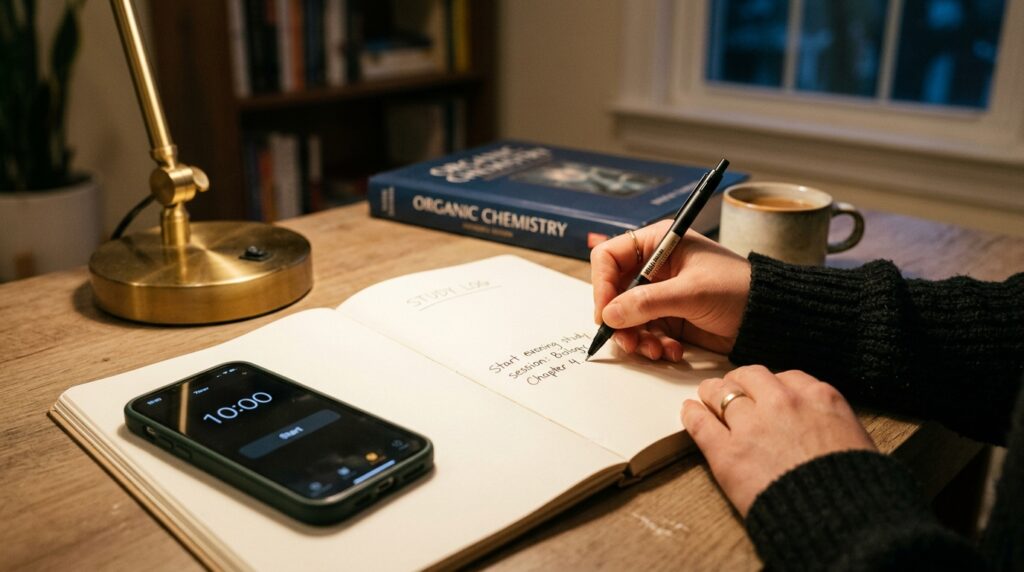
The goal of the preparation phase is to create a simple, distraction-free environment and define exactly what you will work on for the next 10 minutes.
Clear your workspace (30–60 seconds):
Remove everything from your desk except what you need for tonight’s task.
If you are reviewing vocabulary, keep only your notebook or flashcard app open.
If you are writing a section of a report, close all browser tabs except the document you are working on.
Write down tonight’s task in one sentence (1 minute):
Use a notebook, sticky note, or note app to write one specific, completable task.
Examples:
- “Review 20 vocabulary words from Chapter 3”
- “Write the introduction paragraph for my project proposal”
- “Watch one 10-minute lecture video and take notes”
The key is to make the task small enough that you can finish it in 10 minutes.
Set a timer for 10 minutes (30 seconds):
Use your phone timer, a browser extension, or a simple desk timer.
The timer creates a clear boundary: once you start, you will not check your phone, open social media, or switch tasks until the alarm goes off.
If you use Notion or a similar note app, you can create a simple “Evening 15-Min Log” page where you track your daily task and timer in one place.
For a step-by-step guide on setting up study tracking systems in Notion, see our guide on building a study habit tracker.
Tools that help:
A desk lamp, a simple timer app, and a clean notebook or digital note page are enough.
You do not need expensive tools—the key is protecting your 10-minute focus window from interruptions.
Step 2 – Focus Work (10 Minutes)
This is your core study block.
For the next 10 minutes, you work on the one task you defined in Step 1, and nothing else.
Turn off notifications:
Flip your phone face-down, close messaging apps, and silence browser notifications.
Even a single notification can break your focus and make it harder to return to deep work.
Work on one thing only:
If your task is “review 20 vocabulary words,” do not switch to reading a different chapter or checking your email halfway through.
If your task is “write one paragraph,” write that paragraph—do not edit yesterday’s work or research a new topic.
What to do if you feel stuck:
If you sit down and still feel mentally blocked, start with the smallest possible action.
Open the book.
Read the first sentence.
Type one word.
Your brain will often follow once you take the first tiny step.
Why 10 minutes works:
Attention research suggests that most people can sustain deep focus for around 10–20 minutes at a time, especially after a full day of work.
A 10-minute block is short enough to feel manageable but long enough to accomplish something meaningful.
If you are working on a longer project that requires multiple focus blocks, you can check our guide on chaining 15-minute study blocks together for extended work sessions.
Step 3 – Review and Log (2 Minutes)

When the timer goes off, stop working immediately and move to the review phase.
Write down what you finished (1 minute):
In your notebook or note app, write one sentence describing what you completed.
Examples:
- “Reviewed vocab Day 3, 20 words”
- “Wrote introduction paragraph (120 words)”
- “Watched lecture 4, took 5 bullet-point notes”
This small record creates a sense of progress and makes it easier to see your consistency over time.
Write down what comes next (1 minute):
Before you close your notebook or app, write one sentence about what you will work on tomorrow.
Examples:
- “Tomorrow: review vocab Day 4”
- “Tomorrow: write body paragraph 1”
- “Tomorrow: watch lecture 5”
This eliminates the “what should I do now?” hesitation when you sit down the next evening.
Leaving a clear next step written down also reduces decision fatigue and helps you start faster tomorrow.
If you want to see how this daily logging practice fits into a larger weekly review system, see our guide on the 15-Minute Monday Study Review routine.
Everyday Tips for Making This Routine Stick
Fix Your Study Time to a Daily Anchor
Instead of deciding when to study each night, tie your 15-minute routine to a fixed daily event.
Examples:
- “Right after I finish dinner and wash the dishes”
- “Before I take my evening shower”
- “As soon as I change out of my work clothes”
When you anchor your study routine to a consistent part of your day, it becomes easier to remember and harder to skip.
Create a Minimum Routine for Low-Energy Days
On days when you are too tired to do the full 15-minute routine, have a “minimum version” ready.
Example:
- Prep: 1 minute (write task, set timer)
- Focus: 5 minutes (one very small task)
- Review: 1 minute (log what you did)
Even a 7-minute session is better than skipping entirely.
The goal is to keep the habit alive, not to be perfect every day.
Self-directed learning research shows that maintaining small, consistent routines is more important for long-term success than occasional intense study marathons.
Use Your Digital Tools to Reduce Friction
If you use Notion, create a simple “Evening Study Log” database with three fields: Date, Task, and Next Step.
Each evening, add one row in under 30 seconds.
If you use a timer app, set a favorite preset for “10-minute focus block” so you do not have to manually enter the time every night.
If you use a note app like Apple Notes or Google Keep, create a dedicated “Evening Study” note and update it daily.
The less friction between “I should study” and “I am studying,” the easier it becomes to start.
For more on setting up a complete digital study workspace, see our guide on building a Notion study dashboard.
Related Routines You Might Like
15-Minute Study Routine: How to Make Short, Focused Blocks Actually Work
A deeper dive into building short study blocks and chaining multiple sessions together.
15-Minute Time Blocking: How to Turn a Scattered Day into Focused Study Blocks
How to plan your entire day around short focus sessions without feeling overwhelmed.
Evening 15-Minute Reset Study Routine: How to Get Back on Track When Work, Study, and Rest All Collide
A complete evening reset routine that pairs well with this quick study set.
Frequently Asked Questions
Q1. What if I only have 5 minutes, not 15?
Use the minimum routine: 1 minute prep, 3–4 minutes focus, 1 minute review.
Even a 5-minute session keeps your habit alive and prevents you from breaking your streak on low-energy days.
Q2. Can I use this routine for work tasks, not just studying?
Yes.
This routine works for any focused task: writing emails, reviewing reports, planning tomorrow’s meetings, or learning a new skill.
The structure (prep, focus, review) applies to any type of knowledge work.
Q3. Which tools do I need to start?
You only need a timer and a way to write down your task and progress (notebook, sticky note, or note app).
Everything else—desk lamp, Notion database, study tracker—is optional.
Q4. What if 10 minutes feels too short and I want to keep going?
If you finish your 10-minute block and still have energy, you can start a second 15-minute set.
But do not skip the 2-minute review phase—logging your progress is what builds the habit and keeps you consistent over time.
Learn More
For more on focus, study habits, and building consistent routines after work, see:
Jotverse – Time Blocking for Students: The Ultimate Productivity System for Academic Success
Practical guide to using time blocking to manage study sessions and reduce decision fatigue.
https://www.jotverse.com/time-blocking-for-students-the-ultimate-productivity-system-for-academic-success/
Summit Learning Charter – 7 Benefits of Time Blocking Methods for Studying
Explains how time blocking can improve concentration and academic performance.
https://summitlearningcharter.org/resources/blog/benefits-of-time-blocking/
University of Illinois News – Brief Diversions Vastly Improve Focus, Researchers Find
Research on how short breaks and task switches restore attention during prolonged mental effort.
https://news.illinois.edu/brief-diversions-vastly-improve-focus-researchers-find/
Chloe Burroughs – How to Find the Time, Energy and Motivation to Study After Work
Practical strategies for managing study routines when you’re balancing a full-time job.
https://chloeburroughs.com/find-time-energy-motivation-study-after-work/