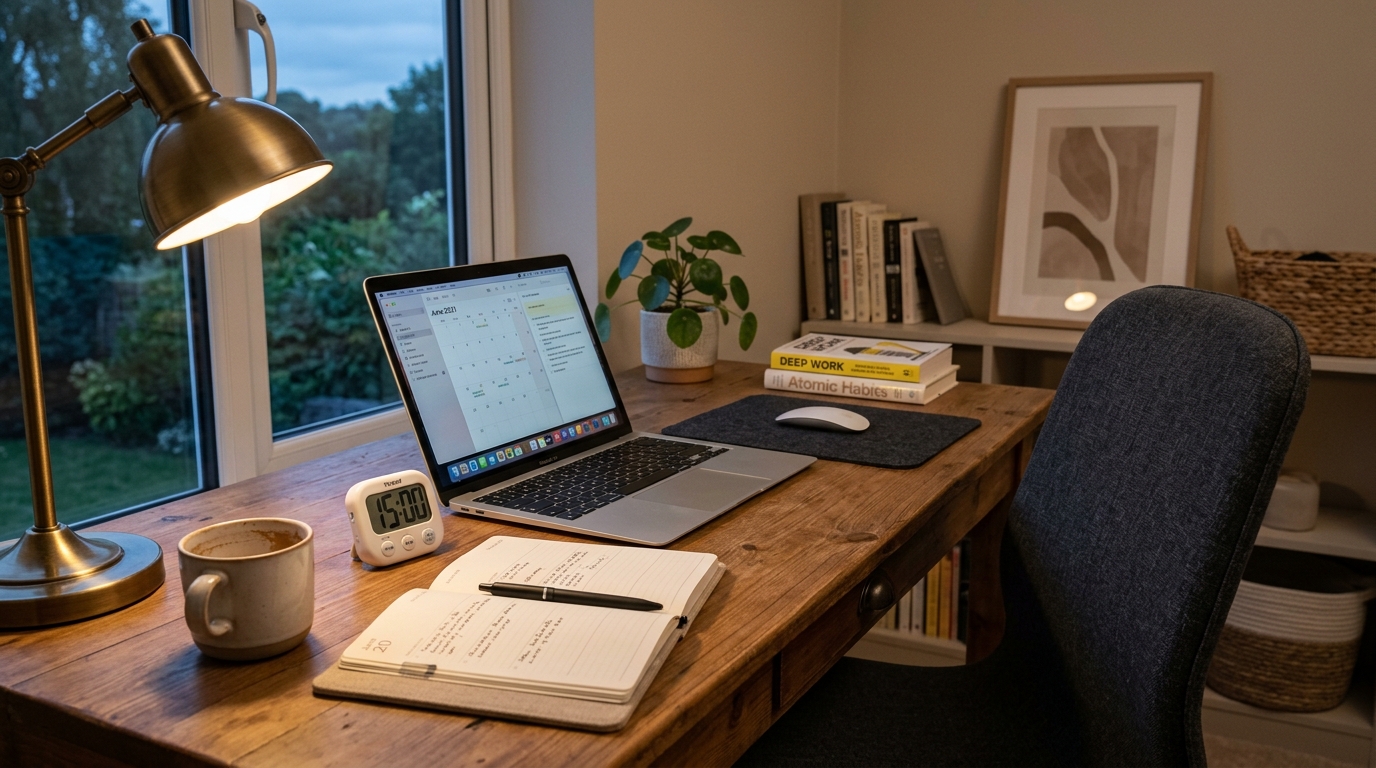
When Work, Study, and Rest All Collide in the Evening
You finish work, reply to a few late emails, try to squeeze in some study time, and also want to relax a bit before bed.
By the end of the evening, it often feels like you did a little bit of everything—but nothing properly.
Maybe you check your inbox, scroll through a couple of videos, open your book but can’t focus, and suddenly it’s almost bedtime.
Your body is stiff from sitting, your brain is tired, and your to‑do list is still staring at you.
This is where a simple evening 15 minute study reset routine can help.
In this guide, we’ll design a 30‑minute block that combines a 15‑minute posture reset and a 15‑minute study and review block, so your body, your tools, and your mind all get reset together as one evening 15 minute study reset routine you can actually keep.
I started using this 15‑minute posture + 15‑minute study setup on evenings when my brain felt scattered, and it was just enough structure to actually finish one small but meaningful task.
Why Evening 15-Minute Blocks Work Better Than “I’ll Study for 2 Hours”
Many knowledge workers and adult learners fall into the same trap:
“If I don’t have at least two hours, it’s not worth studying.”
In reality, that mindset often leads to doing nothing when the day doesn’t go perfectly.
Attention and learning research suggest that our ability to focus deeply tends to drop after around 15–20 minutes, especially in lecture or screen-heavy environments.
Short, time‑boxed focus blocks are often more realistic to sustain after a long day than one long, heroic session.
At the same time, studies on self‑directed learning highlight that students who plan and manage their own learning in small, manageable steps tend to feel more in control and engaged, even if total study hours aren’t huge.
In other words, consistent routines matter at least as much as raw study time.
An evening 15 + 15 routine solves two problems at once:
- Your body gets a short posture reset so you’re not fighting stiffness while trying to focus.
- Your brain gets a clear, limited block for one task, so you don’t waste half the evening deciding what to do.
And importantly, setting a minimum goal like “Just one 15‑minute set is enough today” helps you avoid the “Today I did absolutely nothing” streak that breaks your study identity.
Overview: The Evening 30-Minute Reset
One Simple 30-Minute Structure
In this article, we’ll build a single 30‑minute evening routine:
- Step 1 – Posture Reset (15 minutes)
- 10 minutes: light stretches for your back, neck, shoulders, and hips
- 5 minutes: calm breathing and simple relaxation
- Step 2 – Study and Review (15 minutes)
- 3 minutes: prep your space, set a clear goal, start your timer
- 10 minutes: focused study on one task
- 2 minutes: quick review and one‑line plan for tomorrow
The goal is not to create the perfect routine.
The goal is to have one reliable block you can turn on almost automatically, even on messy evenings.
All you need is:
- A small space on the floor (yoga mat, carpet, or even your bed)
- Your study tools (laptop/tablet, notebook, or textbook)
- A timer (phone, browser extension, or a physical timer)
- A planner or note app for a three‑line evening log
If your digital workspace feels chaotic, you may want to pair this with a simple dashboard later—
for example, our guide on 15-Minute Reading and Notion Routine: How to Turn Scattered Book Notes into a Simple Reading System can help you centralize your notes and links in one place.

Step 1 – 15-Minute Posture Reset: Switch Your Body Out of “Work Mode”
Why Your Body Needs a Transition Block
The evening is when “work mode” and “rest mode” crash into each other.
If you jump straight from email to study without moving, your body is still in desk posture, and your brain is still half‑stuck in notifications.
A short posture reset tells your nervous system:
“Work is done, now we switch to reset and focus.”
You don’t need a full workout.
Just 10 minutes of simple stretches plus 5 minutes of easier breathing and relaxation is enough to change how your body feels in the chair.
10 Minutes: Simple Stretch Sequence
You can adapt this to your own mobility and comfort.
Move slowly, never into sharp pain, and modify anything that doesn’t feel right.
Aim for about 20–30 seconds per movement, and loop through a few simple patterns:
- Neck mobility
- Gently tilt your head forward and back, then side to side.
- Finish with slow, comfortable half‑circles if they feel okay.
- Shoulder release
- Roll your shoulders forward and backward in big, smooth circles.
- Reach your arms overhead and stretch long, then relax them down.
- Spine and lower back
- In a seated or standing position, gently round and then extend your spine.
- If you’re on the floor or bed, try a light knees‑to‑chest hold for 20 seconds.
- Hips and pelvis
- Sit or lie down and pull one knee toward your chest, then switch sides.
- If comfortable, cross one ankle over the opposite knee and lean forward slightly to stretch your hip.
Each movement is simple, but together they remind your body that you are no longer locked into a chair.
Harvard Health notes that regular stretching supports flexibility, posture, and everyday comfort—especially as we age and spend more time sitting.
If you already have a favorite 15‑minute stretch routine from your physical health blog, you can drop that in here.
Think of this as the “plug‑in” slot for your go‑to after‑work stretch sequence.
5 Minutes: Breathing and Light Relaxation
After the stretch sequence, take 5 minutes to slow your breathing and ease into “evening focus mode.”
You can try something as simple as:
- Sit or lie down comfortably.
- Inhale for a count of 4, hold for 1–2 seconds, exhale for a count of 6–8.
- Repeat this for 5 minutes, keeping your shoulders and jaw relaxed.
This doesn’t have to be a formal meditation.
The goal is just to let your nervous system step down a level so that your next 10‑minute study block doesn’t feel like pushing through a wall.
If you use a breathing app or a simple timer with soft sounds, you can let it guide you through this short reset.
Step 2 – 15-Minute Study + Review: End the Day Without Feeling Scattered
3 Minutes: Prep Your Space, Goal, and Timer
Once your body is reset, move back to your desk or study spot.
You’re going to do three small things before you start the 10‑minute focus block:
- Clear what doesn’t belong.
- Push non‑study items to the side of your desk or into a drawer.
- Put your phone out of sight or set it to Do Not Disturb.
- Write one clear 10‑minute goal.
Examples:- “Read 4 pages of my certification textbook (pp. 32–35).”
- “Summarize today’s lecture notes in 5 bullet points.”
- “Solve 3 practice questions from Chapter 2.”
- Set a 10‑minute timer.
- Use a simple timer app, a browser extension, or a physical focus timer.
- The important part is having a clear time boundary: “Just 10 minutes.”
If you like using Notion, this is a great moment to log your plan in a simple database.
To build that from scratch, you can follow the approach in 15-Minute Planner Reset: How to Set Today’s Study Priorities Without Feeling Overwhelmed and adapt it to evening sessions.
10 Minutes: Focus on One Thing Only
When you start the timer, commit to one task only for the full 10 minutes.
A few guidelines:
- If you’re solving problems, focus on solving.
Do grading, checking answers, and reading explanations after the timer if needed. - If you’re reviewing theory or lecture notes, prioritize finding key ideas and summarizing over making your notes look perfect.
- When notifications pop up or random thoughts appear, park them.
Jot down “email,” “WhatsApp,” or “idea for tomorrow” on a sticky note, then come back to your task.
Think of this as a mini focus training session.
There’s evidence that regular practice of short, structured focus blocks can help rebuild our “focus muscle” in a world full of interruptions.
If you’ve already tried our 15-Minute Study Routine: How to Make Short, Focused Blocks Actually Work, this evening block uses the same logic—just placed at the end of the day.

2 Minutes: Quick Review and One-Line Plan
When the 10‑minute timer rings:
- Take a deep breath in, then a long exhale.
- Mark a natural stopping point in your material—underline the last line you read, or put a small symbol next to the last question.
Then, in your planner or note app, write three short lines:
- What you did
- “Read 4 pages of Unit 2 and highlighted key terms.”
- “Solved 3 questions on conditional probability.”
- How it felt
- “10 minutes went by faster than I expected.”
- “I was tired, but it was still doable.”
- What you’ll do next time
- “Next: review today’s highlights + add flashcards.”
- “Next: repeat questions 2–3 and add 2 more.”
Articles on self‑directed learning and time management often emphasize that planning small steps and reflecting briefly can increase both satisfaction and a sense of control over your learning.
Your three‑line log is a lightweight way to do exactly that—without needing a complex system.
If you’re into digital tools, you can store these three lines in a Notion database or a note app and tag them “Evening 15+15 Routine” to see your streak over time.
Everyday Tips for Making This Routine Stick
Choose One Evening Slot and Protect It
Pick one evening time window as your default 30‑minute block—for example:
- 8:00–8:30 p.m. after dinner
- 9:30–10:00 p.m. before bed
- Or right after you get home, before you open social media
The key is to make that time predictable.
With time blocking, assigning fixed blocks for specific tasks helps reduce decision fatigue and makes it easier to show up consistently.
You can even color‑code this block in your digital calendar as “15 + 15 Reset,” so your brain learns to treat it as a non‑negotiable but lightweight appointment with yourself.
Set a Minimum Goal for Messy Days
On days when everything explodes and you feel too tired to do anything:
- Make the rule: “Today, just one 15 + 15 set is enough.”
- Or even: “Just the 15‑minute posture reset and a three‑line log.”
The goal is to avoid zero.
Once you break the “I did nothing today” streak, it’s much easier to keep your routine alive.
Many learners find that once they start a tiny block, they sometimes keep going.
But even if you don’t, you’ve still protected the identity of “I’m someone who shows up for my routine,” which is more powerful than one perfect study marathon.
Related Routines You Might Like
- 15-Minute Study Routine: How to Make Short, Focused Blocks Actually Work
A deeper dive into building short study blocks and chaining multiple sessions together for longer focus. - 15-Minute Evening Study Routine for Busy Office Workers
A practical evening routine that fits around a full workday, even when you’re tired. - 15-Minute Planner Reset: How to Set Today’s Study Priorities Without Feeling Overwhelmed
Step-by-step guide to planning realistic study priorities using short planning blocks.
Frequently Asked Questions
Q1. What if I only have 5–10 minutes, not 30?
A: Then shrink the routine, don’t cancel it.
Do a 5‑minute stretch and a 5‑minute study block, plus one line in your log.
The priority is to keep the chain alive, not to complete the full 30 minutes every time.
Q2. Can I use this routine for work tasks, not just studying?
A: Absolutely.
You can use the 10‑minute focus block for any deep work task—writing a report, processing a mini inbox, reviewing a document, or planning tomorrow.
The structure (reset, focus, quick review) works the same way.
Q3. Which tools do I need to start?
A: At minimum, you need three things:
- A timer (phone, browser, or physical)
- A place to write your three‑line log (notebook or note app)
- A small space to stretch
If you enjoy digital tools, you can later add Notion databases, focus timer apps, or calendar blocks—but they’re optional upgrades, not requirements.
Q4. How many evenings per week should I aim for?
A: Start with 3 evenings per week, and treat anything above that as a bonus.
Once 3 evenings feel normal, you can move toward 4–5 if your schedule allows.
Consistency over months matters more than hitting a perfect number every week.
Learn More
For more on focus, time blocking, and consistent study habits, see:
- CPD Online College – Time Block Technique: Explanation & Benefits
Overview of how time blocking supports focus, reduces decision fatigue, and creates better balance between work, learning, and rest.
https://cpdonline.co.uk/knowledge-base/business/time-block-technique/ - SMARtS Executive Function – Can’t Concentrate for More than 20 Minutes? No Problem!
Discusses spaced learning and 20‑minute focus blocks with breaks to improve memory and reduce overload.
https://smarts-ef.org/blog/cant-concentrate-for-more-than-20-minutes-no-problem/ - The Knowledge Journal – Relationship between Self-Directed Learning and Academic Success
Explores how planning and managing your own learning steps relates to academic outcomes in university students.
https://theknowledge.com.pk/index.php/tn/article/view/72
Leave a Reply