Author: focustoolslab

  • 15-Minute Study Routine with Tiny Rewards: What to Do on Days You Don’t Want to Sit at Your Desk

    15-Minute Study Routine with Tiny Rewards: What to Do on Days You Don’t Want to Sit at Your Desk

    When You Know You Should Study but Really Don’t Want to Sit at Your Desk

    You finish a long day of work or classes, glance at your desk, and feel your whole body say, “Not tonight.” You tell yourself you’ll make up for it tomorrow with a perfect three‑hour session, but tomorrow never looks as perfect as you imagined.

    On these low‑motivation days, what you need is not a huge plan—it is a tiny, repeatable 15-minute study routine with a built‑in reward at the end. This guide gives you one simple structure you can use on “I really don’t want to” days so you still touch your work, protect your habit, and feel a little better about yourself instead of guilty.

    I started using this 15-minute routine on evenings when my brain felt tired and stubborn, and even one small block plus a tiny reward was enough to keep my study habit alive through rough weeks.


    Why Short Study Blocks and Small Rewards Work So Well

    Many attention and learning resources point out that most people can focus deeply for only about 10–20 minutes at a time before their attention naturally dips, especially when they are tired or stressed. Starting with short, pre‑planned blocks often feels more realistic than demanding two hours of deep work on a night when you are already exhausted.

    Research on self‑regulated learning and time management suggests that consistent routines and specific plans matter more for long‑term achievement than occasional long study marathons. Regularly showing up for short sessions, especially around the same time of day, is linked with better persistence and academic performance compared to studying only when you “feel like it.”

    Habit and motivation research also emphasizes the power of small, immediate rewards: when your brain learns that “after I hold my seat for 15 minutes, something pleasant happens,” it becomes much easier to start again tomorrow. The routine below is built around that idea.


    Overview: One 15-Minute Study Block with a Tiny Reward
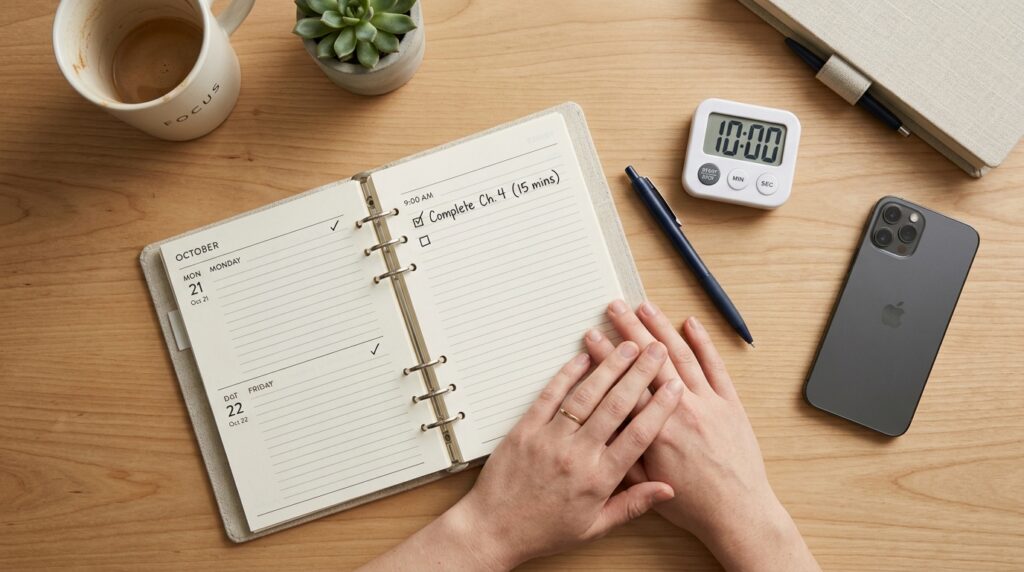
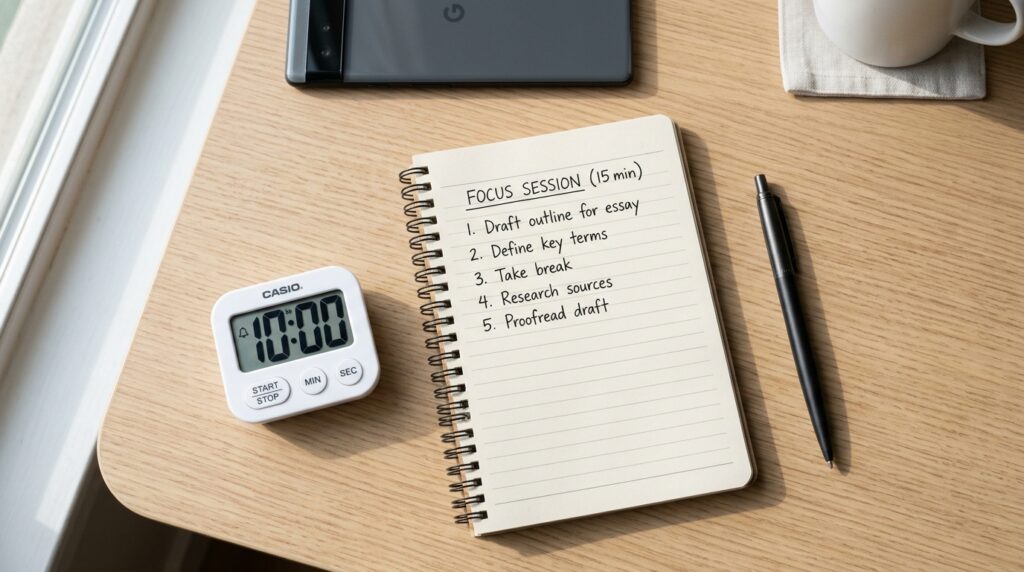
    An overhead view of a clean study desk setup with an open planner showing a one-line task, a pen, a 10-minute study timer and a smartphone placed face down for a short focus routine.

    On days when you do not want to study at all, your goal is one 15‑minute block:

    • 3 minutes: get to your desk and set up
    • 10 minutes: focus on exactly one small task
    • 2 minutes: write one line of notes and give yourself a tiny reward

    You can always do more later, but the minimum success definition is:

    “If I complete one 15-minute block today, I count today as a win.”

    That shift—from “three perfect hours” to “one small, completed block”—reduces all‑or‑nothing thinking and makes it easier to keep your habit alive on rough days.


    Step 1 – Prep (3 Minutes): Just Get to the Desk

    The goal of this step is not to be productive. The goal is only to sit at your desk and make it possible to start.

    1. Clear Just Enough Space (About 1 Minute)

    Spend one minute doing the simplest possible tidy‑up:

    • Remove anything that obviously does not belong in this study block
    • Leave only today’s book or PDF, your notebook, and a pen or keyboard

    You are not organizing your whole life. You are just making your desk look like it has one job for the next 15 minutes. A cleaner visual field gives your brain fewer reasons to wander and makes the block feel lighter.

    If you often feel overwhelmed by digital clutter as well, you may like 15-Minute Time Blocking: How to Turn a Scattered Day into Focused Study Blocks, which shows how to plan short sessions across your calendar.

    2. Write Today’s One-Line Task (About 1 Minute)

    Now decide what you will do in your 10-minute block and write one short line in your planner or notes app. For example:

    • “Review 20 vocabulary words.”
    • “Do 2 pages of practice questions.”
    • “Listen to 10 minutes of a lecture and jot key ideas.”

    Make the task so small that you almost feel silly writing it down. That is the point: on low‑motivation days, you want something you are almost certain you can finish.

    If you want help designing small, realistic study blocks for exam prep days, see 15-Minute Study Blocks: How to Plan a Whole Exam Day in 15-Min Chunks.

    3. Set a 10-Minute Timer (About 1 Minute)

    Use any timer you like:

    • Phone timer with Focus/Do Not Disturb mode
    • A simple study timer app
    • A browser‑based timer on your laptop

    Set it to 10 minutes and make a quiet deal with yourself:

    “Until this timer rings, I will stay at my desk and work on only this one line.”

    You are not promising to enjoy it or to do brilliant work—just to stay seated and try.


    Step 2 – Focus (10 Minutes): One Task Only

    Once you tap start on the timer, you enter a tiny sandbox: this is your 10 minutes of protected time.

    1. Follow the One Line You Wrote

    Focus on that single line and ignore everything else:

    • Lecture day → listen to 10 minutes and take a few notes
    • Problem‑solving day → work through 3–5 questions of the same type
    • Memorization day → read and say today’s list out loud, then write it once

    Close any browser tabs that are not needed for this task. Put your phone screen‑down or out of reach. If a new idea pops into your head, jot it in the margin and keep going instead of opening another app or tab.

    Short, clearly defined bursts reduce decision fatigue. Your brain does not have to keep asking, “What now?” It only has to follow the small plan you already wrote.

    If you find that your focus collapses even inside a 10-minute block, you might also like Can’t Focus? Try This 15-Minute Study Reset Routine for a quick reset you can run before starting again.

    2. Treat This Like a Small Experiment

    For these 10 minutes, you are not trying to prove you are a disciplined person. You are just running an experiment:

    • “What can I actually do in 10 focused minutes?”
    • “What happens to my mood if I stick with one thing until the timer rings?”

    If your mind wanders, gently bring it back and remind yourself, “It’s only 10 minutes.” On many low‑energy days, finishing something small feels much better than promising yourself something huge and never starting.


    Step 3 – Review and Reward (2 Minutes)

    When the timer rings, you are not done yet. Use two more minutes to lock in the habit and trigger your tiny reward.

    1. Write One Line About What You Actually Did

    Take one minute to log the block in your planner, Notion page, or notes app:

    • “May 10 – Reviewed 20 vocab words; marked 5 to review again.”
    • “May 10 – Solved 2 pages of practice; 3 questions still unclear.”

    This turns “I kind of studied” into a concrete record. Over days and weeks, these tiny lines become visual proof that you show up even when you do not feel like it.

    If you enjoy tracking your progress, you can combine this with 15-Minute Study Routine: How to Make Short, Focused Blocks Actually Work, which explains how to chain multiple blocks across a week.

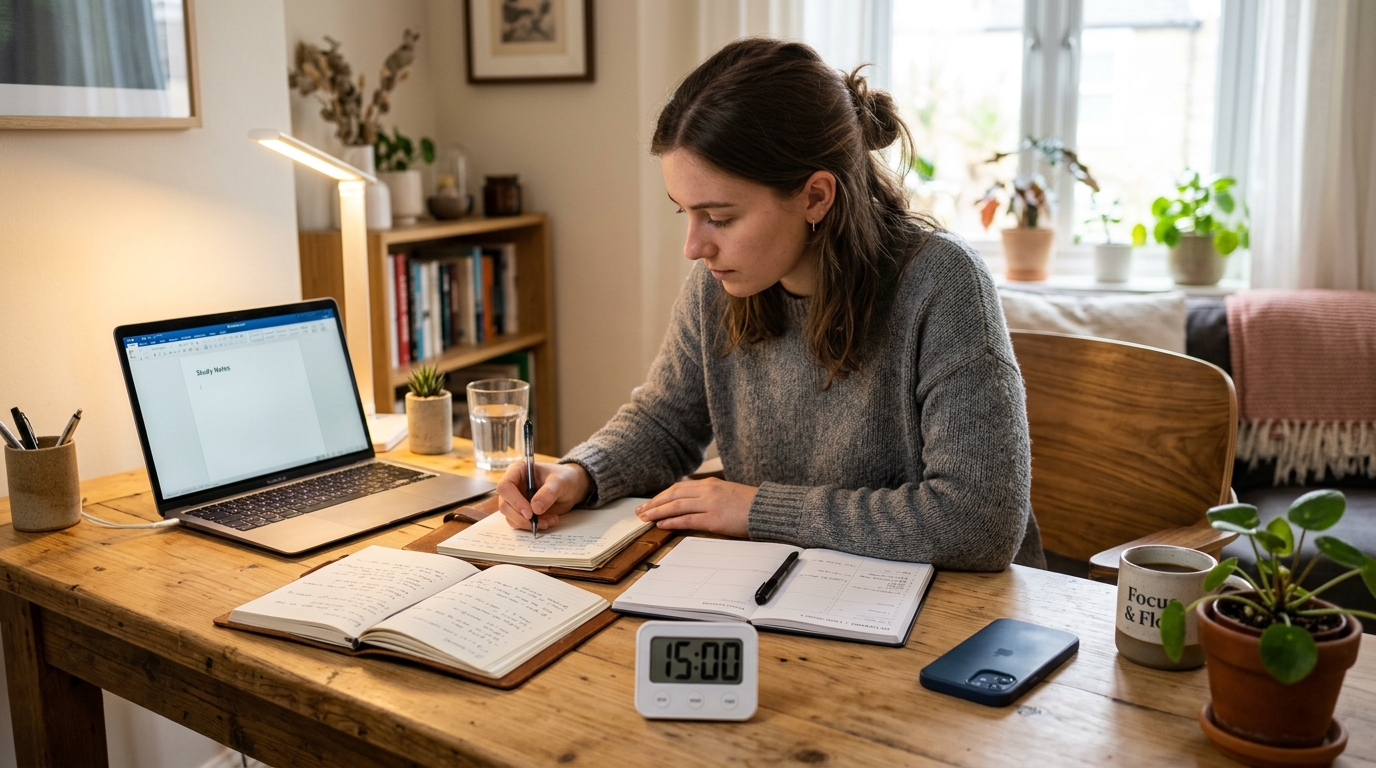
    A person at a study desk writing a one-line study log in a notebook while a small timer has just finished and a mug of tea sits nearby as a tiny reward after a 15-minute focus routine.

    2. Leave One Line for Next Time

    Now write one line for your next 10-minute block:

    • “Next: review the 5 marked vocab words.”
    • “Next: redo the 3 unclear questions and check solutions.”

    Future you will thank you. When you sit down tomorrow, you will not have to decide what to do; you will simply follow the line you already wrote.

    3. Give Yourself a Tiny Reward

    This is the key to making the routine stick. After writing your two lines, choose one short, pleasant reward, such as:

    • Watching 5–10 minutes of a favorite video
    • Drinking a warm cup of tea while stretching or resting your eyes
    • Doing a light 5‑minute stretch routine

    The reward is not for getting the right answers or finishing a huge task. It is for showing up and staying for 15 minutes. Over time, your brain starts to associate “I finished my 15-minute block” with a small but reliable good feeling, which makes starting again tomorrow less painful.


    Everyday Tips for Using This Routine

    Use a Fixed Time Window as Your “Default 15 Minutes”

    Pick one time that will be your default 15-minute slot:

    • Morning: within 30 minutes after waking up
    • Evening: 15 minutes before your shower
    • Night: 30–60 minutes before bedtime

    Studies on self‑regulated learning and time management find that students who study at regular times with clear routines tend to manage their time better and achieve more than those who study only when they feel motivated. Treat this time as non‑negotiable—the question is not if you study, only how much you do beyond the first block.

    Use This as Your “Bad Day Minimum,” Not Your Maximum

    On good days, you can stack 2–4 blocks and turn them into longer sessions. On bad days, you still count the day as a success if you complete one block.

    This prevents zero‑days from piling up during busy or stressful periods. In the long run, a year of imperfect 15-minute blocks beats a few weeks of perfect three‑hour sessions followed by burnout.

    Keep Tools Simple So You Cannot Procrastinate by “Setting Up”

    To run this routine you only need:

    • A place to write your one‑line task and log (paper planner, Notion, or notes app)
    • A timer (phone, watch, or browser)

    Optional: a simple habit tracker or calendar where you mark each day you complete at least one block. Avoid spending an hour configuring new apps; the tools are there to make starting easier, not to become the new way you procrastinate.

    If you want a more structured way to combine multiple blocks into one focused hour, see 15-Minute Focus Blocks: How to Turn Four Short Sessions into One Hour of Real Work.


    Frequently Asked Questions

    Q1. What if I only have 5 minutes, not 15?

    Start with 5. On very hard days, set a 5‑minute timer, write one tiny task (“read one paragraph,” “review 5 words”), and do just that. If you feel better afterward, you can add another 5 or 10 minutes, but the goal is simply to show up.

    Q2. Can I use this routine for work tasks, not just studying?

    Yes. This structure works for email triage, writing reports, coding, planning tomorrow’s tasks, or reading research. Just write one clear 10‑minute work task, follow it until the timer rings, then log what you did and give yourself a small reward.

    Q3. Which tools do I need to get started?

    You only need three things: a timer, somewhere to write your one‑line task, and a simple way to reward yourself. A paper notebook plus your phone’s timer is enough. If you enjoy digital tools, you can use Notion or a notes app to track how many blocks you complete each week.

    Q4. What if my lack of motivation feels overwhelming or constant?

    If you feel persistently drained, hopeless, or unable to do even tiny tasks for weeks at a time, a 15‑minute routine alone might not be enough. Consider talking with a mental health professional or counselor—seeking support is a strength, and you can still use small routines alongside proper care.


    Learn More

    For more on focus, study habits, and building consistent routines, see:

  • 15-Minute Focus Timer Routine: How to Stop Checking Your Phone While You Study

    15-Minute Focus Timer Routine: How to Stop Checking Your Phone While You Study

    When You Sit Down to Study and Reach for Your Phone Again

    You finally sit down after work to study or work on a side project, and within five minutes your hand is back on your phone. You tell yourself you are “just checking one notification,” and suddenly 30 minutes of scrolling, shorts, and messages have evaporated.

    If you are a working adult or exam student who spends most of the day at a desk, the combination of stress, fatigue, and a smartphone within arm’s reach can quietly destroy your study time. This 15-minute focus timer routine helps you protect short blocks of attention by giving your brain a simple rule, a clear goal, and a tiny structure to follow instead of fighting your phone with willpower alone.

    I started using this 15-minute timer routine on evenings when I kept “accidentally” opening my phone, and even a single block was enough to finish one small task and feel like I actually studied that day.


    Why a 15-Minute Focus Timer Works Better Than Just “Trying Harder”

    Articles on attention span and study routines note that many adults can focus deeply for only about 20–30 minutes before their attention naturally drops, especially when phones and notifications are nearby. That is why starting with shorter 10–15 minute blocks often feels more realistic than trying to force a two-hour deep‑work session from day one.

    Focus and time‑management guides also consistently recommend silencing notifications, using Focus or Do Not Disturb modes, and moving your phone out of reach during study blocks, because these simple changes cut a large portion of digital interruptions without needing complicated apps. Research on self‑regulated learning and time management further suggests that learners who set specific goals for each time block and then record what they did tend to manage their study time better and procrastinate less.

    This routine brings those ideas together: you decide one tiny task, set a 10‑minute timer, physically block your phone, and then spend 2 minutes writing what you did and what you will do next. The point is not perfection; it is making it easier to start and to repeat.


    Overview: One 15-Minute Focus Timer Block

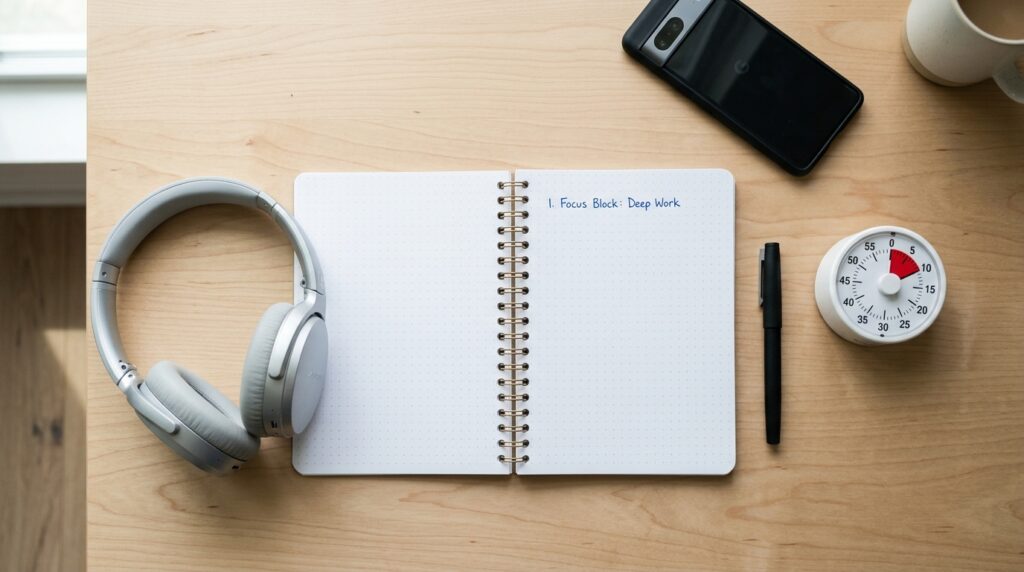
    An overhead view of a clean study desk setup with an open notebook, a short written task, a 10-minute study timer and a smartphone flipped face down for a focus routine.

    In this routine, one 15-minute block looks like this:

    • 3 minutes: prep your desk, your phone, and your brain
    • 10 minutes: focused work on exactly one task
    • 2 minutes: quick review and one line for the next block

    Two blocks give you roughly 30 minutes of real focus; four blocks give you about an hour. The key rule is simple:

    “While the 10-minute timer is running, I do not touch my phone.”

    If you want a more general guide to building short study blocks you can use any time of day, see 15-Minute Study Routine: How to Make Short, Focused Blocks Actually Work for a step‑by‑step breakdown you can chain across your schedule.


    Step 1 – Prep (3 Minutes): Set Up Your Desk, Phone, and Brain

    1. Clear Your Desk So Only This Study Task Is Visible (About 1 Minute)

    For one minute, make your desk show only one story:

    • Keep: today’s textbook or document, your notebook, and a pen
    • Move aside: other books, papers, devices, and random items

    The more visual noise on your desk, the more your brain has to decide “What should I pay attention to?” which quietly drains your energy. A lighter desk makes the coming 10 minutes feel less heavy and helps your brain accept, “For this block, we are doing just this.”

    If you also want to declutter your digital space, you might like 15-Minute Focus Blocks: How to Turn Four Short Sessions into One Hour of Real Work, which shows how to structure multiple short blocks and protect them from digital distractions.

    2. Write One Line for This 10-Minute Block (About 1 Minute)

    Next, decide exactly what you will do in your first 10-minute block and write it in one line. For example:

    • “Learn vocabulary pages 4–5.”
    • “Solve 3 practice questions from chapter 2.”
    • “Draft one paragraph of my report introduction.”

    Log it in:

    • A paper planner
    • A Notion page called “15-Min Focus Blocks”
    • A simple notes app on your laptop

    Research on self‑regulated learning and time management shows that students who set specific, short goals for each study period and then track what they did manage their time better and procrastinate less than those who just think “I should study.” Your one-line goal is a tiny but powerful version of that.

    3. Set a 10-Minute Timer and Block Your Phone (About 1 Minute)

    Now set your timer and your phone:

    • Set a 10-minute timer on your phone, smartwatch, or browser
    • Turn on Airplane, Focus, or Do Not Disturb mode
    • Flip your phone face down and place it slightly out of reach or in a drawer

    Focus guides consistently recommend silencing notifications and moving your phone out of sight because even brief alerts and screen glances can break your focus more than you expect. When you repeat this “phone blocking ritual” before each block, your brain gradually learns, “When we do this, it means study time starts now.”


    Step 2 – Focus (10 Minutes): One Task Only, No Phone

    1. Follow the One Line You Wrote

    Once you tap start on the timer, your job is incredibly simple:

    “For the next 10 minutes, I will only do the one line I wrote. Nothing else.”

    That means:

    • If you chose vocabulary, you are not allowed to “quickly” check messages or social media
    • If you chose practice problems, you do not switch to a different subject halfway through
    • If a question pops into your head, you write it in the margin and come back to it later

    This routine reduces decision fatigue by giving your brain one clear instruction instead of many micro‑choices (“Should I check my phone now? Should I answer that message?”). Short focus blocks with a clear boundary feel more manageable, especially on days when you are tired.

    If you notice your focus crashing often during study, you may also like Can’t Focus? Try This 15-Minute Study Reset Routine for a quick reset you can run when your brain feels drained.

    2. Treat 10 Minutes as a Small Experiment

    For these 10 minutes, you are not trying to become a perfect student. You are just running a small experiment:

    • “What happens if I do not touch my phone for 10 minutes?”
    • “What can I actually do in this one small window?”

    If your mind wanders, gently bring it back to the page in front of you and remind yourself, “It’s only 10 minutes.” Many people find that it is easier to accept “just 10 minutes of effort” than to commit to a long session when they already feel tired or distracted.


    Step 3 – Review (2 Minutes): Capture Today and Prime the Next Block

    1. Write One Line About What You Actually Did

    A person at a study desk writing a one-line study log in a notebook while a small timer shows the end of a 10-minute focus session and the smartphone stays face down.

    When the timer rings, do not grab your phone yet. Take one minute to write a short log:

    • “Studied vocabulary pages 4–5, marked 6 new words.”
    • “Solved 3 practice questions, got 2 correct, 1 still unclear.”

    Logging visible progress—even when the block is tiny—helps build a sense of self‑efficacy and makes your effort concrete rather than fuzzy. Over time, your notebook or digital log becomes a record of what you actually did, not just what you intended.

    2. Leave One Line for the Next 10-Minute Block

    Then write one line for what you will do in the next block:

    • “Next: review marked vocabulary.”
    • “Next: redo the 1 missed question and check solution.”

    This removes the “What should I study now?” friction next time you sit down. Future you just has to open the planner and follow the next line.

    Once you finish this 2-minute wrap‑up, you can take a short 3–5 minute break to check your phone—ideally with clear limits like “scan notifications once, reply to 2–3 quick messages, then put it away again.”


    Everyday Tips for Making This 15-Minute Routine Stick

    Fix One Timer Window in Your Day

    Instead of trying to study “whenever you feel like it,” choose one consistent window:

    • Within 30 minutes after waking up
    • 15 minutes before dinner
    • 30–60 minutes before your usual bedtime

    Educational and time‑management guides often emphasize that studying at a consistent time of day helps your brain build a routine and reduces the mental effort of deciding when to work. When your brain learns that “around 8 p.m., we always run at least one 15-minute focus timer,” it becomes a habit, not a negotiation.

    If you want to plan more of your day around such blocks, see 15-Minute Time Blocking: How to Turn a Scattered Day into Focused Study Blocks for a full-day planning approach.

    Define a Minimum Goal: One Block Is a Win

    If you always plan 2–3 hours of study and then fail to start, it is easy to end the day with guilt and self‑criticism. Instead, define a minimum win:

    • “Even on busy days, one 15-minute block counts as success.”
    • “On better days, I can add more blocks, but one block is the base.”

    Coaching and self‑regulation resources often stress that repeatable routines matter more than single long efforts; short blocks you actually do are better than perfect plans you never start. Over a couple of weeks, four or five 15-minute blocks per week add up quickly.

    Use Simple Tools, Not a Complicated App Stack

    To run this routine you need:

    • A place to write one-line goals and logs (paper planner, Notion page, or notes app)
    • A timer (phone, watch, or browser timer)
    • Focus or Do Not Disturb mode on your phone

    You can experiment with study timer apps later (for example, apps that lock your phone while the timer runs), but start with the simplest possible setup so you are not “setting up productivity tools” instead of studying.


    Frequently Asked Questions

    Q1. What if I cannot even do 15 minutes?

    Start with 5. Seriously. If 15 minutes feels too long, set a timer for 5 minutes and write one tiny task, like “review 3 words” or “read one paragraph.” The goal is to show up and protect at least one short block from your phone, not to be perfect from day one.

    Q2. Can I use this routine for work tasks, not just studying?

    Yes. The 3–10–2 structure works well for writing emails, drafting reports, coding, reading research papers, or planning your day. Just write one clear work task for the 10-minute block and follow the same steps: clear your desk, block your phone, focus on one task, then log what you did.

    Q3. Which tools do I need to start this focus timer routine?

    You only need three things: a place to write your one-line goals, a timer, and the ability to silence or move your phone. A paper notebook and your phone’s built-in timer with Focus mode are enough. If you enjoy digital tools, a simple Notion page or notes app can make it easier to see how many blocks you complete each week.

    Q4. What if my phone use feels completely out of control?

    If your phone use or attention problems feel overwhelming or are seriously disrupting your daily life, consider talking with a mental health professional rather than relying only on routines and apps. This 15-minute timer routine is designed to help with everyday distraction and habit‑building, not to diagnose or treat underlying conditions like ADHD or anxiety.


    Learn More

    For more on attention, study habits, and self‑regulated time management, see:

  • 15-Minute Focus Blocks: How to Turn Four Short Sessions into One Hour of Real Work

    15-Minute Focus Blocks: How to Turn Four Short Sessions into One Hour of Real Work

    When “2 Hours of Deep Work” Keeps Failing

    You sit down after work, open your laptop, and promise yourself, “Tonight I’ll do two hours of deep work.” Ten minutes later, you are checking messages, browsing tabs, or staring at your notes without really reading them. The evening disappears, and you end up feeling guilty instead of accomplished.

    If you are a working adult studying for exams, building skills for your career, or juggling side projects on top of a full-time job, long deep-work sessions often feel too heavy to start and too fragile to maintain. Between meetings, notifications, and mental fatigue, what you really need is a routine that respects your limited attention and still moves your learning forward.

    I started using this 15-minute focus block on evenings when I felt too tired for “serious study,” and it was just enough structure to actually finish one small but meaningful task instead of abandoning the whole plan.

    Why Four 15-Minute Focus Blocks Work Better Than One 2-Hour Sprint

    Many microlearning and productivity guides now recommend short, focused sessions of around 5–20 minutes instead of marathon study blocks. Short bursts let your brain process one idea at a time without cognitive overload, keep engagement higher, and are much easier to fit into a busy day.

    Research on attention and study routines also shows that focus naturally drops when you try to concentrate for too long without breaks, while several shorter sessions with small pauses help you reset and stay mentally present. In practice, this means that four short blocks with clear goals often produce more real progress than one heroic “deep work” session you keep postponing.

    Self-regulated learning studies further suggest that planning specific blocks of time and monitoring what you do in each block are linked to better time use, less procrastination, and higher academic performance. When you stack four 15-minute focus blocks, you are not just surviving after work; you are deliberately training your planning and self-monitoring skills one small session at a time.


    Overview: Four 15-Minute Focus Blocks = One Hour

    In this routine, you treat one 15-minute block as a complete mini-cycle:

    • 3 minutes: prep your space, your brain, and your tools
    • 10 minutes: focused work on one clearly defined task
    • 2 minutes: quick wrap-up and next-step note

    Four of these blocks add up to roughly one hour of focused work. You can:

    • Start with just one block per day as your “minimum routine”
    • On better days, add a second, third, or fourth block
    • Mix study tasks (reading, practice questions) and work tasks (writing, coding, planning) inside the same structure

    If you are new to short, focused sessions, you may also like our guide on 15-Minute Study Routine: How to Make Short, Focused Blocks Actually Work, which explains how to build and chain simple 15-minute sessions across your day.


    Step 1 – Prep (3 Minutes): Set Up Your Space, Task, and Timer

    An overhead view of a clean focus desk setup with an open notebook, a single 10-minute study task, a simple study timer and a phone placed face down.

    1. Quickly Reset Your Physical and Digital Space (About 1 Minute)

    For one minute, act like you are clearing a small launchpad:

    • On your desk: keep only today’s book or document, your notebook, and a pen
    • Move other books, papers, and random items to the side
    • On your screen: close tabs and apps that are not needed for this block

    Visual clutter is a decision magnet; the more you see, the more your brain has to decide what to pay attention to. A lightweight reset makes this first block feel less heavy and signals, “For the next 15 minutes, this is the only thing that exists.”

    If you want a more permanent way to organize your digital study space, you can also check out our guide on Building a Notion Study Dashboard to create a simple home base where your tasks, notes, and focus blocks live together. (Use your actual Notion dashboard article URL here.)

    2. Write One Line for This 10-Minute Block (About 1 Minute)

    Next, decide exactly what today’s first 10-minute focus block is for and write it in one line. For example:

    • “Review vocabulary pages 10–12 and mark new words.”
    • “Read certification textbook section 3.2 and highlight key formulas.”
    • “Draft the opening paragraph of my report.”

    Keep it tiny and concrete: one subject, one chunk. You can log this in:

    • A paper planner
    • A simple Notion page called “15-Min Focus Blocks”
    • A basic notes app like Apple Notes, Google Keep, or any memo tool

    Studies on self-regulated learning emphasize that setting specific, manageable goals and then monitoring what you do helps learners use their time more effectively and procrastinate less. Your one-line goal is a mini version of that: just enough structure to tell your brain what “done” looks like for the next 10 minutes.

    3. Set a 10-Minute Timer (About 1 Minute)

    Finally, set a timer for 10 minutes:

    • Use your phone’s timer in Do Not Disturb or focus mode
    • Use a minimalist focus timer app
    • Use a browser-based timer on your laptop

    Treat this 10-minute window as a small container: “From now until the alarm rings, I will just do this one thing.” Let the timer handle the time so your brain can stay inside the task instead of checking the clock.


    Step 2 – Focus (10 Minutes): Protect One Task at a Time

    1. Minimize Distractions Before You Press Start

    Before you tap “start” on the timer:

    • Put your phone face down and slightly out of reach
    • Close messaging apps and social media tabs
    • If possible, use a separate browser profile just for study/work so only relevant tabs are visible

    These may sound simple, but they dramatically reduce how often your attention is pulled away during a short block. Think of this as giving your brain a quiet 10-minute room rather than a noisy open office.

    If you find yourself constantly bouncing between apps, you might also like 15-Minute Time Blocking: How to Turn a Scattered Day into Focused Study Blocks, which shows how to schedule your short focus sessions so that meetings, admin tasks, and deep work are not all fighting for the same time.

    2. Do Only the One Line You Wrote

    Once the timer starts, your only job is:

    “Do the one line I wrote. Nothing else.”

    That means:

    • If you chose vocabulary, you do not “quickly” check email
    • If you chose practice questions, you do not switch to a different subject
    • If you get stuck, you take one tiny helpful action: reread the question, check one example, or ask an AI assistant a single clarification, then return to the task

    If your mind wanders, tell yourself:

    “I’ll just come back to this page until the timer rings.”

    One of the big advantages of 15-minute focus blocks is psychological: “Just 10 minutes of actual work” feels manageable even when you are tired or distracted. You lower the emotional resistance to starting, which is often the hardest part.

    3. Optional Micro-Break Between Blocks

    After each block, you can take a 2–5 minute break:

    • Stand up, stretch, or walk to another room
    • Drink water or make tea
    • Look away from screens

    Short movement breaks reset attention better than scrolling another app, and they prepare your brain for the next block. After four 15-minute cycles with tiny breaks, you will often have a surprisingly focused hour behind you.


    Step 3 – Wrap-Up (2 Minutes): Capture Progress and Prime the Next Block

    A digital study room with a laptop showing a minimalist focus dashboard, a small study timer and a notebook logging completed 15-minute focus blocks.

    1. Write One Line About What You Did

    When the timer rings, do not instantly grab your phone or open a new app. Spend one minute logging what you actually did. For example:

    • “Reviewed vocabulary pages 10–12, marked 9 new words.”
    • “Read section 3.2 and highlighted 5 key formulas.”
    • “Drafted the opening paragraph, needs one more edit.”

    This turns your 10 minutes into visible progress instead of a fuzzy memory. Over time, your notebook, Notion database, or notes app becomes a record of effort, not just a list of intentions. Studies on self-regulated learning note that students who regularly monitor their study activities—what they did and what comes next—tend to be more consistent and strategic in how they learn.

    2. Leave One Line for the Next Block

    Then write one line for what you will do in the next block:

    • “Next: review vocabulary pages 13–14.”
    • “Next: solve 3 practice problems from section 3.2.”
    • “Next: revise paragraph and outline section 2.”

    This removes the “What should I do now?” friction from your next session. Future you just has to show up, open your log, and follow the next instruction.

    If you’re curious how to apply this same three-step pattern at different times of day, see 15-Minute Morning Study Routine: How Changing Just 15 Minutes Boosts Your Focus All Day for a version tailored to early hours before work.


    Everyday Tips for Using Four 15-Minute Blocks

    Fix a Morning or Evening Slot

    Most people cannot focus at their best at every hour of the day. But guides on study routines consistently recommend choosing one fixed window when you usually run at least one block, such as:

    • Within 30 minutes after waking up
    • Right after dinner
    • One hour before you normally go to bed

    Research on time management and self-regulated learning suggests that consistent, planned study windows are associated with better academic outcomes and lower procrastination. When your brain learns that “around 8 p.m., we always do one 15-minute block,” starting becomes a habit, not a debate.

    Define a Minimum Routine for Hard Days

    There will be days when you are exhausted, stressed, or unmotivated. For those days, decide in advance:

    • “If today is really hard, one 15-minute block still counts as success.”
    • “On better days, I can go up to four blocks, but one block is the minimum win.”

    Coaching guides on microlearning and habit formation often emphasize that short, repeatable cycles (like 10–20 minutes) are more sustainable and easier to maintain than sporadic marathons. One small block is always better than zero, especially when your alternative is “I failed again.”

    Use Simple Tools, Not a Complicated System

    To run this routine, you only need:

    • Somewhere to write one-line goals and logs (paper planner, Notion page, or notes app)
    • A timer (phone, watch, browser, or minimalist focus app)

    You can layer more tools later—a Notion dashboard, AI assistants for quick clarifications, or a dedicated “study” browser profile—but the routine itself should work even if you only have a notebook and a phone timer. Start simple; add complexity only when the basic 15-minute cycle feels solid.


    Frequently Asked Questions

    Q1. How many 15-minute blocks should I do in one sitting?

    Start with just one 15-minute block and treat it as your minimum success. Once that feels automatic, you can add a second, third, or fourth block in the same sitting or at different times of day. The goal is to build a consistent rhythm, not to max out your capacity from day one.

    Q2. What if I only have 5 minutes, not 15?

    Use a micro-block: 1 minute to clear your space, 1 minute to write one tiny goal, 3 minutes to do it, then stop. Microlearning research suggests that even 5–10 minute bursts, repeated over time, can improve retention and reduce procrastination, especially when they focus on a single concept or task.

    Q3. Can I use this routine for work tasks, not just studying?

    Yes. The 3–10–2 structure works well for writing reports, coding, reading research papers, handling email triage, or planning your day. Just write one clear work task for the 10-minute block (“Draft outline for client proposal,” “Review three pull requests”) and follow the same steps: prep, focus, and quick wrap-up.

    Q4. Which tools do I need to start this routine?

    You only need three things: a place to write your one-line goals, a timer, and somewhere to log what you did. A paper notebook and your phone’s timer are enough. If you like digital tools, a simple Notion page or basic notes app is more than enough—no complex setup required.


    Learn More

    For more on focus, study habits, and building consistent short routines, see:

  • 15-Minute Morning Study Routine: How Changing Just 15 Minutes Boosts Your Focus All Day

    15-Minute Morning Study Routine: How Changing Just 15 Minutes Boosts Your Focus All Day

    When Your Brain Is Awake but Not Logged In Yet

    Some mornings you technically wake up, but your brain still feels like it is “not logged in” yet. You sit at your desk, open your laptop, and suddenly 20 minutes disappear into checking messages, scrolling, or staring at the wall.

    If you are a working adult studying for exams, certifications, or a degree—or you use your mornings for self‑development projects—the way you spend your first 15 minutes can change how focused the rest of your day feels. A vague plan like “study more in the morning” is not enough; you need a small, concrete routine to switch your brain into study mode.

    I started using this 15-minute morning study routine on days when my mind felt foggy, and it was just enough structure to turn sleepy mornings into one clear, finished block of study instead of a blurry warm‑up phase.


    Why a 15-Minute Morning Study Routine Works

    A lot of neuroscience‑inspired study advice points out that our brains tend to focus best in short, focused sessions, not in long, exhausting marathons. Many microlearning and study habit articles highlight that 5–20 minute blocks can be easier to start and repeat than hour‑long sessions, especially for busy adults.

    Research summaries on microlearning describe how shorter sessions reduce cognitive overload, help you focus on one idea at a time, and are easier to fit around work and life. When you start your day with one small, focused block, you lower the barrier to entry and make “showing up” much more likely.

    A 15-minute morning routine is not meant to replace all your deep work. It is an anchor that tells your brain, “We are the kind of person who studies today,” and it makes your later study blocks or evening learning sessions much easier to start. If you want a deeper dive into why short routines feel easier than classic Pomodoro, see:
    👉 Why 15-Minute and 5-Minute Routines Feel Easier Than Pomodoro.


    Overview: A 15-Minute Morning Study Starter

    This routine is designed for:

    • Exam students who also work
    • Knowledge workers studying for certifications or graduate school
    • Adult learners who want to protect a small slice of morning focus

    The routine is simple:

    • Prep: 3 minutes
    • Focused study: 10 minutes
    • Wrap‑up: 2 minutes

    In those 15 minutes, you will:

    • Clear your space just enough to reduce distractions
    • Decide one tiny, specific task
    • Set a timer
    • Do that one task
    • Capture what you did and what comes next

    Even if you only run this routine once each morning, you will feel a clear difference between “a day where you never really started” and “a day where you already finished one meaningful block.”

    If you want a more general guide to short study blocks before you tailor your mornings, you may also like:
    👉 15-Minute Study Routine: How to Make Short, Focused Blocks Actually Work.


    Step 1 – Prep (3 Minutes): Wake Up Your Space and Your Brain

    hands clearing extra books from a study desk and leaving one textbook, an open planner and a phone placed face down to start a 15-minute focus routine

    Clear Your Study Space (About 1 Minute)

    First, reset your physical environment.

    • Put away books, papers, and random items that are not related to today’s first study task.
    • Keep only today’s textbook or document, your notebook, and a pen on the desk.
    • Close unrelated tabs and apps on your laptop.

    Clutter is a decision magnet. The more visual and digital noise in front of you, the more your brain has to decide what to pay attention to. A simpler space makes your first 15 minutes feel lighter.

    If you need help organizing your digital workspace so your notes and tasks live in one place, you can also check out our guide on Building a Notion Study Dashboard to create a simple home base for your learning.

    Write One Line for Today’s First 10 Minutes (About 1 Minute)

    Next, decide exactly what you will do in your first 10-minute block and write it in one line.

    Examples:

    • “Read vocabulary pages 3–5.”
    • “Review 5 questions I got wrong yesterday.”
    • “Outline the introduction paragraph for my report.”

    Keep it tiny and concrete. One subject, one chunk. You can write this in:

    • A paper planner
    • A Notion page called “Morning 15-Min Blocks”
    • A notes app like Apple Notes, Google Keep, or any simple memo app

    Self-regulated learning research emphasizes that setting specific, manageable goals and tracking what you do each day helps learners take more control of their progress. Your one-line goal is a small but powerful version of that.

    Set a 10-Minute Timer (About 1 Minute)

    Finally, set a timer for 10 minutes:

    • Use your phone’s timer in focus or Do Not Disturb mode.
    • Use a minimalist focus timer app.
    • Or use a simple browser‑based timer on your laptop.

    Treat this 10-minute window as a small container: “From now until the alarm rings, I will just do this one thing.” Let the timer handle the time, so your brain can focus on the work instead of the clock.


    Step 2 – Focus (10 Minutes): One Task Only

    Remove Distractions Before You Start

    Before you press “start” on the timer:

    • Put your phone face down and slightly out of reach.
    • Close messaging apps and any browser tabs not needed for this task.
    • If you use an AI assistant, keep it open only if you need it for this specific block (for example, to clarify one concept or translate a short passage).

    Microlearning guides often point out that short, focused sessions work best when you protect them from interruptions and context‑switching. Think of these 10 minutes as a mini deep‑focus window, not a time to multitask.

    Stick to the One Line You Wrote

    Once the timer starts, your only job is:

    “Do the one line I wrote. Nothing else.”

    That means:

    • If you chose vocabulary, you do not switch to social media or email.
    • If you chose practice problems, you do not suddenly change to reading an article.
    • If you get stuck, you try a small step: reread the question, check one example, or ask an AI tool for a single clarification, then come back.

    If your mind wanders, tell yourself:

    “I’ll just come back to this page until the timer rings.”

    One of the biggest advantages of 15-minute blocks is that they reduce the emotional resistance to starting. You know that even if you feel slow or sleepy, it is only 10 minutes of actual work.

    If you notice that your focus crashes later in the day, you might also like:
    👉 Can’t Focus? Try This 15-Minute Study Reset Routine – a short reset you can use when your brain feels drained.


    Step 3 – Wrap-Up (2 Minutes): Capture Today and Prime Tomorrow

    Write One Line About What You Did

    When the timer rings, do not immediately pick up your phone or open another app. Take one minute to write down what you actually did.

    Examples:

    • “Read vocabulary pages 3–5, marked 12 new words.”
    • “Reviewed 5 questions, 2 still unclear.”
    • “Drafted introduction paragraph, needs a final edit.”

    This simple log turns your 10 minutes into visible progress instead of a fuzzy memory. Over time, your notebook, Notion page, or notes app becomes a record of your effort, not just your intentions.

    Articles on study skills and self‑regulated learning often highlight that students who regularly monitor what they did and what they will do next study more systematically and consistently.

    Leave One Line for the Next Block

    Then, write one line for what you will do next time:

    • “Next: review vocabulary pages 6–8.”
    • “Next: reread explanation for 2 difficult questions.”
    • “Next: edit introduction and outline body paragraph 1.”

    This removes the “What should I do today?” friction from your next morning. Future you just has to show up and follow the next instruction.

    top down view of a desk showing a planner with short completed study notes and a small digital study timer that has just finished a 15-minute focus block

    Everyday Tips for Keeping This 15-Minute Routine

    Choose a Fixed Morning Window

    Pick one clear window in your morning when this routine will live, for example:

    • Within 30 minutes after waking up
    • Right after breakfast
    • Before you check email or messages

    Guides on building study routines often suggest using a consistent cue—like a time of day or a specific action (making coffee, opening your planner)—to signal that “study time starts now.” Self‑regulated learning approaches also emphasize that routines built on structure and timing are easier to sustain than routines built on motivation alone.

    Set a “Minimum Routine” for Hard Days

    There will be days when you feel tired, stressed, or unmotivated. For those days, decide in advance:

    “If today is really hard, one 15-minute block still counts as success.”

    This removes the all‑or‑nothing pressure of “2 hours or nothing.” Research summaries and tutor guides often note that short, repeatable study cycles—like 15 or 20 minutes at a time—can improve focus and memory without overwhelming you. One small block is always better than zero.

    Think “Short and Consistent” Rather Than “Long and Rare”

    Microlearning articles consistently point out that several small, focused sessions across the week can lead to better retention, less stress, and more sustainable progress than rare, very long study marathons. Your morning 15-minute routine is not about doing everything; it is about building a foundation you can keep.

    Once the morning routine feels solid, you can start adding more blocks later in the day or using time blocking to schedule longer sessions around work and life.


    Frequently Asked Questions

    Q1. How many 15-minute blocks should I do in the morning?

    Start with just one 15-minute block. Once that feels automatic, you can add a second block or place another block later in the day. The goal is to make “showing up” easy and repeatable, not to squeeze in as many minutes as possible right away.

    Q2. What if I only have 5 minutes, not 15?

    Use a micro‑block: 1 minute to clear your space, 1 minute to write one tiny goal, 3 minutes to do it, and then you are done. The key is to keep the habit of starting so that longer blocks feel more natural on better days.

    Q3. Can I use this routine for work tasks, not just studying?

    Yes. You can use the same 3–10–2 structure for writing reports, coding, reading research papers, preparing presentations, or even planning your day. Just write one clear work task for your 10-minute block and follow the same steps.

    Q4. Which tools do I need to start this morning routine?

    You only need three things: a place to write your one‑line goals, a timer, and somewhere to log what you did. A paper notebook and your phone’s timer are enough. If you like digital tools, a basic Notion page or a simple notes app is more than enough—no complex setup required.


    Learn More

    For more on short study sessions, self‑regulation, and building routines that stick:

  • 15-Minute Study Blocks: How to Plan a Whole Exam Day in 15-Min Chunks

    15-Minute Study Blocks: How to Plan a Whole Exam Day in 15-Min Chunks

    When You “Study All Day” but Don’t Remember What You Did

    During exam season, it’s easy to spend hours sitting at your desk and still end the day wondering, “What did I actually get done?” You look back and realize your day was a mix of half‑focused reading, phone scrolling, and staring at the wall.

    For high school seniors, repeat exam takers, and university students, the problem usually isn’t a lack of time. It’s that “study all day” is too vague. You need a plan that tells you exactly what to do in the next 10–15 minutes, not just “study for 8 hours.”

    I started using 15-minute study blocks on days when my brain felt foggy and overwhelmed, and it turned my exam days from a blur into a clear list of small, finished pieces of work.


    Why 15-Minute Study Blocks Work for Exams

    A lot of focus and productivity advice still assumes you can sit and study deeply for long stretches at a time. In reality, our brains tend to give their best attention in short, focused bursts rather than in endless marathons.

    Research on microlearning and bite‑sized study suggests that many learners focus best in blocks of around 10–20 minutes, and that short, repeated sessions often beat long cram sessions for both retention and motivation. After that window, your mind naturally starts to wander and your efficiency drops.

    Self‑regulated learning research also shows that what matters is not just how many hours you sit, but how you plan, act, and review your learning. A 15-minute study block routine fits this pattern perfectly: you set a specific goal, do the work, and then leave a trace for the next block.

    If you want a deeper explanation of why short routines feel easier than traditional Pomodoro, you might also like:
    👉 Why 15-Minute and 5-Minute Routines Feel Easier Than Pomodoro.


    Overview: One Exam Day in 15-Minute Study Blocks

    Instead of planning an exam day as “8 hours of study,” we’ll break it into 15-minute study blocks, each made of:

    • Prep: 3 minutes
    • Focused work: 10 minutes
    • Wrap‑up: 2 minutes

    This might seem small, but:

    • 8 blocks = 80 minutes of focused study
    • 16 blocks = 160 minutes
    • And you can spread these across your morning, afternoon, and evening.

    You can insert short breaks between blocks (for example, 10 minutes study + 5 minutes break), and still build a lot of high‑quality study time without burning out.

    Rather than starting with a perfect exam‑day schedule, set a realistic baseline:

    “Even one 15-minute block today counts as success.”

    If you want to understand the basic 15-minute study routine in more detail before planning your whole day, see:
    👉 15-Minute Study Routine: How to Make Short, Focused Blocks Actually Work.


    Step 1 – Prep (3 Minutes): Environment, One-Line Goal, Timer

    person sitting at a desk in front of a laptop writing a one line study goal in a planner next to a small study timer for a 15-minute focus routine

    Clear Your Space

    In each block, start by preparing your environment.

    • Keep only the textbook, notebook, and pen you need for this single block on your desk.
    • Put your phone out of reach or at least on Do Not Disturb.
    • Close all browser tabs except those you truly need for this short task.

    The simpler your desk, the less your attention gets pulled away, and the easier it is to treat each 15-minute block as something you can start right away.

    Write a One-Line Goal for This Block

    Next, decide exactly what you will do in the upcoming 10 minutes and write it in one line.

    Examples:

    • Math: solve problems 3–5.
    • English: review 2 pages of vocabulary.
    • History: read pages 120–123 once.

    Make it tiny and clear: subject + very small chunk of work. If you start listing multiple goals, your 10-minute block will break under the weight of your plan.

    You can write these one-line goals in:

    • A paper planner,
    • A Notion page called “Today’s 15-Minute Study Blocks,” or
    • A simple notes app.

    If you’d like help building a digital place to hold all your study blocks, you can also check out our guide on Building a Notion Study Dashboard to keep your tasks and notes in one place.

    Set a 10-Minute Timer

    Finally, set a timer for 10 minutes:

    • Use your phone’s timer in focus mode,
    • A minimalist focus timer app, or
    • A browser timer on your laptop.

    Let the timer manage the time. Your job is just to stay with the task until the timer rings, not to keep checking the clock.


    Step 2 – Focus (10 Minutes): One Block, One Task

    Stick to the One Line You Wrote

    The rule for your 10-minute focus block is simple:

    “Do the one line I wrote. Nothing else.”

    That means:

    • Don’t switch to another subject because it suddenly feels more urgent.
    • Don’t open other apps “just to check one thing.”
    • Don’t aim for perfect understanding. Aim to move through the planned section.

    Focus is not about never getting distracted; it’s about noticing distraction and coming back. During the block, if your mind wanders, tell yourself:

    “I’ll just come back to this page or this problem until the timer rings.”

    Short, repeatable blocks like this reduce the mental resistance to starting and make it easier to show up many times across the day.

    If your focus tends to collapse partway through a session, you may also find this helpful:
    👉 Can’t Focus? Try This 15-Minute Study Reset Routine.

    Use Digital Tools Carefully (Optional)

    Digital tools can support your focus, but they can also distract you. Use them with a clear purpose:

    • Notes app or Notion – If you remember another task (“I should email the professor,” “I need to print something”), write it once and come back to it later instead of leaving your block.
    • AI assistant – If you get stuck on a concept, ask for a quick explanation or example, then return to your main material. Don’t fall into a long chat.

    The goal of each block is not to build the perfect system. It’s to complete one small, specific chunk of study.


    Step 3 – Wrap-Up (2 Minutes): Leave a Trace for the Next Block

    Write One Line About What You Did

    When the timer rings, resist the urge to immediately open your phone or change tasks. Take 1 minute to write one line about what you just did.

    Examples:

    • “Math: solved problems 3–5 once.”
    • “Vocabulary: reviewed pages 20–21.”
    • “History: read pages 120–123 once.”

    This turns your 10 minutes into visible progress instead of a vague memory. Over time, your planner or digital log becomes a record of your exam preparation.

    Decide One Line for the Next Block

    Then write one line for what you’ll do in the next block:

    • “Next block: solve problems 6–8.”
    • “Next block: vocabulary pages 22–23.”

    This reduces the “What should I do now?” friction when you start your next 15-minute block. Future you just has to sit down and follow the next line.

    Self‑regulated learning research highlights that short cycles of goal setting → doing → self‑monitoring help students take more control of their learning and improve academic outcomes. Your 3–10–2 structure is exactly that cycle in miniature.

    student checking off completed 15-minute study blocks in a planner at a clean desk with a digital study timer nearby

    Everyday Exam-Period Tips for Using 15-Minute Blocks

    Fix One or Two Daily Time Windows

    Choose specific times in your day when 15-minute blocks are non‑negotiable:

    • One block before school or work
    • Two blocks after 9 p.m.
    • One block right after dinner

    Articles on effective study habits often emphasize that studying at a consistent time and place helps your brain recognize, “This is study time now,” which makes starting easier.

    Set a Minimum Exam-Period Routine in Advance

    Some days your energy or mood will be low. To prepare for those days, decide in advance:

    “On really hard days, one 15-minute block still counts as success.”

    On better days, you can chain many blocks. But your baseline success metric is always one block. This prevents all‑or‑nothing thinking and reduces the number of days you give up entirely.

    Think “Short and Often” Rather Than “Long or Nothing”

    Several summaries of learning science point out that short, consistent study sessions can support understanding and exam performance more effectively than rare, very long cram sessions. When you build a habit of 15-minute blocks, you improve both your attention span and your confidence that “I can always do at least one block.”


    Frequently Asked Questions

    Q1. What if I only have 5 minutes, not 15?

    Use a micro‑block: 1 minute to write a one-line goal, 3 minutes to do a tiny piece of it, and 1 minute to write what you did. The key is to keep the habit of showing up, even when you can’t do a full 15-minute block.

    Q2. Can I use this 15-minute block system for work tasks, not just studying?

    Yes. You can use it to outline part of a report, process a few emails, review one document, or plan tomorrow’s tasks. Any work that feels overwhelming becomes more manageable when you slice it into one clear 10-minute task at a time.

    Q3. Which tools do I need to get started?

    You only need three things: a place to write your one-line goals, a timer, and somewhere to log what you did. A paper planner and your phone’s timer are enough. If you like digital tools, a simple Notion page or note can replace the paper.

    Q4. How many 15-minute blocks should I aim for on an exam day?

    Start by aiming for one or two blocks in each major part of your day (morning, afternoon, evening). Once that feels stable, you can add more. The number of blocks matters less than your ability to follow through on them consistently.


    Learn More

    For more on short study sessions, self‑regulation, and time‑blocked planning:

  • 15-Minute Evening Study Routine for Busy Office Workers

    15-Minute Evening Study Routine for Busy Office Workers

    When Studying After Work Feels Impossible

    You come home from work, sit down for a moment, and the first thought that comes to mind is: “Maybe I’ll just study tomorrow instead.” By the time you’ve made dinner, helped with family or housework, and checked a few messages, the idea of opening a book feels huge.

    For many office workers in their 30s and 40s, it’s not a lack of motivation. It’s that your energy, attention, and time are fragmented. Long evening study plans—like “2 hours every night”—sound great in theory but collapse in real life. What you need is a routine that respects your limits and still moves you forward.

    I started using this 15-minute evening study block on days when I could barely convince myself to sit at my desk, and it was just enough structure to keep learning without draining the little energy I had left.


    Why a 15-Minute Study Routine Works for Busy Adults

    A lot of productivity advice assumes you have long, uninterrupted blocks of time. Most working adults do not. Research on microlearning and study habits shows that short, focused sessions can often beat long, exhausting marathons in both retention and motivation.

    Microlearning studies note that:

    • Our ability to give full attention drops over time, often after 15–30 minutes.
    • Short, focused sessions (5–15 minutes) create less resistance and are easier to repeat.
    • Consistency—showing up regularly—is a stronger predictor of progress than occasional long sessions.

    Adult learning research also points out that busy adults are more likely to use and benefit from bite‑sized learning that fits into small pockets of time in the evening or between responsibilities. A 15-minute study routine respects your current life while still building a real study habit.


    15-Minute Routine Overview

    In this article, we’ll build a realistic 15-minute evening study routine for office workers in their 30s and 40s who are studying after work.

    person writing a one line study goal in a planner next to a laptop and a small study timer for a 15-minute focus routine

    Each set is:

    • Prep: 3 minutes
    • Focused study: 10 minutes
    • Wrap-up: 2 minutes

    Prep is for clearing your space and choosing one specific mini‑goal. The 10-minute focus block is for doing only that one thing. The 2-minute wrap-up is for writing down what you did and what you’ll do next.

    It looks small, but:

    • 2 sets = 30 minutes of focused time
    • 3 sets = 45 minutes

    Rather than starting with an ambitious “2 hours every night,” we’ll set the baseline as:

    “Even one 15-minute set today counts as success.”

    If you want to understand why 15-minute blocks work so well for focus in general, you may also find this helpful:
    👉 Why 15-Minute and 5-Minute Routines Feel Easier Than Pomodoro.


    Step 1 – Prep (3 Minutes): Environment, One-Line Goal, Timer

    Clear Your Space

    After work, sitting at your desk is often the hardest part. Once you’re there, reduce friction:

    • Put your phone face down or in another room.
    • Close every browser tab that is not needed for this one study task.
    • On your desk, keep only today’s book, notebook, and pen.

    The aim is to make study feel less like a giant project and more like “something I can start immediately.”

    If you prefer to manage everything digitally, you can keep today’s materials in a simple Notion page or note. For a deeper dive into short study blocks, see:
    👉 15-Minute Study Routine: How to Make Short, Focused Blocks Actually Work.

    Write a One-Line Goal

    Next, write one line that describes what you will do in the upcoming 10 minutes.

    Examples:

    • “Scan 20 English vocabulary words.”
    • “Read 4 pages of the certification textbook.”
    • “Carefully read one article for my report.”

    The key is to shrink the task until it feels almost too easy. If you start listing multiple goals, the 10-minute routine will collapse under its own weight.

    You can write this one-line goal in:

    • A paper planner,
    • A simple “Today’s 15-Minute Goals” page in Notion, or
    • A basic notes app.

    Set a 10-Minute Timer

    Finally, set a timer for 10 minutes:

    • Use your phone’s timer in Do Not Disturb mode,
    • A minimal focus timer app, or
    • A small physical timer on your desk.

    Let the timer take care of the time. Your brain does not need to keep calculating “How much longer?” and can focus entirely on the current task.


    Step 2 – Focus (10 Minutes): One Thing Only

    Stick to the One-Line Goal

    The rule for these 10 minutes is:

    “Do the one line I wrote. Nothing else.”

    That means:

    • Don’t switch to another textbook because it suddenly looks easier.
    • Don’t open extra apps or tabs “just to check one thing.”
    • Don’t aim for perfect understanding—aim to move through the planned section.

    For someone who has already worked all day, perfect comprehension is less important than the feeling that “I still moved forward today.”

    Microlearning research highlights that short, focused sessions reduce mental resistance and encourage daily consistency, which is critical for busy adults.

    If your mind drifts:

    • Gently bring your eyes back to the page or problem and tell yourself,“I’ll just stay with this line / this problem until the timer rings.”

    Think of focus not as “never getting distracted” but as “noticing distraction and coming back.”

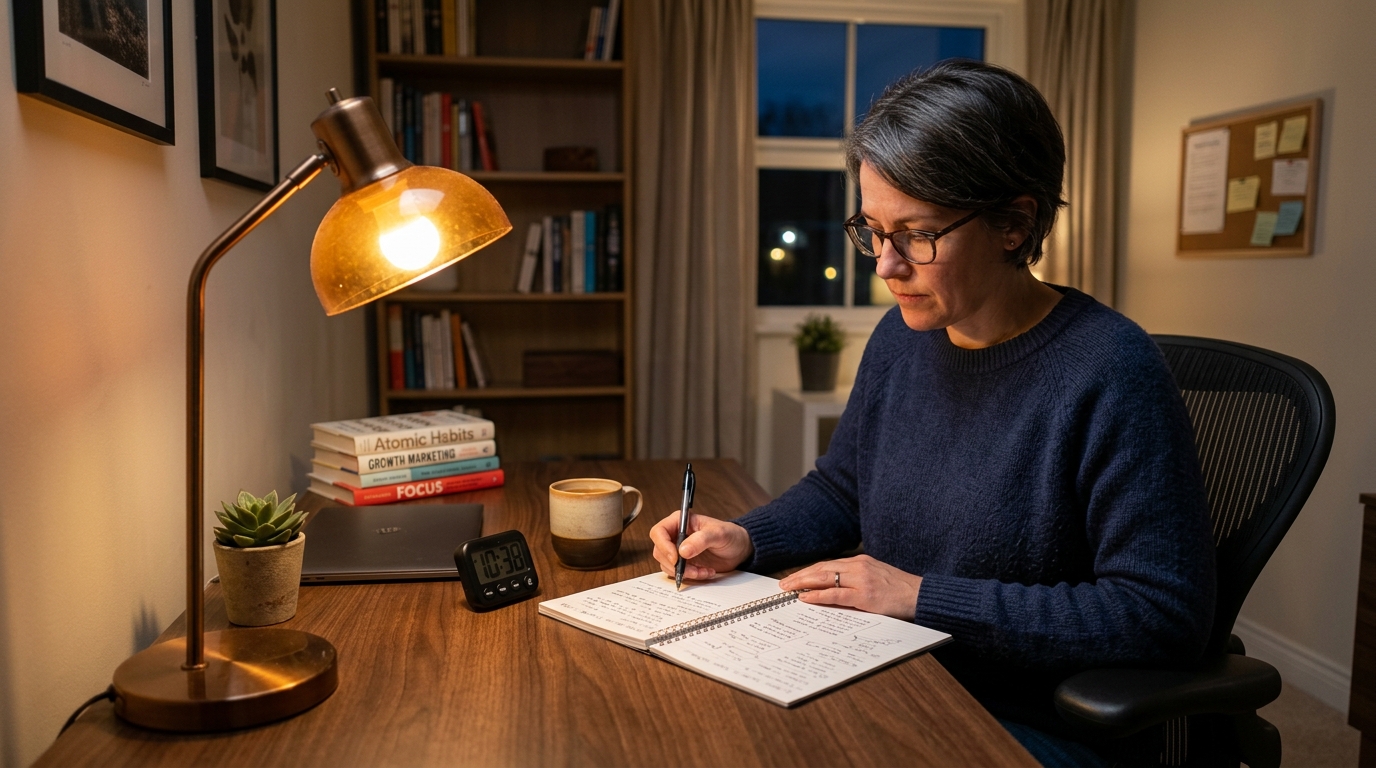
    office worker in their 40s focusing on one notebook at a clean desk with a digital study timer running a 15-minute study block

    Use Digital Tools Lightly (Optional)

    You can use digital tools to support your focus, but keep them simple:

    • Notes app or Notion – Jot down ideas or tasks that pop into your mind so you don’t leave the study task to chase them.
    • AI assistant – If you get stuck on a concept, ask for a quick explanation, then go back to your main material instead of falling into a long chat.

    If you want to rebuild focus on days when your brain feels scattered, you might also like:
    👉 Can’t Focus? Try This 15-Minute Study Reset Routine.


    Step 3 – Wrap-Up (2 Minutes): Leave a Trail

    Write One Line About What You Did

    When the timer goes off, don’t immediately close everything and walk away. Use 2 minutes to leave a small trace.

    Write one short sentence about what you did:

    • “Reviewed 20 vocabulary words.”
    • “Read pages 4–7 once.”
    • “Read 1 article and highlighted key points.”

    That is all you need for your 10 minutes to become visible progress instead of a vague memory.

    You can log this in:

    • A paper notebook,
    • A simple “15-Min Study Log” in Notion,
    • A daily note in your memo app.

    Self‑regulated learning research shows that short cycles of planning, doing, and reflecting help learners take more ownership of their progress.

    Decide One Line for Next Time

    Then write one line for what you will do in the next set:

    • “Next: read pages 8–11.”
    • “Next: start article 2.”

    This tiny cue lets “tomorrow you” sit down and start without spending energy on “What should I do now?”

    Short, repeatable routines that include a goal, performance, and reflection are a practical way for busy adults to build self‑regulated learning habits.


    Everyday Tips for Making This Routine Work in Your 40s

    Fix One Time Window

    Choose a time slot and treat it as your minimum:

    • “Every night at 10:00 p.m., I do at least one 15-minute set.”
    • “After my kids go to bed at 10:30 p.m., I do one set.”

    Learning experts often emphasize that studying at a consistent time helps your brain recognize, “This is study time now,” which makes starting easier over time.

    Set a Minimum Routine in Advance

    Decide ahead of time:

    “On really tired days, one 15-minute set is enough.”

    On good days, you can do 2–3 sets. But your baseline success is always one set. This prevents all‑or‑nothing thinking (“two hours or nothing”) and makes it much easier to keep going for months.

    Remember: Your Plan Might Be Too Heavy, Not Your Willpower Too Weak

    When a 2-hour evening plan fails, it’s easy to blame your willpower. In reality, the plan often doesn’t match your current life as a working adult.

    A 15-minute study routine acknowledges that you have limited energy after work, but still gives you a way to show up and move forward. When repeated at the same time every day, even this small unit can slowly change how familiar and natural it feels to sit at your desk.


    Frequently Asked Questions

    Q1. What if I only have 5 minutes, not 15?

    Use a micro‑version: 1 minute to clear your space, 3 minutes to do one tiny action, and 1 minute to write what you did. The goal is to stay connected to your study, not to hit a perfect number every day.

    Q2. Can I use this routine for work tasks, not just studying?

    Yes. You can use a 15-minute set to draft part of a report, read one research article, plan tomorrow’s priorities, or document code. Any task that benefits from focused progress fits this structure.

    Q3. Which tools do I need to start?

    You only need three things: a place to write a one-line goal, a timer, and somewhere to log what you did. A paper notebook plus your phone’s timer is enough. If you like digital tools, a simple Notion page or notes app can replace the notebook.

    Q4. How many 15-minute sets should I aim for each day?

    Start with one set as your non‑negotiable. Once that feels stable, add a second or third set on days when you have extra energy. Long-term consistency matters more than hitting a high number on any single day.


    Learn More

    For more on short study sessions, adult learning, and self‑regulated routines:

  • Why 15-Minute and 5-Minute Routines Feel Easier Than Pomodoro

    Why 15-Minute and 5-Minute Routines Feel Easier Than Pomodoro

    Why 15-Minute and 5-Minute Routines Feel Easier Than Pomodoro

    You sit down to study or work after a long day, open your laptop, and within five minutes you’re checking your phone or clicking into another tab. The classic 25-minute Pomodoro sounds great in theory, but in practice it can feel too long when your brain is already tired.

    For many students and knowledge workers juggling meetings, messages, and multiple apps, the real problem is not “willpower” but the starting barrier. A shorter, lighter structure can make it much easier to begin and actually finish one meaningful piece of work.

    I started using this 15-minute block on days when my brain felt scattered, and it was just enough structure to finish one small but important task instead of giving up entirely.

    person writing a one line study goal in a planner next to a laptop and a 10 minute focus timer

    Why Shorter Focus Blocks Work

    A lot of productivity advice focuses on “how long you can sit and grind,” but research on learning and attention increasingly points to short, focused, repeatable sessions as a more realistic way to study and work.

    Recent work on microlearning and spaced practice shows that:

    • Shorter learning sessions, repeated over time, improve retention and practical performance more than long, exhausting blocks.
    • Spaced learning—coming back to material in multiple shorter sessions—strengthens memory and reduces the forgetting curve compared to cramming.

    Self‑regulated learning research also emphasizes simple routines that repeat the cycle of setting a clear goal, doing focused work, and briefly reflecting on what worked. That is exactly what a 15-minute routine can do for you.

    The classic Pomodoro uses 25‑minute blocks because its creator experimented and found that duration effective for many people, but even in Pomodoro communities the interval is treated as adjustable rather than sacred. If 25 minutes keeps breaking, it often means the block is a little too long for your current context—not that you are weak.


    15-Minute Routine Overview

    In this guide, we’ll use a simple 15-minute structure:

    • Prep: 3 minutes
    • Focus: 10 minutes
    • Wrap-Up: 2 minutes

    Even if this looks short, two sets a day already give you 30 minutes of focused time. Five sets give you 75 minutes, often with less resistance than forcing a single long block.

    This routine is flexible: you can use it for exam prep, report writing, reading, coding, language study, or side projects. And because it’s short, it pairs well with digital tools like Notion, timers, and note apps without becoming overwhelming.


    Step 1 – Prep (3 Minutes): Environment, One-Line Goal, Timer

    Clear Your Space and Screens

    Start by reducing obvious distractions in your physical and digital space:

    • Put your phone face down or in another room.
    • Close every browser tab except the ones you need for this one task.
    • On your desk, keep only what you’ll actually use in the next 10 minutes: book, notebook, laptop, pen.

    If you want a more structured way to organize your digital workspace, you can create a simple Notion page or dashboard where you keep today’s tasks, notes, and links in one place.

    Write a One-Line Goal

    Next, write a single, tiny goal for this 10-minute block. One line only.

    Examples:

    • “Read pages 4–7 of the vocabulary book.”
    • “Draft one paragraph of the report.”
    • “Solve three practice problems from Chapter 3.”

    The key is to shrink the task until it feels almost too easy. Self‑regulated learning research shows that clear, specific goals make it easier to start and to notice progress later.

    You can write this goal in:

    • A paper planner,
    • A simple Notion page called “Today’s 15-Minute Goals,” or
    • A quick note in your favorite memo app.

    Set a 10-Minute Timer

    Finally, set a timer for 10 minutes.

    You can use:

    • Your phone’s built-in timer in Do Not Disturb mode,
    • A minimal focus-timer app, or
    • A Notion template with a linked timer if you prefer everything in one workspace.

    The point is not which tool you use, but that your brain hears a clear signal: “For the next 10 minutes, I’m only doing this one small thing.”


    Step 2 – Focus Block (10 Minutes): One Thing Only

    Stick to the One-Line Goal

    During the 10-minute block, your rule is simple:

    Do the one thing you wrote down. Nothing else.

    That means:

    • Don’t switch to another chapter or task “because it looks easier.”
    • Don’t open extra tabs or apps “just to check something quickly.”
    • Don’t chase perfection—aim to move through the planned part, not master everything in one go.

    Short, focused intervals like this are powerful because your brain knows there is a near end point. There is less pressure to “stay perfect” for a long time, and more permission to just start.

    If your mind wanders during the block, gently bring yourself back and think:

    “I’ll just stay with this page / this paragraph / this problem until the timer rings.”

    Wandering is normal. The real practice is “notice, then return.”

    Optional: Use Digital Tools Lightly

    You can optionally use digital tools to support this block, but keep the setup minimal:

    • Notion or a notes app – jot down quick ideas or questions that pop up, so you don’t leave the task to chase them.
    • AI assistant – if you get stuck on a concept, use AI for a brief clarification, then go back to your main task instead of falling into a long chat.

    If you want a more detailed structure for your study blocks, you may find it helpful to read:
    👉 15-Minute Study Routine: How to Make Short, Focused Blocks Actually Work.


    Step 3 – Wrap-Up (2 Minutes): Leave a Trail for Next Time

    Log What You Just Did

    When the timer ends, don’t immediately jump to your phone or another task. Spend two minutes closing the loop.

    First, write one simple line about what you did:

    • “Scanned vocabulary pages 4–7.”
    • “Drafted the introduction paragraph.”
    • “Solved 3 of 5 practice problems.”

    You can log this in:

    • A paper notebook,
    • A “15-Min Focus Log” database in Notion, or
    • A simple rolling note in your memo app.

    This tiny log builds a visible history of effort, which is key for motivation and self‑regulated learning.

    knowledge worker at a digital study desk setup reviewing notes after a short deep work focus session

    Leave One Cue for Next Time

    Second, write one line about what to do next:

    • “Next: review pages 8–10.”
    • “Next: refine paragraph 1 and outline paragraph 2.”

    This removes the friction of “What should I work on?” the next time you sit down. Future you can simply read the line and start.

    For a more structured system, you can connect this with time blocking across your day. If that’s interesting, see:
    👉 15-Minute Time Blocking: How to Turn a Scattered Day into Focused Study Blocks.


    Using 5-Minute Routines When 15 Still Feels Too Much

    Some days, even 15 minutes feels heavy. On those days, you can drop down to a 5-minute micro‑routine:

    • 1 minute – Clear your space.
    • 3 minutes – Do one tiny action (read one paragraph, rename three files, highlight one page).
    • 1 minute – Log what you did and write the next step.

    Research on microlearning suggests that very short, focused learning moments repeated over time can improve retention and confidence more than occasional long sessions. A 5-minute block is often enough to “keep the chain alive” on a bad day.

    You can treat this as your “minimum viable routine”: if you’re exhausted, do one 5-minute block and count that as a win.


    Everyday Tips for Making This Routine Stick

    • Fix one anchor time.
      For example, “Every weekday at 9:00 p.m., I do at least one 15-minute set.” Regular timing helps turn the routine into a habit rather than a decision.
    • Set a minimum line.
      Decide in advance: “On tough days, one 15-minute or even one 5-minute set is enough.” This reduces all‑or‑nothing thinking and makes it easier to keep going.
    • Stack sets only when you have energy.
      On good days, chain two or three sets. On low-energy days, stay with one. The goal is consistency, not heroics.
    • Use tools to support, not complicate.
      A simple timer and one place to write your goals and logs (Notion page, notes app, or paper) are enough to start. You can always add more structure later.

    If you like building digital systems around your routines, you might enjoy combining this method with a simple Notion or note-taking setup to track your study streaks and projects over time.


    Frequently Asked Questions

    Q1. What if I only have 5 minutes, not 15?

    Use the 5-minute version: 1 minute to clear your space, 3 minutes for one tiny action, and 1 minute to log what you did. The point is to keep the habit alive, not to hit a perfect number.

    Q2. Can I use this routine for work tasks, not just studying?

    Absolutely. You can use a 15-minute focus block for emails, writing reports, planning meetings, documenting code, or any knowledge work that benefits from short, concentrated effort.

    Q3. Which tools do I need to start?

    You only need three things: somewhere to write a one-line goal, a timer, and a place to log what you did. A simple combination like Notion or a note app plus your phone’s timer is more than enough to begin.

    Q4. How many 15-minute sets should I aim for each day?

    Start with one set per day and treat that as your minimum. When that feels stable, add a second or third set on days when you have more energy. Consistency matters more than hitting a high number on a single day.


    Learn More

    For more on focus, learning routines, and short study sessions:

  • Can’t Focus? Try This 15-Minute Study Reset Routine

    Can’t Focus? Try This 15-Minute Study Reset Routine

    You know you need to study. You’re sitting at your desk, staring at your notes, but the words just won’t sink in.

    Your planner says you should be working for three hours straight. But today? Even 30 minutes feels impossible.

    You start wondering: “Should I just give up for today and try again tomorrow?”

    Here’s the thing: you don’t need to abandon the whole day. What you need is a minimum viable study routine—something so short and simple that even on your worst focus days, you can still show up.

    That’s where the 15-minute study reset routine comes in.

    This isn’t about cramming or grinding through exhaustion. It’s about keeping your study habit alive, one small session at a time, so you don’t have to start from zero tomorrow.


    Why You Need a “Minimum 15-Minute Routine”

    Most study routines fail because they start too big.

    You set a goal like “study for 3 hours every day.” Then life happens—you’re tired, distracted, or just not feeling it. You miss one day, then two, and suddenly the whole routine collapses.

    But when you have a fallback routine—a bare minimum you can do even on low-energy days—you create a safety net.

    Instead of thinking “I failed today,” you think: “I did my 15 minutes. That’s good enough.”

    According to research in learning psychology, consistency beats intensity. Showing up for 15 minutes every day builds stronger habits than sporadic 3-hour sessions.

    And here’s the key: 15 minutes is short enough that you can’t talk yourself out of it, but long enough to actually make progress.


    The 15-Minute Study Reset: Full Breakdown

    This routine is designed to be brutally simple. No complicated steps. No perfect conditions required.

    Here’s the structure:

    • Prep (3 minutes) – Clear your space and set one goal
    • Focus (10 minutes) – Do one thing, nothing else
    • Wrap-up (2 minutes) – Log what you did and prep for next time

    Total: 15 minutes. That’s it.

    Even if your brain feels foggy, you can handle this.


    Step 1: Prep (3 Minutes) – Set Up for Success

    A student preparing their study space by clearing extra books and placing their phone away to minimize distractions before a focused work session.

    Minute 1: Clear Your Physical and Digital Space

    Before you start, remove anything you won’t need for the next 15 minutes.

    Physical:

    • Close extra books and notebooks
    • Put your phone in another room (or at least face-down and out of reach)

    Digital:

    • Close all browser tabs except the one you need
    • Quit messaging apps (Slack, Discord, WhatsApp—all of them)
    • Turn off notifications

    You’re not trying to create the perfect environment. You’re just removing obvious distractions.

    Minute 2: Write Down One Goal

    On a sticky note, in Notion, or on paper, write one sentence:

    • “Review 10 vocab words”
    • “Read 2 pages of Chapter 4”
    • “Watch 10 minutes of lecture video”

    Make it small enough that you think: “Yeah, I can do that.”

    This isn’t the time to be ambitious. You’re resetting, not sprinting.

    Minute 3: Start a Timer

    Use any timer app you like—your phone’s built-in timer, Forest, Be Focused, or Toggl Track.

    Set it for 15 minutes and press start.

    Now you’re locked in. No more “should I start or not?” The decision is made.


    Step 2: Focus (10 Minutes) – One Task Only

    For the next 10 minutes, you only do the one thing you wrote down. Nothing else.

    If you said “review 10 vocab words,” then you review vocab words. You don’t check email. You don’t browse Reddit. You don’t start a new task.

    What If Other Thoughts Pop Up?

    They will. That’s normal.

    Keep a scrap piece of paper or a digital note open. When a random thought appears—“Oh, I need to email my professor”—write it down and come back to it after the timer.

    This is called an external brain dump. It clears your mental RAM without breaking your focus.

    Why 10 Minutes?

    Research on attention spans suggests that deep focus lasts about 10–20 minutes before it starts to fade.

    By keeping your session to 10 minutes, you’re working with your brain’s natural rhythm, not against it.

    And here’s the psychological trick: when you know it’s only 10 minutes, your brain stops resisting. It’s easier to tell yourself “I just need to hold on for 10 minutes” than “I need to focus for an hour.”


    Step 3: Wrap-Up (2 Minutes) – Make Tomorrow Easier

    Close-up of hands writing in a study planner, checking off a completed 15-minute study session with a timer showing completion in the background.

    When the timer goes off, don’t immediately jump to YouTube or Instagram.

    Take 2 more minutes to close the loop.

    Minute 1: Log What You Did

    Check off your goal. Write a quick note:

    • “Reviewed 10 vocab words—8 done”
    • “Read 2 pages—finished Chapter 4 intro”

    You’re not writing an essay. Just a quick record that you showed up.

    Why this matters: Over time, these tiny checkmarks stack up. You start to see: “I’ve done this 20 days in a row.” That builds self-efficacy—the belief that you can actually do hard things.

    Minute 2: Set Tomorrow’s Task

    Before you close your notebook or Notion page, write down what you’ll do next time.

    Example:

    • “Tomorrow’s 15-min: Review next 10 vocab words”
    • “Next session: Read 2 more pages”

    This is pre-decision. When you sit down tomorrow, you don’t have to think about what to do. You just look at the note, start the timer, and go.


    How to Make This Routine Stick

    1. Anchor It to a Specific Time

    Pick one time slot where you’ll do this routine no matter what.

    Examples:

    • Right after dinner (7:00–7:15 PM)
    • During lunch break (12:30–12:45 PM)
    • Before bed (10:00–10:15 PM)

    When you repeat this at the same time every day, your brain starts to recognize: “Oh, this is study time.” You won’t need as much willpower to start.

    2. Set “Good Day” vs. “Bad Day” Minimums

    On good days, you can stack multiple 15-minute sessions. On bad days, you do just one.

    Your plan might look like this:

    • Good energy day: 3 sessions (45 minutes total)
    • Low energy day: 1 session (15 minutes)
    • Absolute worst day: Still 1 session, even if it’s rough

    The point isn’t perfection. It’s keeping the streak alive.

    3. Use a Habit Tracker

    Track your 15-minute sessions in:

    • A paper calendar (X each day you complete it)
    • Notion habit tracker
    • Apps like Habitica or Streaks

    Seeing a chain of completed days makes it harder to skip. You don’t want to break the streak.


    Tools That Make This Easier

    Timers

    • Forest – Gamified timer; plants a tree if you don’t touch your phone
    • Be Focused – Simple Pomodoro timer (15-min sessions instead of 25)
    • Toggl Track – Tracks your study time automatically

    Note-Taking & Task Planning

    • Notion – Create a simple “15-Min Study Log” database
    • Obsidian – Daily notes with quick task entries
    • Apple Notes / Google Keep – If you just need something fast

    Distraction Blockers

    • Cold Turkey (Windows/Mac) – Blocks websites and apps
    • Freedom – Cross-platform blocker
    • LeechBlock (Firefox) – Free browser extension

    You don’t need all of these. Pick one timer and one note app. That’s enough.


    Why This Works (Even When Nothing Else Does)

    Traditional advice says: “Just push through. Study harder.”

    But that doesn’t work when your brain is already maxed out.

    The 15-minute reset works because it:

    1. Lowers the activation barrier – You can’t procrastinate on something that takes 15 minutes.
    2. Builds momentum – Once you start, you often keep going. But even if you don’t, 15 minutes still counts.
    3. Protects your streak – Habits die when you skip too many days. This keeps you in the game.
    4. Reframes failure – You’re not “failing” if you only do 15 minutes. You’re succeeding at your minimum.

    Research on habit formation shows that consistency is more important than volume. Doing a little every day beats doing a lot once in a while.


    If this 15-minute reset helped, you might also enjoy:


    Frequently Asked Questions

    Q: What if I can’t even do 15 minutes?
    Start with 5. Seriously. If 15 feels too long, set a timer for 5 minutes and do one tiny task. The goal is to show up, not to be perfect.

    Q: Can I do this for work tasks, not just studying?
    Absolutely. This works for anything that requires focus—writing reports, coding, reading research papers, even creative work.

    Q: What if I get into a flow and want to keep going after 15 minutes?
    Great! Keep going. The 15-minute rule is a minimum, not a maximum. But if you stop at 15, that’s also fine.

    Q: How do I stop getting distracted by my phone?
    Put it in a different room. Or use Forest app with a high-stakes bet (you lose your tree if you unlock your phone). Make it physically or psychologically harder to pick up.


    Learn More

    For more on focus, study habits, and building consistent routines, see:

  • 15-Minute Time Blocking: How to Turn a Scattered Day into Focused Study Blocks

    15-Minute Time Blocking: How to Turn a Scattered Day into Focused Study Blocks

    Some days, your to-do list is full, but the moment you sit down, nothing actually moves forward.
    By the end of the day you find yourself thinking, “What did I even do today?” while your planner looks strangely clean.

    A common pattern behind these scattered days is that whatwhen, and how far you will study only exist loosely in your head.
    You have a long list of tasks, but they are not tied to specific times, so your brain keeps looking for other, easier stimulation.

    That is where 15-minute time blocks come in.
    Instead of trying to control your entire day at once, you divide your study or work time into small, focused blocks that are easy to start and satisfying to finish.


    Why 15-Minute Time Blocks Help You Focus

    A 15-minute time block is a small unit of time where you decide in advance:

    • Exactly what you will do
    • Exactly when you will start
    • Roughly how far you will go

    Short, focused sessions are easier to begin and easier to repeat than long, vague study plans.
    Research on study habits increasingly shows that shorter, focused sessions paired with breaks can improve concentration, memory, and confidence compared to long, unfocused marathons.

    Education resources on “microlearning” and bite-sized sessions also highlight that breaking work into small chunks makes it more likely you will stick with your routine and remember what you studied.
    Time blocking adds another layer: by pre-scheduling when those blocks will happen, you reduce decision fatigue and train your brain to focus at certain times.


    The Basic 15-Minute Block: 3 + 10 + 2

    For both study and work, you can use the same simple structure for one 15-minute block:

    • 3 minutes – Prepare: set up your environment and write a tiny, specific goal
    • 10 minutes – Focus: work only on that one task
    • 2 minutes – Wrap up: record what you did and decide the next step

    Each block contains just one task.
    For example:

    • “Memorise 10 vocabulary words”
    • “Organise notes for one lecture segment”
    • “Edit one page of a report”

    Studies on attention and learning often suggest that deep focus for a single task tends to be sustainable for roughly 10–20 minutes before it naturally starts to fade.
    Ten minutes sits in the sweet spot: long enough to get something meaningful done, short enough that your brain does not panic.

    The 3 minutes before and 2 minutes after help create a clear frame around that focused time so it actually happens and connects smoothly to your next block.


    Step 1 – Preparation (3 Minutes): Clear the Space and Define the Block

    Close-up of a clean study desk where a person is closing extra laptop tabs and writing one small task in a planner next to a 15-minute study timer.

    Before you ask yourself to “concentrate,” spend three minutes making focus as easy as possible.

    1. 1 minute – Clear your desk and screen
      • Close tabs and apps that are not needed for this block.
      • Leave open only what you will actually use in the next 10 minutes—one book, one document, one app.
    2. 1 minute – Write one small, concrete task
      • In your notebook or notes app, write a line like:
        • “This block: solve 3 math problems”
        • “This block: read 2 pages and highlight key points”
      • Keep it small and specific so you know exactly when this block is “done.”
    3. 1 minute – Remove distractions and start the timer
      • Turn your phone face down, silence notifications, or put it in another room.
      • Set a 15-minute timer.
      • Take one slow, deep breath as your personal signal that the block has started.

    The goal of this step is to cut down “Should I start or not?” time and gently move your brain into focus mode.


    Step 2 – Focus (10 Minutes): One Box, One Task

    Once the timer starts, this 10-minute window belongs to one task only.

    • If other tasks pop into your mind, jot them down on a side note and come back to them after the block.
    • Search, messaging, and social media can wait until the timer rings.

    Aim for “finish this small slice” rather than “understand everything perfectly”:

    • This page, not the whole chapter
    • These 3 problems, not the entire problem set
    • This section of your notes, not the whole course

    Short, focused sessions like this mirror what many learning resources describe as effective “bite-sized” or microlearning blocks, which can lead to better retention and less burnout than cramming.

    More importantly, repeating these blocks at similar times each day turns them into a study rhythm.
    Research on self-directed learning suggests that consistent, self-chosen routines are strongly linked to improved academic performance and motivation.


    Step 3 – Wrap-Up (2 Minutes): Carry the Momentum into the Next Block

    Focused adult checking off a completed 15-minute time block in a study planner with a small timer nearby on a clear desk setup.

    When the timer rings, do not jump straight into messages or another task.
    Use the last 2 minutes to turn this block into part of a longer chain.

    1. 1 minute – Check off what you just did
      • Next to your small goal, write a quick result:
        • “Solved 2 out of 3 problems”
        • “Read 2 pages, highlighted 5 key sentences”
      • This creates a visible record that you actually did something, even on days when you only manage one block.
    2. 1 minute – Decide the next 15-minute block
      • Write one line for what you will do in your next block:
        • “Review the same 3 problems and correct mistakes”
        • “Summarise today’s 2 pages in bullet points”
      • Now your future self does not need to decide “What should I do?”—just sit down, start the timer, and go.

    Over time, this simple habit builds a self-directed learning loop: you choose tasks, act on them, reflect briefly, and plan the next step.


    Everyday Tips for Using 15-Minute Blocks in Real Life

    1) Fix One Main Time Window First

    You do not need a perfect hour-by-hour schedule.
    Instead, choose one main time window when you will open at least one 15-minute block each day, for example:

    • “Around 9:00 p.m. after work”
    • “Before breakfast, between 7:00 and 7:30 a.m.”

    Sitting at your desk at roughly the same time each day trains your brain that “this is focus time,” which makes it easier to get started even when you are tired.

    2) Make Your Minimum Goal “One Block a Day”

    At the beginning, avoid plans like “I’ll do 10 blocks every day.”
    Instead, set a realistic minimum:

    • “Today, one 15-minute block is enough.”

    Ambitious schedules are fragile: once you miss them, it is tempting to give up entirely.
    Small, repeatable plans are much more robust.

    On days with more energy, you can add two or three extra blocks.
    On busy days, keeping just one block protects your routine and lets you honestly say, “I still studied today,” which supports your self-confidence instead of eroding it.


    Keep Your 15-Minute Routines Working Together

    If you want a simple starter routine for building this habit, begin with one 15-minute block each evening using the 3 + 10 + 2 structure.
    Once that feels natural, you can connect it with other 15-minute routines—for example, a morning planning block or a nightly review block—to create a flexible but consistent system.

    If you are just starting and want a basic 15-minute routine focused purely on learning how to concentrate, you may also like my guide 15-Minute Study Routine: How to Make Short, Focused Blocks Actually Work.


    FAQ: Common Questions About 15-Minute Time Blocks

    Q1. Is 15 minutes really enough for serious study?
    On its own, 15 minutes will not replace long-term preparation or deep projects. But when used consistently and linked together, short, focused blocks can produce better learning outcomes than occasional long cram sessions, especially for busy adults.

    Q2. How many blocks should I aim for on a typical day?
    Start with one guaranteed block per day as your minimum. When that feels automatic, you can gradually increase to two or three blocks depending on your goals and schedule. The key is to expand only as fast as you can stay consistent.

    Q3. What tools are helpful for time blocking?
    You can start with simple tools—paper planners, sticky notes, or a basic timer app. Later, you might move to digital calendars, task managers, or Notion templates for more complex schedules. Choose tools that are easy enough that you will actually use them.


    Learn More: Short Study Sessions, Time Blocking, and Self-Directed Learning

    For a deeper explanation of why shorter, focused study sessions can beat long marathons, see this article on the benefits of shorter study sessions and bite-sized learning.
    https://www.lawanswered.com/blogs/la-blog/the-benefit-of-shorter-study-sessions

    To explore how time blocking improves productivity and reduces decision fatigue for students, this guide to time blocking for academic success offers practical examples and research-backed benefits.
    https://www.jotverse.com/time-blocking-for-students-the-ultimate-productivity-system-for-academic-success/

    If you want to understand how self-directed learning habits relate to academic achievement and motivation, this meta-analysis on self-directed learning provides a solid overview.
    https://journalhosting.ucalgary.ca/index.php/ajer/article/view/75098

  • 15-Minute Study Routine: How to Make Short, Focused Blocks Actually Work

    15-Minute Study Routine: How to Make Short, Focused Blocks Actually Work

    You come home from work, think “I really should study today…,” and somehow the day ends without you opening a book.
    It is not that you never study at all, but when your routine is inconsistent, you end up writing beautiful timetables that you only keep for a few days.

    Instead of promising yourself “I’ll study for several hours every day,” it can be much easier to say, “Today I will just keep one 15-minute block.”
    Short, focused study sessions are easier to start and finish, and research on attention and learning suggests that breaking work into smaller chunks can improve focus, memory, and confidence compared to long, unfocused sessions.

    In this guide, you will learn a simple 15-minute routine—3 minutes to get ready, 10 minutes to focus, and 2 minutes to wrap up—that you can repeat once or a few times a day.
    The goal is not perfection but building a habit you can keep even on busy days.


    Why Short, Time-Blocked Study Sessions Work

    One reason studying feels so hard is that we often measure “how long we sat at the desk,” not “how much of that time was real focus.”
    You might sit for three hours, but if you are checking your phone and jumping between tasks, the true focused time might be less than 30 minutes.

    Studies and expert advice on study habits increasingly support short, focused sessions paired with breaks—for example, 25–50 minutes of deep work followed by a brief rest—to maintain concentration and reduce burnout.
    Some learning research even suggests that “microlearning”—breaking study into small, repeatable chunks—can improve retention and student confidence compared to long, traditional revision blocks.

    If an adult’s attention span for one task is often around 15–20 minutes before it naturally starts to fade,
    then designing a routine around 15-minute blocks is not a compromise—it is working with how your brain already functions.
    Instead of forcing yourself into long sessions that you dread, you can commit to short, realistic blocks that actually happen.


    The 15-Minute Study Block: 3 + 10 + 2

    The basic structure looks like this:

    • 3 minutes: Prepare – clear your desk, set a tiny goal, turn on the timer
    • 10 minutes: Focus – work on just one task with no switching
    • 2 minutes: Wrap up – check what you did and decide the next small step

    Even doing this block once per day changes your story from “I did nothing again today” to “I at least kept one focused promise to myself.”
    On better days, you can run the block two or three times, but the baseline stays simple: one block is still a win.


    Step 1 – Preparation (3 Minutes): Make It Easy to Start

    Close-up of hands writing a simple study goal in a planner next to a 15-minute study timer on a clean desk.

    Before you try to “be productive,” make it easy to sit down and begin.

    1. Set your timer for 15 minutes
      • Decide that, for the next 15 minutes, you will stay at your desk.
      • You are not asking yourself to study for hours—just to stay put for one small block.
    2. Spend 1 minute clearing and setting up your desk
      • Put away anything you do not need: extra books, snacks, random notes.
      • Leave only what you will use for this block: one book, one notebook, one pen, maybe your laptop.
    3. Spend 1 minute writing a single concrete task
      On a piece of paper or in a notes app, write exactly what you will do in this block, for example:
      • “Memorise 10 English words”
      • “Read 2 pages of a paper and underline key points”
      • “Watch 10 minutes of a lecture video”
      This is not a to-do list for the whole day; it is just a target for the next 10 minutes.
    4. Spend 1 minute removing distractions and taking a breath
      • Put your phone face down, in a drawer, or in another room.
      • Turn on Do Not Disturb if needed.
      • Start the 15-minute timer and take one slow, deep breath—this is your signal that the block has begun.

    The purpose of this preparation step is to remove decision fatigue—no “What should I do?”—and create a small ritual that leads your brain into focus mode more quickly.


    Step 2 – Focus (10 Minutes): One Task, Start to Finish

    Once the timer is running, the rule is simple:

    • For 10 minutes, touch only one task.

    Do not try to cover multiple subjects at once or switch between apps and tabs.
    Close extra windows, ignore search and messaging unless they are essential to the task, and give yourself permission to ignore everything else until the timer rings.

    Instead of aiming for “perfect understanding,” aim for “finishing this tiny slice”:

    • This page, not the whole chapter
    • These 10 vocab words, not the entire book
    • This 10-minute video, not the full playlist

    Short, focused bursts like this are a form of “mini deep work.”
    When you repeat them with short breaks in between, you train your brain to enter focus mode more quickly and reduce the mental friction of starting.

    Very often, you will notice that just as you begin to settle into focus, the 10 minutes are nearly over.
    This is exactly what you want: it means you are stopping while you still have some energy left, which makes it easier to come back for the next block.


    Step 3 – Wrap-Up (2 Minutes): Turn Effort into a Habit

    Focused adult checking off a completed 15-minute study block in a planner next to a small digital timer on a tidy study desk.

    When the timer rings, avoid the urge to immediately check your phone or walk away.
    Use the last 2 minutes to close the loop:

    1. Use 1 minute to record what you just did
      Next to your small goal, write a quick note such as:
      • “Memorised 8 out of 10 words”
      • “Read 2 pages, underlined 3 key sentences”
      This simple act turns the block into a visible achievement.
      Over time, these little notes show you that you are not starting from zero every day.
    2. Use 1 minute to decide the next block
      Write one line for what you will do in your next 15-minute block, even if you are not sure when it will be:
      • “Review the same 10 words and add 5 more”
      • “Summarise today’s 2 pages in 3 bullet points”

    By doing this, the “next step” is always ready for your future self.
    The next time you sit down, you can skip the “What should I study today?” question and go straight into focus mode.

    Research on self-directed learning suggests that small, consistent actions you choose for yourself are strongly linked to better academic performance and motivation over time.
    Your 15-minute routine becomes a daily vote for that self-directed learning habit.


    Everyday Tips for Making the 15-Minute Routine Stick

    1) Choose Just One Main Time Slot

    You do not need a perfect daily schedule.
    Instead, pick one main time window when you will usually run at least one 15-minute block—for example:

    • “Between 10:00 and 10:30 p.m. after work”
    • “Before breakfast, between 7:00 and 7:30 a.m.”

    Sitting at your desk at roughly the same time each day builds a kind of “muscle memory” for your study routine.

    2) Set a Minimum Goal of One Block per Day

    On your busiest days, tell yourself:

    • “Today, just one 15-minute block is enough.”

    Ambitious schedules often collapse and leave only guilt behind, but realistic, repeatable plans build confidence.
    On days with more energy, you can do two or three blocks; on tougher days, one block still counts as success.

    The key is that the habit survives, even when your energy and schedule fluctuate.


    FAQ: Common Questions About 15-Minute Study Blocks

    Q1. Can 15 minutes really make a difference?
    Yes—if you use those 15 minutes with clear focus and repeat them consistently. Short, focused sessions can improve learning and retention, especially when they are spaced out over days instead of crammed into one long session.

    Q2. How many 15-minute blocks should I aim for on a normal day?
    Start with one guaranteed block per day and treat anything beyond that as a bonus. Once one block feels easy and automatic, you can gradually move to two or three based on your goals and energy.

    Q3. What if I fail and skip several days?
    Do not try to “make up” missed time with a huge session. Just restart with a single 15-minute block. The power of this routine is that it is always small enough to restart, no matter how long the break has been.


    Learn More: Focus, Short Study Sessions, and Self-Directed Learning

    For a deeper look at why shorter, focused study sessions can beat long, unfocused ones, see this article on the benefits of shorter study sessions.
    https://www.lawanswered.com/blogs/la-blog/the-benefit-of-shorter-study-sessions

    To explore how self-directed learning habits relate to academic achievement and motivation, you may find this meta-analysis on self-directed learning helpful.
    https://journalhosting.ucalgary.ca/index.php/ajer/article/view/75098