
When Your To-Do List Lives Only in Your Head
You sit down after work, open your laptop, and suddenly your brain throws twenty different tasks at you.
Reply to that email, finish the report, review lecture notes, read one paper, plan tomorrow… and somehow you end up scrolling your phone instead.
Your planner is there, but it already feels “too late in the day” to plan.
So you tell yourself you’ll start fresh tomorrow, and go to bed with the same foggy, anxious feeling.
When tasks only live in your head, they compete for attention and drain your focus before you even start.
Research on self-regulated learning suggests that students who regularly plan and review their study sessions tend to perform better than those who just add more hours without a clear structure.
This is where a 15-minute planner reset routine comes in.
In a single, focused 15-minute block, you’ll empty your head, set 1–3 clear study priorities, and decide the smallest actions you’ll do today.
I started using this 15-minute reset on evenings when my brain felt scattered, and it was just enough structure to actually finish one small but meaningful task instead of doom-scrolling.
What This 15-Minute Planner Reset Is (and Isn’t)
This routine is designed to:
- Help you clear mental clutter by dumping all your tasks onto paper or a digital tool
- Turn a messy list into 1–3 concrete study priorities
- Define a “minimum win” so even on low-energy days, you still count today as a success
It is not meant to:
- Create a perfect, hour-by-hour timetable
- Force you into unrealistic productivity standards
- Replace deep project planning for complex long-term work
Think of it as a daily calibration ritual.
You give your brain one small, clear list: “These are today’s most important study actions.”
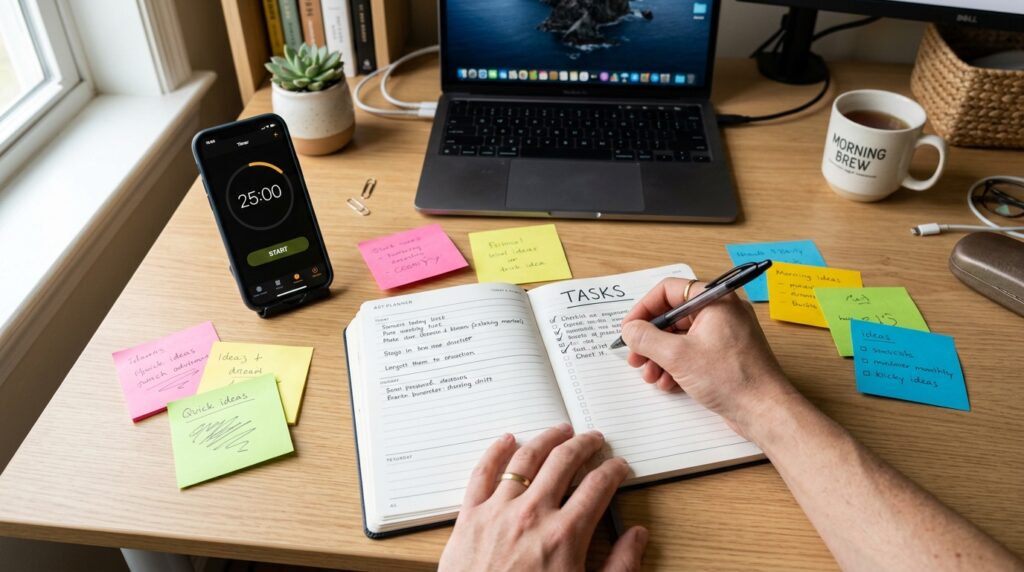
Overview: The 15-Minute Daily Planner Reset
Here’s how we’ll break down the 15 minutes:
- 3 minutes – Prep: Clear a small space, open your planner or app, set a timer
- 10 minutes – Dump & Decide: Brain dump all tasks, then choose today’s 1–3 study priorities
- 2 minutes – Minimum Actions: Write down 1–2 tiny, non-negotiable actions with checkboxes
You can do this on:
- A paper planner or notebook
- A single A4 sheet
- Or a digital tool like Notion, Todoist, Obsidian, Apple Notes, or Google Tasks
If you want a more system-level setup later, you can connect this routine to your daily blocks from
15-Minute Time Blocking: How to Turn a Scattered Day into Focused Study Blocks.
Step 1 – Prep Your Space and Tools (3 Minutes)
The goal of this step is not to have a perfectly aesthetic desk.
It’s simply to create a small, clear area for your planner and your brain.
1. Clear a Small Physical Space
Take a quick look at your desk.
Move anything unrelated to today’s work—receipts, packages, snack wrappers—to one side or into a drawer.
You’re not “deep cleaning.”
You’re just making one notebook-sized space where your planner or laptop can sit without visual noise.
2. Open Your Planner or Digital Tool
Choose your tool for this 15-minute block:
- Paper – Open your planner to today’s page, or grab one blank sheet.
- Notion – Open a simple “Today” page or database view.
- Todoist / task app – Open the “Today” view or create a new task list.
- Notes app – Create a note titled “Today – Brain Dump & Study Priorities”.
At the top, add two simple headings:
- “Today’s Tasks”
- “Today’s Study Priorities”
If you need a place to route all your notes and tasks later, you can also check out our guide on
15-Minute Reading and Notion Routine: How to Turn Scattered Book Notes into a Simple Reading System to build a simple Notion hub.
3. Set a 15-Minute Timer
Use any timer you like:
- Phone timer
- Pomodoro app
- Physical kitchen timer
- Smartwatch
Tell yourself:
“For the next 15 minutes, I’m only doing this planner reset. Nothing else.”
Then hit start.
Step 2 – Dump Everything, Then Choose Priorities (10 Minutes)
We’ll split this into two 5-minute blocks:
- First 5 minutes – Brain dump everything
- Next 5 minutes – Choose 1–3 study priorities
2.1 Brain Dump: 5 Minutes of “Everything on the Page”
For the first 5 minutes, your only job is to write everything down.
Include:
- Today’s tasks (work, study, life admin)
- Things you’ve been “meaning to do”
- Study-related tasks: lectures, problem sets, reading, review, writing, etc.
Don’t worry about order, importance, or neatness.
This is not your final list. It’s a raw download from your brain.
Productivity and cognitive load research shows that getting tasks out of your head and into a trusted system reduces mental stress and frees up attention for actual work.
This is exactly what your brain dump is doing.
If you prefer digital:
- In Notion, create a simple “Inbox” database or just a bullet list.
- In Todoist, dump tasks into “Inbox” and sort later.
- In a notes app, write one item per line without judging.
2.2 Choose Today’s Study Priorities (1–3 Items, 5 Minutes)
Now scan your brain dump.
- Mark anything that is study-related (exam prep, language learning, reading, assignments).
- Ask yourself one simple question:“If I could complete just one study-related thing today that my future self will thank me for tomorrow, what would it be?”
Pick 1–3 items that match that question and mark them with a star ⭐.
Examples:
- ⭐ Review 2 units from my vocabulary book
- ⭐ Solve 10 practice questions for the certification exam
- ⭐ Watch 1 lecture and take basic notes
The goal is not to choose everything you “should” do.
It’s to define the few study tasks that actually matter today.
Research on self-regulated learning and goal setting suggests that learners who consistently set specific, manageable goals and track them over time tend to see better long-term performance than those who just “study more” without a plan.
Step 3 – Set Minimum Actions and Checkboxes (2 Minutes)
Now we turn those priorities into tiny, executable actions.

3.1 Pick 1–2 Minimum Study Actions
From your starred items, choose the 1–2 most important for today.
Then write them in a separate “Minimum Study for Today” section.
For example:
- Minimum Study 1: Review 20 vocabulary words
- Minimum Study 2: Solve 10 certification practice questions
These are the actions where you’ll say:
“If I only do these today, I still count it as a successful day.”
3.2 Add Simple Checkboxes
Add checkboxes or toggles in your planner or app:
- □ Review 20 vocabulary words
- □ Solve 10 certification practice questions
That’s it.
When you plan, it’s tempting to build a packed schedule.
But one missed day can make your motivation collapse.
By defining “I only need to complete these 1–2 actions to win today”, you dramatically reduce pressure and make it much easier to keep going, even during busy or low-energy weeks.
If you want to connect this with actual study time, you can pair these actions with a focus block from
15-Minute Study Routine: How to Make Short, Focused Blocks Actually Work.
Everyday Tips: When and How to Use This Routine
Study and habit resources often emphasize that studying at a consistent time each day supports self-directed learning and better results over time.
Your 15-minute planner reset can become that anchor.
Here are two simple ways to integrate it.
1. Fix One Time Slot (Morning or Evening)
Choose one time that you can realistically hold most days:
- Morning: right after coffee, before opening email
- Evening: after dinner, before Netflix or gaming
Put a repeating event in your calendar:
“15-Min Planner Reset – Today’s Priorities”
Treat it as the switch that turns your brain from “reactive mode” into “focused mode” for study and deep work.
2. On Bad Days, Only Do the Planner Reset
On days when you feel completely unmotivated or wiped out,
change the rule:
“Today, I only have to do the 15-minute planner reset. Actual study is a bonus.”
Even if you stop after the planner routine,
you’ve still maintained the habit of checking in with your goals.
That makes it much easier to restart proper study the next day.
If your week feels especially chaotic, you can pair this with a broader review using
15-Minute Monday Study Review: How to Check Your Monthly and Weekly Plan Without Feeling Overwhelmed.
Why 15 Minutes Actually Works
Neuroscience and attention research often note that our ability to sustain high-quality focus tends to drop after about 15–25 minutes without a break.
That’s one reason why short, clearly framed blocks feel psychologically easier to start and finish.
By keeping your planning ritual to 15 minutes:
- It feels “small enough” to start, even after a long day
- It gives you just enough structure to know what matters
- It naturally connects to your 15-minute or 25-minute focus sessions
You don’t need a perfect system.
You just need a small, repeatable way to decide what matters today.
Related Routines You Might Like
- 15-Minute Study Routine: How to Make Short, Focused Blocks Actually Work – A deeper dive into building short study blocks and chaining multiple sessions together.
- 15-Minute Time Blocking: How to Turn a Scattered Day into Focused Study Blocks – How to plan your entire day around short focus sessions without feeling overwhelmed.
- Weekend 15-Minute Study Routine: How to Plan Your Week with Simple Time-Block Study Sessions – A weekend routine for mapping out your next week’s study blocks.
Frequently Asked Questions
Q1. What if I only have 5 minutes, not 15?
A: That’s okay. Start with 5.
For example, spend 3 minutes on a mini brain dump and 2 minutes picking just one minimum study action.
The important part is showing up consistently, not hitting exactly 15 minutes every time.
Q2. Can I use this planner reset for work tasks, not just studying?
A: Absolutely.
You can mark both work and study items in your brain dump and then decide what today’s top priorities are in each area.
Many knowledge workers use the same 15-minute reset to pick one key work task and one key learning task per day.
Q3. Which tools do I need to start this routine?
A: You only need one capture tool (paper or digital) and a timer.
If you like digital setups, try a simple Notion page, Todoist “Today” view, or a note in Apple Notes / Google Keep.
Later, you can build more advanced dashboards, but a single page is more than enough to begin.
Q4. How does this routine relate to time blocking?
A: This 15-minute reset decides what matters today.
Time blocking decides when you’ll do it.
After you pick your 1–3 study priorities, you can drop them into 15-minute or 30-minute blocks using the approach in our
15-Minute Time Blocking: How to Turn a Scattered Day into Focused Study Blocks.
Learn More
For more on focus, study habits, and planning routines, these resources are helpful:
- Vanderbilt University – Self-Regulated Learning
Overview of self-regulated learning and how planning, monitoring, and reflecting on one’s own study improves academic outcomes.
https://cft.vanderbilt.edu/guides-sub-pages/self-regulation-in-learning/ - APA (American Psychological Association) – Self-regulated learning
Short article explaining what self-regulated learning is and why strategies like goal setting and self-monitoring matter.
https://www.apa.org/education-career/k12/learners