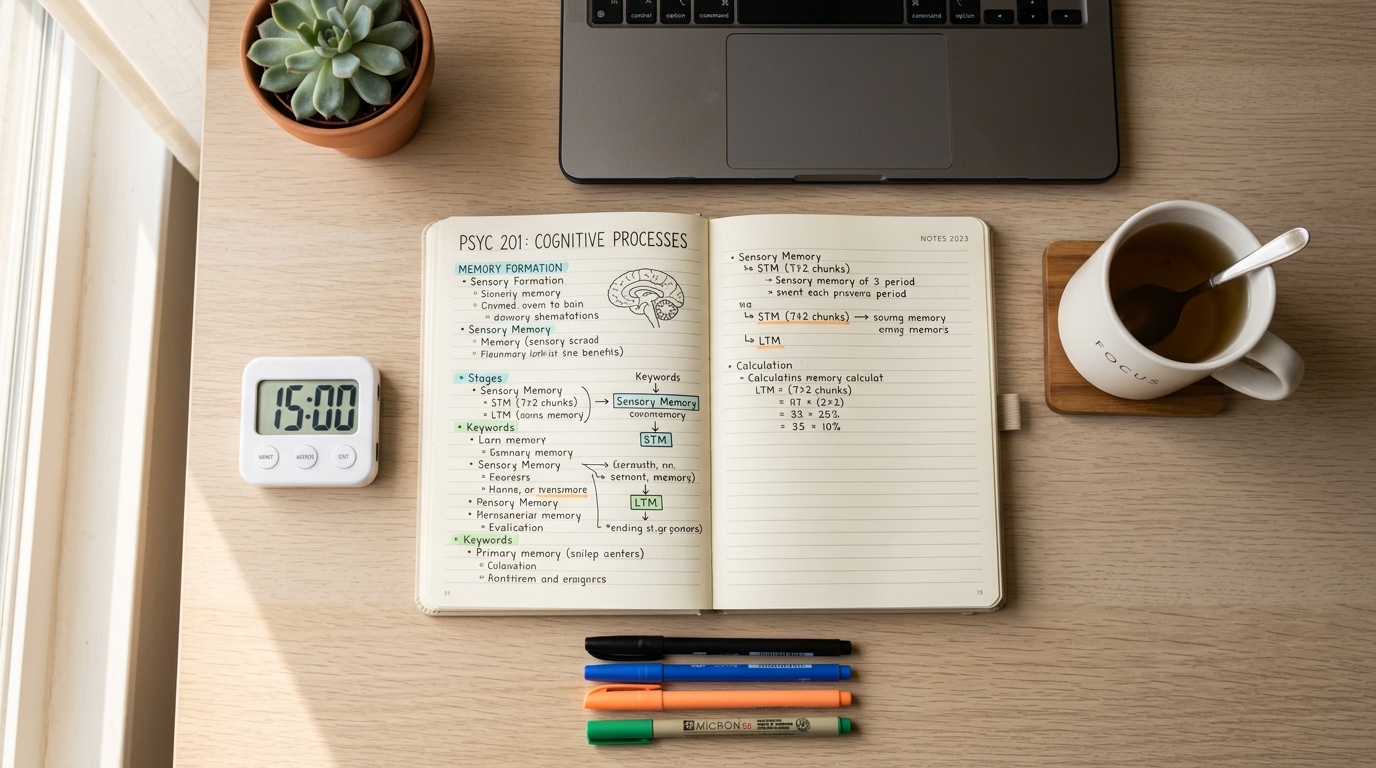
Why 15-Minute and 5-Minute Routines Feel Easier Than Pomodoro
You sit down to study or work after a long day, open your laptop, and within five minutes you’re checking your phone or clicking into another tab. The classic 25-minute Pomodoro sounds great in theory, but in practice it can feel too long when your brain is already tired.
For many students and knowledge workers juggling meetings, messages, and multiple apps, the real problem is not “willpower” but the starting barrier. A shorter, lighter structure can make it much easier to begin and actually finish one meaningful piece of work.
I started using this 15-minute block on days when my brain felt scattered, and it was just enough structure to finish one small but important task instead of giving up entirely.

Why Shorter Focus Blocks Work
A lot of productivity advice focuses on “how long you can sit and grind,” but research on learning and attention increasingly points to short, focused, repeatable sessions as a more realistic way to study and work.
Recent work on microlearning and spaced practice shows that:
- Shorter learning sessions, repeated over time, improve retention and practical performance more than long, exhausting blocks.
- Spaced learning—coming back to material in multiple shorter sessions—strengthens memory and reduces the forgetting curve compared to cramming.
Self‑regulated learning research also emphasizes simple routines that repeat the cycle of setting a clear goal, doing focused work, and briefly reflecting on what worked. That is exactly what a 15-minute routine can do for you.
The classic Pomodoro uses 25‑minute blocks because its creator experimented and found that duration effective for many people, but even in Pomodoro communities the interval is treated as adjustable rather than sacred. If 25 minutes keeps breaking, it often means the block is a little too long for your current context—not that you are weak.
15-Minute Routine Overview
In this guide, we’ll use a simple 15-minute structure:
- Prep: 3 minutes
- Focus: 10 minutes
- Wrap-Up: 2 minutes
Even if this looks short, two sets a day already give you 30 minutes of focused time. Five sets give you 75 minutes, often with less resistance than forcing a single long block.
This routine is flexible: you can use it for exam prep, report writing, reading, coding, language study, or side projects. And because it’s short, it pairs well with digital tools like Notion, timers, and note apps without becoming overwhelming.
Step 1 – Prep (3 Minutes): Environment, One-Line Goal, Timer
Clear Your Space and Screens
Start by reducing obvious distractions in your physical and digital space:
- Put your phone face down or in another room.
- Close every browser tab except the ones you need for this one task.
- On your desk, keep only what you’ll actually use in the next 10 minutes: book, notebook, laptop, pen.
If you want a more structured way to organize your digital workspace, you can create a simple Notion page or dashboard where you keep today’s tasks, notes, and links in one place.
Write a One-Line Goal
Next, write a single, tiny goal for this 10-minute block. One line only.
Examples:
- “Read pages 4–7 of the vocabulary book.”
- “Draft one paragraph of the report.”
- “Solve three practice problems from Chapter 3.”
The key is to shrink the task until it feels almost too easy. Self‑regulated learning research shows that clear, specific goals make it easier to start and to notice progress later.
You can write this goal in:
- A paper planner,
- A simple Notion page called “Today’s 15-Minute Goals,” or
- A quick note in your favorite memo app.
Set a 10-Minute Timer
Finally, set a timer for 10 minutes.
You can use:
- Your phone’s built-in timer in Do Not Disturb mode,
- A minimal focus-timer app, or
- A Notion template with a linked timer if you prefer everything in one workspace.
The point is not which tool you use, but that your brain hears a clear signal: “For the next 10 minutes, I’m only doing this one small thing.”
Step 2 – Focus Block (10 Minutes): One Thing Only
Stick to the One-Line Goal
During the 10-minute block, your rule is simple:
Do the one thing you wrote down. Nothing else.
That means:
- Don’t switch to another chapter or task “because it looks easier.”
- Don’t open extra tabs or apps “just to check something quickly.”
- Don’t chase perfection—aim to move through the planned part, not master everything in one go.
Short, focused intervals like this are powerful because your brain knows there is a near end point. There is less pressure to “stay perfect” for a long time, and more permission to just start.
If your mind wanders during the block, gently bring yourself back and think:
“I’ll just stay with this page / this paragraph / this problem until the timer rings.”
Wandering is normal. The real practice is “notice, then return.”
Optional: Use Digital Tools Lightly
You can optionally use digital tools to support this block, but keep the setup minimal:
- Notion or a notes app – jot down quick ideas or questions that pop up, so you don’t leave the task to chase them.
- AI assistant – if you get stuck on a concept, use AI for a brief clarification, then go back to your main task instead of falling into a long chat.
If you want a more detailed structure for your study blocks, you may find it helpful to read:
👉 15-Minute Study Routine: How to Make Short, Focused Blocks Actually Work.
Step 3 – Wrap-Up (2 Minutes): Leave a Trail for Next Time
Log What You Just Did
When the timer ends, don’t immediately jump to your phone or another task. Spend two minutes closing the loop.
First, write one simple line about what you did:
- “Scanned vocabulary pages 4–7.”
- “Drafted the introduction paragraph.”
- “Solved 3 of 5 practice problems.”
You can log this in:
- A paper notebook,
- A “15-Min Focus Log” database in Notion, or
- A simple rolling note in your memo app.
This tiny log builds a visible history of effort, which is key for motivation and self‑regulated learning.

Leave One Cue for Next Time
Second, write one line about what to do next:
- “Next: review pages 8–10.”
- “Next: refine paragraph 1 and outline paragraph 2.”
This removes the friction of “What should I work on?” the next time you sit down. Future you can simply read the line and start.
For a more structured system, you can connect this with time blocking across your day. If that’s interesting, see:
👉 15-Minute Time Blocking: How to Turn a Scattered Day into Focused Study Blocks.
Using 5-Minute Routines When 15 Still Feels Too Much
Some days, even 15 minutes feels heavy. On those days, you can drop down to a 5-minute micro‑routine:
- 1 minute – Clear your space.
- 3 minutes – Do one tiny action (read one paragraph, rename three files, highlight one page).
- 1 minute – Log what you did and write the next step.
Research on microlearning suggests that very short, focused learning moments repeated over time can improve retention and confidence more than occasional long sessions. A 5-minute block is often enough to “keep the chain alive” on a bad day.
You can treat this as your “minimum viable routine”: if you’re exhausted, do one 5-minute block and count that as a win.
Everyday Tips for Making This Routine Stick
- Fix one anchor time.
For example, “Every weekday at 9:00 p.m., I do at least one 15-minute set.” Regular timing helps turn the routine into a habit rather than a decision. - Set a minimum line.
Decide in advance: “On tough days, one 15-minute or even one 5-minute set is enough.” This reduces all‑or‑nothing thinking and makes it easier to keep going. - Stack sets only when you have energy.
On good days, chain two or three sets. On low-energy days, stay with one. The goal is consistency, not heroics. - Use tools to support, not complicate.
A simple timer and one place to write your goals and logs (Notion page, notes app, or paper) are enough to start. You can always add more structure later.
If you like building digital systems around your routines, you might enjoy combining this method with a simple Notion or note-taking setup to track your study streaks and projects over time.
Related Routines You Might Like
- 15-Minute Study Routine: How to Make Short, Focused Blocks Actually Work – A deeper dive into building short study blocks and chaining multiple sessions together.
- 15-Minute Time Blocking: How to Turn a Scattered Day into Focused Study Blocks – How to plan your entire day around short focus sessions without feeling overwhelmed.
- Can’t Focus? Try This 15-Minute Study Reset Routine – A reset you can use when your brain feels scattered and you need a gentle restart.
Frequently Asked Questions
Q1. What if I only have 5 minutes, not 15?
Use the 5-minute version: 1 minute to clear your space, 3 minutes for one tiny action, and 1 minute to log what you did. The point is to keep the habit alive, not to hit a perfect number.
Q2. Can I use this routine for work tasks, not just studying?
Absolutely. You can use a 15-minute focus block for emails, writing reports, planning meetings, documenting code, or any knowledge work that benefits from short, concentrated effort.
Q3. Which tools do I need to start?
You only need three things: somewhere to write a one-line goal, a timer, and a place to log what you did. A simple combination like Notion or a note app plus your phone’s timer is more than enough to begin.
Q4. How many 15-minute sets should I aim for each day?
Start with one set per day and treat that as your minimum. When that feels stable, add a second or third set on days when you have more energy. Consistency matters more than hitting a high number on a single day.
Learn More
For more on focus, learning routines, and short study sessions:
- More Curricular – The Science Behind Bite-Sized Study Sessions: Why Shorter Really Is Better
Explains why short, focused study blocks and microlearning can improve retention, performance, and confidence compared to long revision sessions.
https://www.morecurricular.co.uk/post/the-science-behind-bite-sized-study-sessions-why-shorter-really-is-better - Neuroscience News – Variability and Spaced Learning Key to Enhanced Memory
Summarizes research showing how spaced learning across multiple shorter sessions strengthens memory more than cramming.
https://neurosciencenews.com/spaced-learning-memory-25747/ - Structural Learning – Self-Regulated Learning: A Teacher’s Guide
Introduces self‑regulated learning and shows how short, repeatable routines with clear goals and reflection build independent learning habits.
https://www.structural-learning.com/post/self-regulation-of-learning - FAQ About – The Pomodoro Technique
Explains the logic behind the 25-minute Pomodoro interval and how the technique can be adapted to different needs and contexts.
https://faqabout.me/iam/the-pomodoro-technique