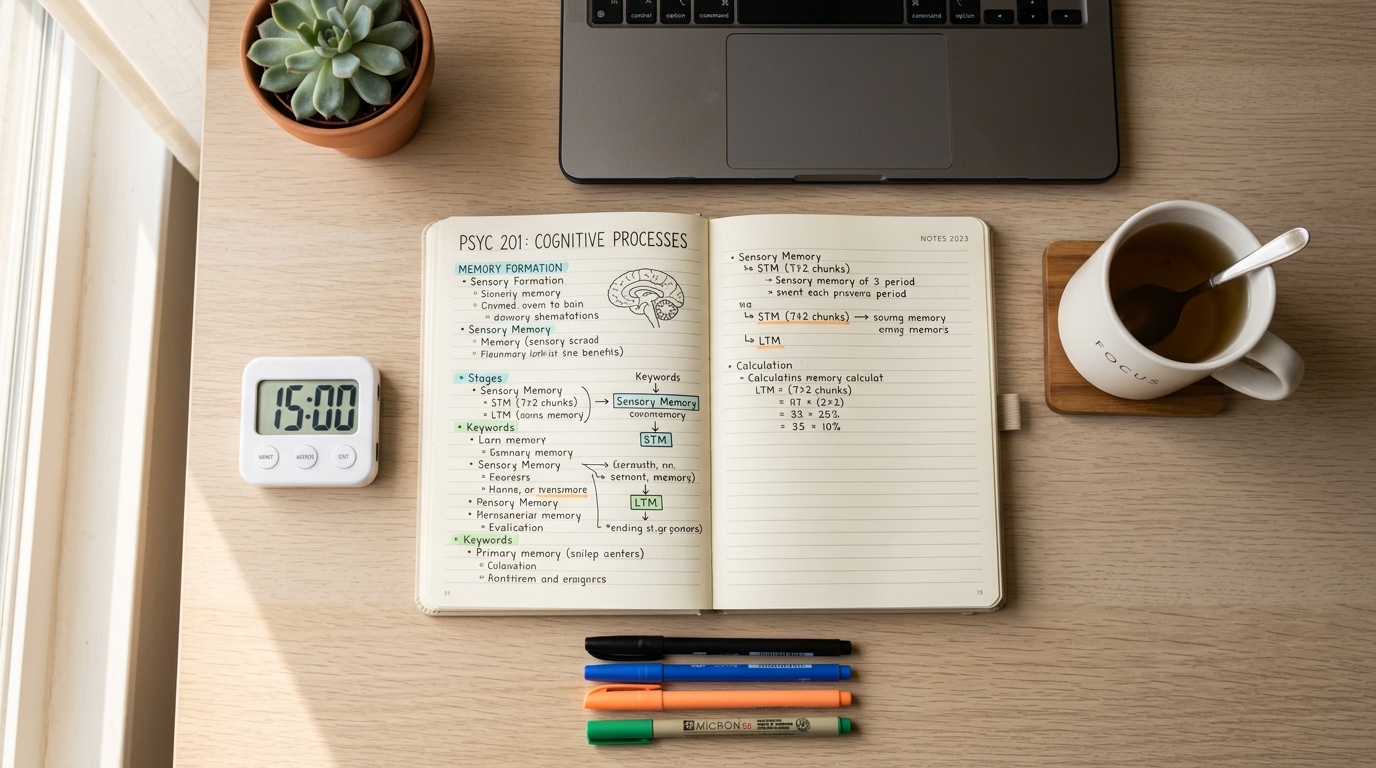
You know you need to study. You’re sitting at your desk, staring at your notes, but the words just won’t sink in.
Your planner says you should be working for three hours straight. But today? Even 30 minutes feels impossible.
You start wondering: “Should I just give up for today and try again tomorrow?”
Here’s the thing: you don’t need to abandon the whole day. What you need is a minimum viable study routine—something so short and simple that even on your worst focus days, you can still show up.
That’s where the 15-minute study reset routine comes in.
This isn’t about cramming or grinding through exhaustion. It’s about keeping your study habit alive, one small session at a time, so you don’t have to start from zero tomorrow.
Why You Need a “Minimum 15-Minute Routine”
Most study routines fail because they start too big.
You set a goal like “study for 3 hours every day.” Then life happens—you’re tired, distracted, or just not feeling it. You miss one day, then two, and suddenly the whole routine collapses.
But when you have a fallback routine—a bare minimum you can do even on low-energy days—you create a safety net.
Instead of thinking “I failed today,” you think: “I did my 15 minutes. That’s good enough.”
According to research in learning psychology, consistency beats intensity. Showing up for 15 minutes every day builds stronger habits than sporadic 3-hour sessions.
And here’s the key: 15 minutes is short enough that you can’t talk yourself out of it, but long enough to actually make progress.
The 15-Minute Study Reset: Full Breakdown
This routine is designed to be brutally simple. No complicated steps. No perfect conditions required.
Here’s the structure:
- Prep (3 minutes) – Clear your space and set one goal
- Focus (10 minutes) – Do one thing, nothing else
- Wrap-up (2 minutes) – Log what you did and prep for next time
Total: 15 minutes. That’s it.
Even if your brain feels foggy, you can handle this.
Step 1: Prep (3 Minutes) – Set Up for Success

Minute 1: Clear Your Physical and Digital Space
Before you start, remove anything you won’t need for the next 15 minutes.
Physical:
- Close extra books and notebooks
- Put your phone in another room (or at least face-down and out of reach)
Digital:
- Close all browser tabs except the one you need
- Quit messaging apps (Slack, Discord, WhatsApp—all of them)
- Turn off notifications
You’re not trying to create the perfect environment. You’re just removing obvious distractions.
Minute 2: Write Down One Goal
On a sticky note, in Notion, or on paper, write one sentence:
- “Review 10 vocab words”
- “Read 2 pages of Chapter 4”
- “Watch 10 minutes of lecture video”
Make it small enough that you think: “Yeah, I can do that.”
This isn’t the time to be ambitious. You’re resetting, not sprinting.
Minute 3: Start a Timer
Use any timer app you like—your phone’s built-in timer, Forest, Be Focused, or Toggl Track.
Set it for 15 minutes and press start.
Now you’re locked in. No more “should I start or not?” The decision is made.
Step 2: Focus (10 Minutes) – One Task Only
For the next 10 minutes, you only do the one thing you wrote down. Nothing else.
If you said “review 10 vocab words,” then you review vocab words. You don’t check email. You don’t browse Reddit. You don’t start a new task.
What If Other Thoughts Pop Up?
They will. That’s normal.
Keep a scrap piece of paper or a digital note open. When a random thought appears—“Oh, I need to email my professor”—write it down and come back to it after the timer.
This is called an external brain dump. It clears your mental RAM without breaking your focus.
Why 10 Minutes?
Research on attention spans suggests that deep focus lasts about 10–20 minutes before it starts to fade.
By keeping your session to 10 minutes, you’re working with your brain’s natural rhythm, not against it.
And here’s the psychological trick: when you know it’s only 10 minutes, your brain stops resisting. It’s easier to tell yourself “I just need to hold on for 10 minutes” than “I need to focus for an hour.”
Step 3: Wrap-Up (2 Minutes) – Make Tomorrow Easier

When the timer goes off, don’t immediately jump to YouTube or Instagram.
Take 2 more minutes to close the loop.
Minute 1: Log What You Did
Check off your goal. Write a quick note:
- “Reviewed 10 vocab words—8 done”
- “Read 2 pages—finished Chapter 4 intro”
You’re not writing an essay. Just a quick record that you showed up.
Why this matters: Over time, these tiny checkmarks stack up. You start to see: “I’ve done this 20 days in a row.” That builds self-efficacy—the belief that you can actually do hard things.
Minute 2: Set Tomorrow’s Task
Before you close your notebook or Notion page, write down what you’ll do next time.
Example:
- “Tomorrow’s 15-min: Review next 10 vocab words”
- “Next session: Read 2 more pages”
This is pre-decision. When you sit down tomorrow, you don’t have to think about what to do. You just look at the note, start the timer, and go.
How to Make This Routine Stick
1. Anchor It to a Specific Time
Pick one time slot where you’ll do this routine no matter what.
Examples:
- Right after dinner (7:00–7:15 PM)
- During lunch break (12:30–12:45 PM)
- Before bed (10:00–10:15 PM)
When you repeat this at the same time every day, your brain starts to recognize: “Oh, this is study time.” You won’t need as much willpower to start.
2. Set “Good Day” vs. “Bad Day” Minimums
On good days, you can stack multiple 15-minute sessions. On bad days, you do just one.
Your plan might look like this:
- Good energy day: 3 sessions (45 minutes total)
- Low energy day: 1 session (15 minutes)
- Absolute worst day: Still 1 session, even if it’s rough
The point isn’t perfection. It’s keeping the streak alive.
3. Use a Habit Tracker
Track your 15-minute sessions in:
- A paper calendar (X each day you complete it)
- Notion habit tracker
- Apps like Habitica or Streaks
Seeing a chain of completed days makes it harder to skip. You don’t want to break the streak.
Tools That Make This Easier
Timers
- Forest – Gamified timer; plants a tree if you don’t touch your phone
- Be Focused – Simple Pomodoro timer (15-min sessions instead of 25)
- Toggl Track – Tracks your study time automatically
Note-Taking & Task Planning
- Notion – Create a simple “15-Min Study Log” database
- Obsidian – Daily notes with quick task entries
- Apple Notes / Google Keep – If you just need something fast
Distraction Blockers
- Cold Turkey (Windows/Mac) – Blocks websites and apps
- Freedom – Cross-platform blocker
- LeechBlock (Firefox) – Free browser extension
You don’t need all of these. Pick one timer and one note app. That’s enough.
Why This Works (Even When Nothing Else Does)
Traditional advice says: “Just push through. Study harder.”
But that doesn’t work when your brain is already maxed out.
The 15-minute reset works because it:
- Lowers the activation barrier – You can’t procrastinate on something that takes 15 minutes.
- Builds momentum – Once you start, you often keep going. But even if you don’t, 15 minutes still counts.
- Protects your streak – Habits die when you skip too many days. This keeps you in the game.
- Reframes failure – You’re not “failing” if you only do 15 minutes. You’re succeeding at your minimum.
Research on habit formation shows that consistency is more important than volume. Doing a little every day beats doing a lot once in a while.
Related Routines You Might Like
If this 15-minute reset helped, you might also enjoy:
- 15-Minute Study Routine: How to Make Short, Focused Blocks Actually Work – a deeper dive into building study blocks
- 15-Minute Time Blocking: How to Turn a Scattered Day into Focused Study Blocks – how to plan your day around short focus sessions
Frequently Asked Questions
Q: What if I can’t even do 15 minutes?
Start with 5. Seriously. If 15 feels too long, set a timer for 5 minutes and do one tiny task. The goal is to show up, not to be perfect.
Q: Can I do this for work tasks, not just studying?
Absolutely. This works for anything that requires focus—writing reports, coding, reading research papers, even creative work.
Q: What if I get into a flow and want to keep going after 15 minutes?
Great! Keep going. The 15-minute rule is a minimum, not a maximum. But if you stop at 15, that’s also fine.
Q: How do I stop getting distracted by my phone?
Put it in a different room. Or use Forest app with a high-stakes bet (you lose your tree if you unlock your phone). Make it physically or psychologically harder to pick up.
Learn More
For more on focus, study habits, and building consistent routines, see:
- NIH/PMC – Applying Cognitive Learning Strategies to Enhance Learning and Retention
Research-based guide on five evidence-based learning strategies: spaced retrieval, interleaving, elaboration, generation, and reflection.
https://pmc.ncbi.nlm.nih.gov/articles/PMC6946583/ - MIT Teaching + Learning Lab – Metacognition and How People Learn
Explores metacognitive strategies that help students self-regulate, plan study time, and improve learning effectiveness.
https://tll.mit.edu/teaching-resources/how-people-learn/metacognition/ - James Clear – Atomic Habits: The Science of Tiny Habits
Explains why small, consistent actions beat big, sporadic efforts—perfect for understanding why 15-minute routines work.
https://jamesclear.com/atomic-habits
Leave a Reply