Tag: focus timer

  • 15-Minute Study Routine by Subject: How to Build a High-Score Study Schedule Without Burnout

    15-Minute Study Routine by Subject: How to Build a High-Score Study Schedule Without Burnout

    You sit down after work or late in the evening during exam season, ready to study—but before you even open your textbook, you already feel exhausted.

    You think, “I should study for at least two hours tonight,” but then the moment your plan shifts even slightly, the whole schedule collapses, and you end up doing nothing.

    This guide is for exam students, certification learners, and working adults who need to juggle multiple subjects without burning out.

    We’ll walk through how to design a 15-minute study routine by subject—how to divide your limited study time across different courses, how to decide which subjects get more blocks, and how to build a schedule that actually sticks.

    I started using this 15-minute block system on evenings when my brain felt too scattered to commit to a two-hour session, and it was just enough structure to actually finish one small but meaningful task in each subject.


    Why Long Study Plans Often Fail

    When you sit down to study multiple subjects—whether it’s for high school exams, college finals, or professional certifications—the biggest challenge isn’t finding time. It’s deciding how much time to give each subject.

    You might think, “I’ll do two hours of math, one hour of English, and squeeze in some science,” but that plan often falls apart the moment something unexpected happens.

    Research on focus and mental fatigue suggests that most people can sustain deep concentration for about 10 to 20 minutes at a time before their attention starts to drift.

    Instead of trying to power through two-hour marathons, building short, high-density 15-minute blocks and repeating them across subjects is more realistic—and often more effective.


    The 15-Minute Study Block Structure

    Before you divide your time by subject, you need a basic template for what one 15-minute block looks like.

    Here’s the structure I recommend:

    • Prep (3 minutes)
    • Focus work (10 minutes)
    • Wrap-up (2 minutes)

    This becomes your unit of measurement. Instead of saying “I’ll study for two hours,” you say, “I’ll complete 8 blocks today—3 for math, 2 for English, 2 for history, and 1 for science.”

    Let’s break down each phase.


    Step 1: Prep (3 Minutes) – Clear Your Space and Set a One-Line Goal

    The prep phase isn’t about studying—it’s about lowering the barrier to starting.

    Clear your desk
    Push aside anything unrelated to the subject you’re about to study. If you’re doing math, clear everything except your math textbook, notebook, and pen.

    Put your phone out of sight
    Not just face-down—actually out of the room, or in a drawer. Turn off notifications if possible.

    Write a one-line goal for this block
    Don’t write “study math.” Write something specific:

    • “Math: Solve 3 practice problems from Chapter 5”
    • “English: Read and underline key points in one essay prompt”
    • “History: Review today’s lecture notes and highlight 3 main events”

    The more specific your one-line goal, the easier it is to stay on track during your 10-minute focus window.

    This preparation step is backed by research on reducing decision fatigue—when you remove ambiguity from “what to do,” you can start working faster.

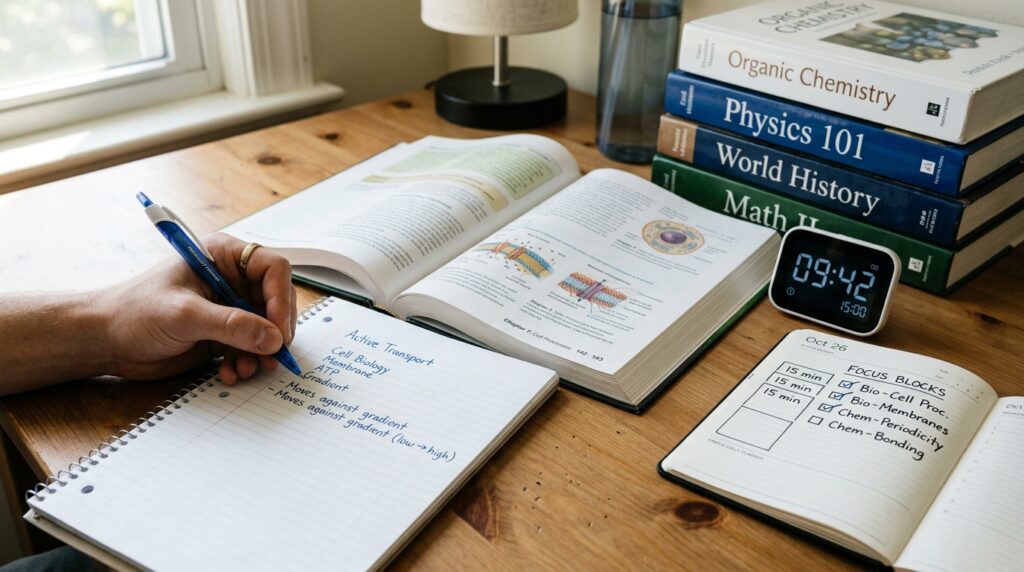
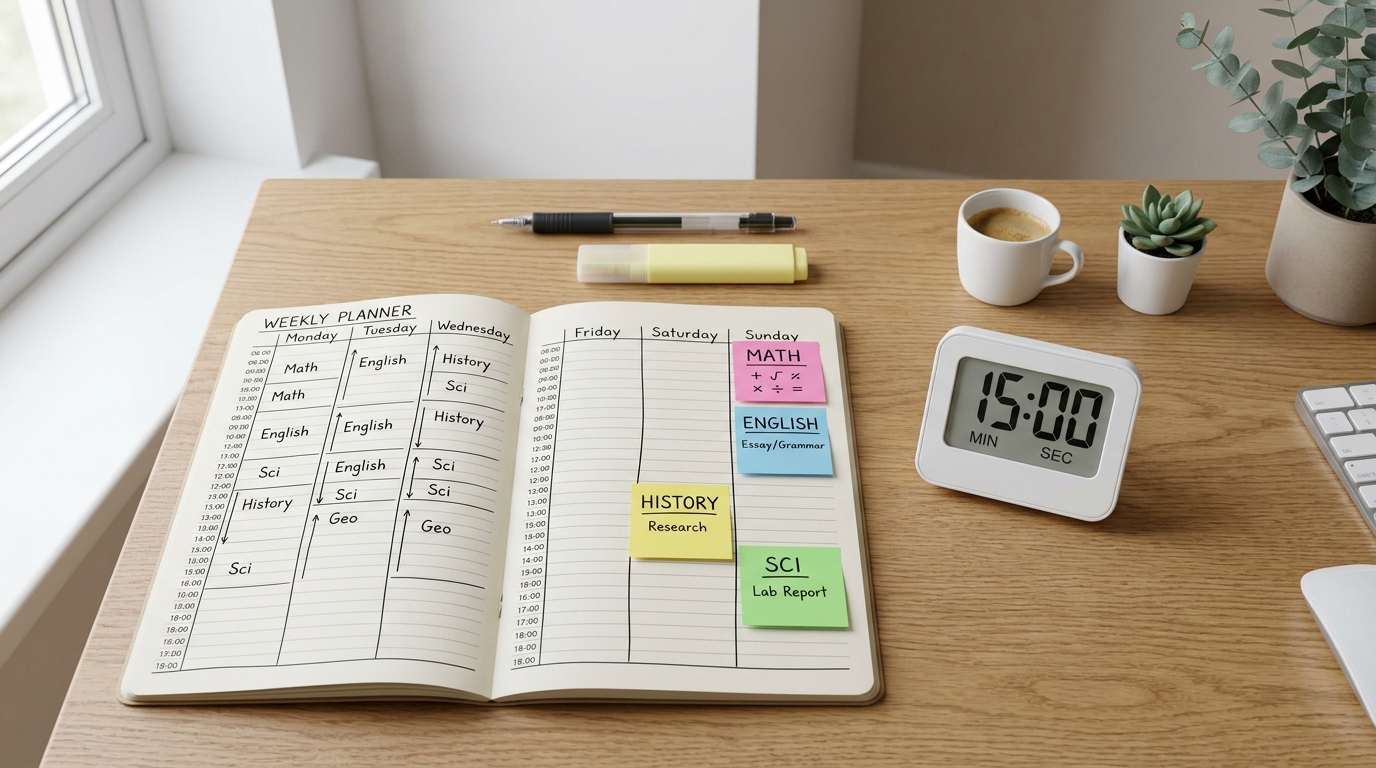
    Person organizing study materials by subject and clearing desk space to start a focused 15-minute study session

    Step 2: Focus (10 Minutes) – One Subject, One Task

    Now you have 10 minutes. During this time, focus on one thing only for the subject you selected.

    If it’s a math block, solve problems. If it’s an English block, read and annotate. If it’s a history block, review notes and write one summary sentence per section.

    What if another subject pops into your head?
    Jot it down on a sticky note and return to your current block. Don’t switch mid-block.

    Why 10 minutes?
    Because focus peaks around 10 to 20 minutes, then gradually declines. By keeping blocks short, you’re working with your brain’s natural attention cycle, not against it.

    How to distribute blocks by subject

    • Strong subjects: 1 block every 2–3 days (maintenance only)
    • Weak subjects: 2–3 blocks per day (needs improvement)
    • Required subjects: At least 1 block daily (non-negotiable)

    For example, a high school student preparing for exams might allocate:

    • Math: 3 blocks
    • English: 2 blocks
    • History: 2 blocks
    • Science: 1 block

    A working adult studying for a certification might use:

    • Core subject: 2 blocks
    • Supplementary subject: 1 block
    • Review: 1 block
    Active 15-minute study session with notebook textbook and timer showing focused work time for subject-based learning

    If you’re using digital tools like Notion or a study timer app to track your blocks, you might find our guide on 15-Minute Time Blocking: How to Turn a Scattered Day into Focused Study Blocks helpful for setting up a visual tracker.


    Step 3: Wrap-Up (2 Minutes) – One Line for Today, One Line for Tomorrow

    When your 10 minutes are up, don’t immediately jump to the next subject.

    Take 2 minutes to write two lines:

    Today’s line:
    What did you just finish?

    Example:

    • “Math: Solved 3 problems, got stuck on #2”
    • “English: Read one essay prompt, underlined 5 key arguments”
    • “History: Reviewed lecture notes, highlighted 3 events”

    Tomorrow’s line:
    What’s the next step?

    Example:

    • “Math: Review solution for #2, then do 2 similar problems”
    • “English: Write a rough outline for the essay”
    • “History: Rewrite the 3 events in my own words”

    This two-line habit creates continuity between blocks. When you sit down for your next 15-minute session, you won’t waste time asking, “What should I do now?”

    Studies on self-regulated learning suggest that students who regularly set short-term goals and review their progress tend to perform better academically.

    If you want a step-by-step guide on building review habits into your routine, check out 15-Minute Study + 5-Minute Review: A Simple Routine for Days You Can’t Stick to Your Plan.


    How to Distribute 15-Minute Blocks Across Subjects

    Not all subjects need the same amount of time, and trying to split everything equally is inefficient.

    Here’s a simple framework:

    1. Required subjects (e.g., math, English)
    → At least 1 block per day, no exceptions.

    2. Weak subjects (subjects where you’re struggling)
    → Add 1 extra block compared to required subjects.

    3. Strong subjects (maintenance only)
    → 1 block every 2–3 days is enough.

    Example: High school exam student

    • Math (weak): 3 blocks daily
    • English (required): 2 blocks daily
    • History (required): 2 blocks daily
    • Science (strong): 1 block every other day

    Example: Working adult studying for certification

    • Core subject: 2 blocks daily
    • Elective subject: 1 block daily
    • “Minimum viable routine” on busy days: 1 block total (core subject only)

    This distribution method is supported by research on spaced practice and interleaving, which show that distributing study time across subjects improves retention more than massed practice (studying one subject for hours at a time).


    Tools That Make This Easier

    Notion
    Create a simple “15-Min Study Log” database with columns for Date, Subject, Block Count, and Notes. At the end of each week, review which subjects got the most attention.

    For a detailed tutorial on setting up Notion for study tracking, see How to Build Weekly and Monthly Study Plans with 15-Minute Blocks.

    Physical timer
    A simple kitchen timer or desk timer works better than a phone app because it removes the temptation to check notifications.

    If you’re deciding between timers and apps, our guide How to Choose a Planner, Timer, and App for Your 15-Minute Study Routine: 5 Simple Criteria breaks down the pros and cons.

    Google Calendar or time-blocking app
    Block out your 15-minute sessions by subject at the start of each week. Treat these blocks like appointments.


    Practical Tips for Daily Use

    Fix one time slot per day
    Choose a consistent time—9 PM every evening, or 6 AM before work—and dedicate that slot to 2–3 study blocks. Consistency builds habits faster than intensity.

    Set a “minimum viable routine”
    On days when you’re exhausted or your schedule falls apart, decide in advance: “If I can only do one thing today, it’s one 15-minute block for [subject].”

    This prevents your routine from collapsing completely when life gets messy.

    Review and adjust weekly
    At the end of each week, look at your block distribution. Did you overcommit to one subject? Did another subject get neglected? Adjust next week’s plan accordingly.


    Related Routines You Might Like


    Frequently Asked Questions

    Q1. What if I only have 5 minutes, not 15?

    A: Do a 5-minute block. The structure still works—just skip the 2-minute wrap-up and use 5 minutes for focus work. The goal is consistency, not perfection.

    Q2. Can I use this routine for work tasks, not just studying?

    A: Absolutely. This works for anything that requires focus—writing reports, learning new software, reading research papers, or creative projects. Just replace “subject” with “project.”

    Q3. How do I decide which subject gets more blocks?

    A: Prioritize based on three factors: (1) upcoming deadlines, (2) your current proficiency (weaker subjects get more blocks), and (3) importance (required subjects get at least 1 block daily).

    Q4. What if I finish my task in 7 minutes?

    A: Use the remaining 3 minutes to review what you just did, or preview the next task. Don’t end early—use the full 10 minutes to deepen your focus.


    Learn More

    For more on time blocking, study schedules, and building consistent routines, see:

    Jotverse – Time Blocking for Students: The Ultimate Productivity System
    Practical guide to using time blocking to manage study sessions and reduce decision fatigue.
    https://www.jotverse.com/time-blocking-for-students-the-ultimate-productivity-system-for-academic-success/

    Summit Learning Charter – 7 Benefits of Time Blocking Methods for Studying
    Explains how time blocking can improve concentration and academic performance.
    https://summitlearningcharter.org/resources/blog/benefits-of-time-blocking/

    Schoolhouse World – How to Create a Study Schedule
    Step-by-step guide to building a realistic study schedule using time-blocking principles.
    https://schoolhouse.world/blog/how-to-create-a-study-schedule
  • How to Choose a Planner, Timer, and App for Your 15-Minute Study Routine: 5 Simple Criteria

    How to Choose a Planner, Timer, and App for Your 15-Minute Study Routine: 5 Simple Criteria

    You sit down at your desk after work, open your laptop, and stare at the screen.

    There’s a pile of things to study, a long to-do list, and somewhere in there, you know you need to make progress—but you don’t know where to start.

    You bought a beautiful planner. You downloaded three study apps. You even set up a Notion dashboard. But when it’s 9 PM and you finally have 15 minutes to focus, you still can’t figure out how to actually use them.

    If that sounds familiar, you’re not alone.

    The problem isn’t that you don’t have the tools. It’s that you don’t have a clear system for choosing and using the right ones for short, focused study blocks.

    This guide is for office workers who study after hours, exam students juggling multiple subjects, and anyone trying to fit real learning into a scattered schedule. It’s not about buying more apps or filling out prettier planners—it’s about building a minimal setup that matches the way you actually study.

    I started using this 15-minute planner + timer setup on nights when my brain felt too tired to “study properly,” and it turned out to be just enough structure to finish one small but meaningful task without burning out.


    How a 15-Minute Study Block Actually Works

    Before we talk about tools, let’s break down what happens in a real 15-minute study session.

    Most 15-minute routines follow this structure:

    Prep (3 minutes): Clear your space, decide what to focus on, set a timer
    Focus (10 minutes): Work on one specific task without switching
    Wrap-up (2 minutes): Write down what you did, note what’s next

    This isn’t random. Research on attention and cognitive load suggests that most people can sustain deep focus for 10–20 minutes before mental fatigue starts to creep in. That’s why 15 minutes works—it’s long enough to make progress, but short enough that your brain doesn’t fight you.

    When you’re choosing a planner, timer, or app, ask yourself: Which part of this 3-step cycle does this tool help with?

    • Does it help you decide what to do? (Prep)
    • Does it keep you focused? (Focus)
    • Does it help you track progress? (Wrap-up)

    If a tool doesn’t clearly answer one of these questions, you probably don’t need it.


    Step 1: Prep (3 Minutes) – What Planners and Apps Should Do

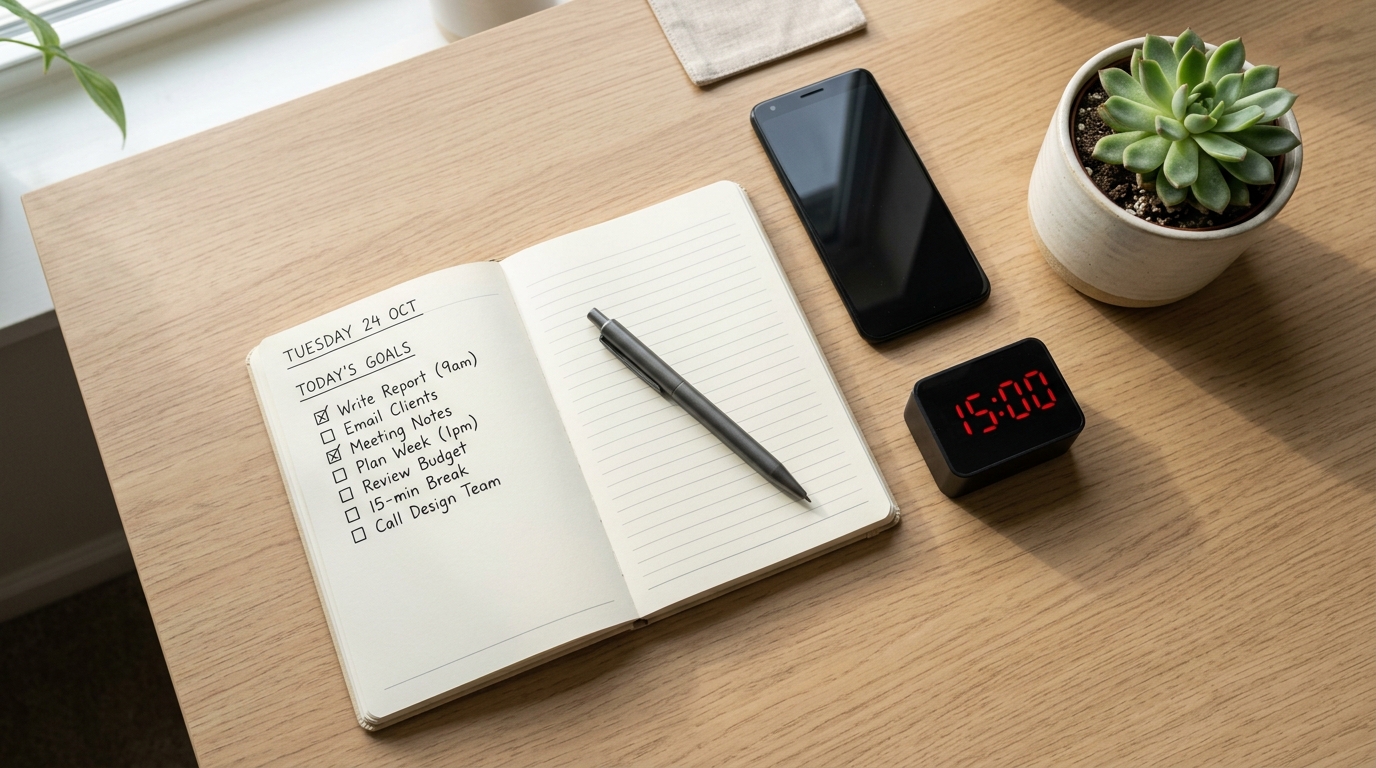
    Professional writing study priorities in planner before starting 15-minute focus block at home office desk

    The goal of the prep phase is simple: clear your mind and choose one thing to focus on for the next 10 minutes.

    Physical vs. Digital: Which One Should You Use?

    Paper planners work best if:

    • You like writing by hand to think clearly
    • You want zero screen time during study prep
    • You prefer a fixed daily or weekly layout

    Digital planners (Notion, Todoist, Google Calendar) work best if:

    • You switch between devices (phone, laptop, tablet)
    • You want to search, filter, or rearrange tasks easily
    • You’re already using digital tools for work or school

    There’s no “better” option. Choose based on how you naturally organize information, not what looks impressive on social media.

    What Should Be in Your Planner?

    Keep it minimal. You only need two sections:

    1. Today’s tasks – A short list of what needs to get done
    2. Study priority – One task you’ll tackle in your next 15-minute block

    That’s it. No elaborate color-coding, no weekly reflections, no motivational quotes. Just enough structure to answer: What am I doing in the next 15 minutes?

    If you’re using a digital tool like Notion and want to build a simple dashboard for tracking study sessions, check out our guide on 15-Minute Study Routine: How to Make Short, Focused Blocks Actually Work for a step-by-step setup.

    The 3-Minute Checklist

    Before you start the timer:

    • Clear your desk (push unrelated items aside)
    • Open your planner or app to today’s page
    • Write down or select one task for this block
    • Set your timer to 15 minutes

    This small ritual signals to your brain: “We’re starting now.”


    Step 2: Focus (10 Minutes) – What Timers Should Do

    Active study session with Pomodoro timer running on laptop screen and planner showing task checklist

    Once your timer starts, your only job is to stay with the task you chose.

    Timer Features That Actually Matter

    You don’t need a fancy Pomodoro app with analytics and achievements. You need a timer that:

    1. Counts down visibly – You should see how much time is left without opening another screen
    2. Makes a clear sound when it ends – No silent vibrations you might miss
    3. Doesn’t send notifications – The timer itself shouldn’t distract you

    Good options:

    • Phone’s built-in timer – Simple, reliable, no extra apps needed
    • Pomofocus (web-based) – Clean interface, customizable intervals
    • Be Focused (Mac/iOS) – Minimal design, tracks sessions automatically
    • Forest – If you need extra motivation to stay off your phone

    According to time blocking research, breaking study sessions into short, intentional blocks (like 15 or 25 minutes) significantly reduces decision fatigue and helps maintain consistent focus throughout the day.

    How to Protect Your Focus Block

    Turn off notifications. All of them. For 15 minutes, you won’t miss anything important.

    Close browser tabs that aren’t related to your current task. If you’re studying on paper, put your phone screen-down or in another room.

    One task only. If you think of something else you need to do, write it down in your planner and go back to your original task. Don’t switch.

    For more strategies on staying focused during short study blocks, see 15-Minute Focus Timer Routine: How to Stop Checking Your Phone While You Study.


    Step 3: Wrap-Up (2 Minutes) – What Your System Should Track

    When the timer goes off, don’t just close your books and walk away. Spend 2 minutes finishing the loop.

    What to Write Down

    Today: One sentence about what you did
    Examples:

    • “Read chapter 3, pages 45–60”
    • “Solved 10 practice problems, marked 3 for review”
    • “Watched lecture 4, took notes on main argument”

    Next time: One sentence about what comes next
    Examples:

    • “Continue from page 61”
    • “Review marked problems and redo”
    • “Summarize lecture 4 notes into 3 bullet points”

    This “done + next” habit eliminates the worst part of studying: staring at your desk tomorrow wondering where you left off.

    Why Tracking Matters (Even If You Hate It)

    You’re not tracking to judge yourself. You’re tracking to reduce friction.

    When you sit down tomorrow, you won’t waste 5 minutes scrolling through your textbook trying to remember where you were. You’ll just read your “next” note and start.

    If you want to build this into a larger weekly planning system, check out 15-Minute Planner Reset: How to Set Today’s Study Priorities Without Feeling Overwhelmed.


    Everyday Tips for Using Your Setup

    Fix One Time Slot

    Pick one time of day when you’re least likely to get interrupted. It could be:

    • Morning before work (6:30–6:45 AM)
    • Lunch break (12:15–12:30 PM)
    • Evening after dinner (9:00–9:15 PM)

    Anchor your 15-minute block to this time. Consistency matters more than perfection.

    Set a Minimum Goal, Not a Maximum

    Don’t tell yourself: “I need to study for 2 hours tonight.”

    Instead, say: “I’ll do one 15-minute block. If I feel like continuing, I can add another.”

    This mental shift makes it easier to start. And once you start, you’ll often keep going naturally.

    If you’re struggling to stay consistent, our post on 15-Minute Study Routine with Tiny Rewards: What to Do on Days You Don’t Want to Sit at Your Desk offers practical motivation strategies.

    Use the “Done + Next” Format Every Time

    Even on days when you only finish 5 minutes of actual work, write down:

    • What you did
    • What’s next

    This habit compounds. After a week, you’ll have 7 “next” notes waiting for you, which means zero decision fatigue when you sit down.


    Tools That Make This Easier

    You don’t need all of these. Pick one from each category and stick with it.

    Planners

    • Paper planner – Any daily layout with space for a task list
    • Notion – Build a simple “Today” page with checkboxes
    • Google Calendar – Create 15-minute events with task names in the title
    • Todoist – Use labels like “Next 15-min block”

    Timers

    • Phone timer – Free, always with you
    • Pomofocus – Web-based, no download needed
    • Be Focused – Clean Mac/iOS app
    • Forest – Gamified focus timer (helps if you struggle with phone distraction)

    Study Tracking

    • Notion database – Log each session with date + task + status
    • Google Sheets – Simple table: Date | Task | Done | Next
    • Bullet journal – Handwritten log in the back of your planner

    For a deeper dive into using digital tools to organize your study sessions, see 15-Minute Time Blocking: How to Turn a Scattered Day into Focused Study Blocks.


    Putting It All Together

    Choosing a planner, timer, and app isn’t about finding the “perfect” system. It’s about building a setup that supports the 3-step cycle: prep, focus, wrap-up.

    Here’s what a realistic setup looks like:

    Planner: Notion page with “Today” and “Next 15-min task”
    Timer: Phone’s built-in timer set to 15 minutes
    Tracking: One-sentence “done + next” note at the bottom of the Notion page

    That’s it. No elaborate dashboards, no color-coded categories, no weekly reviews (unless you want them).

    Start with this. If it works, keep it. If something feels clunky, adjust one piece at a time—but don’t throw out the whole system just because one tool didn’t feel perfect.

    The goal isn’t to impress anyone with your setup. It’s to sit down, focus for 15 minutes, and finish something small but meaningful.

    Ready to start? Open your planner (or create a blank Notion page), write down one task for your next 15-minute block, and set a timer. Don’t overthink it. Just pick one thing and start.


    Related Routines You Might Like


    Frequently Asked Questions

    Q1. What if I only have 5 minutes, not 15?

    A: Do a 5-minute block. The structure is the same: pick one task, set a timer, focus. Even 5 minutes of intentional work beats 30 minutes of unfocused scrolling. The key is showing up consistently, not hitting a specific number.

    Q2. Can I use this system for work tasks, not just studying?

    A: Absolutely. This works for anything that requires focus—writing reports, coding, reading research papers, organizing files, even creative work. The “prep, focus, wrap-up” cycle applies to any task you want to finish without distractions.

    Q3. Which tools do I actually need to start?

    A: You need three things: something to write your task on (paper or app), a timer (phone is fine), and a way to log what you did (one sentence in a notebook or app). Start with what you already have. Don’t buy anything new until you’ve used your current setup for at least a week.

    Q4. Do I need a fancy planner or can I just use a notebook?

    A: A plain notebook works perfectly. Write today’s date, list your tasks, circle the one you’ll do next, set a timer, and write one sentence when you’re done. Fancy planners can be motivating, but they’re not required. Use what feels natural to you.


    Learn More

    For more on focus, study habits, and time management strategies, see:

    Jotverse – Time Blocking for Students: The Ultimate Productivity System
    Practical guide to using time blocking to manage study sessions and reduce decision fatigue for students.
    https://www.jotverse.com/time-blocking-for-students-the-ultimate-productivity-system-for-academic-success/

    Schoolhouse – How to Create a Study Schedule
    Step-by-step framework for building a realistic study schedule using time-blocking and SMART goals.
    https://schoolhouse.world/blog/how-to-create-a-study-schedule

    Stanford CTL – Weekly Planning: Time Blocking Method
    Overview of the time-blocking method with examples and templates for organizing study and work sessions.
    https://ctl.stanford.edu/weekly-planning-time-blocking-method