
When You Know You Should Study but Really Don’t Want to Sit at Your Desk
You finish a long day of work or classes, glance at your desk, and feel your whole body say, “Not tonight.” You tell yourself you’ll make up for it tomorrow with a perfect three‑hour session, but tomorrow never looks as perfect as you imagined.
On these low‑motivation days, what you need is not a huge plan—it is a tiny, repeatable 15-minute study routine with a built‑in reward at the end. This guide gives you one simple structure you can use on “I really don’t want to” days so you still touch your work, protect your habit, and feel a little better about yourself instead of guilty.
I started using this 15-minute routine on evenings when my brain felt tired and stubborn, and even one small block plus a tiny reward was enough to keep my study habit alive through rough weeks.
Why Short Study Blocks and Small Rewards Work So Well
Many attention and learning resources point out that most people can focus deeply for only about 10–20 minutes at a time before their attention naturally dips, especially when they are tired or stressed. Starting with short, pre‑planned blocks often feels more realistic than demanding two hours of deep work on a night when you are already exhausted.
Research on self‑regulated learning and time management suggests that consistent routines and specific plans matter more for long‑term achievement than occasional long study marathons. Regularly showing up for short sessions, especially around the same time of day, is linked with better persistence and academic performance compared to studying only when you “feel like it.”
Habit and motivation research also emphasizes the power of small, immediate rewards: when your brain learns that “after I hold my seat for 15 minutes, something pleasant happens,” it becomes much easier to start again tomorrow. The routine below is built around that idea.
Overview: One 15-Minute Study Block with a Tiny Reward
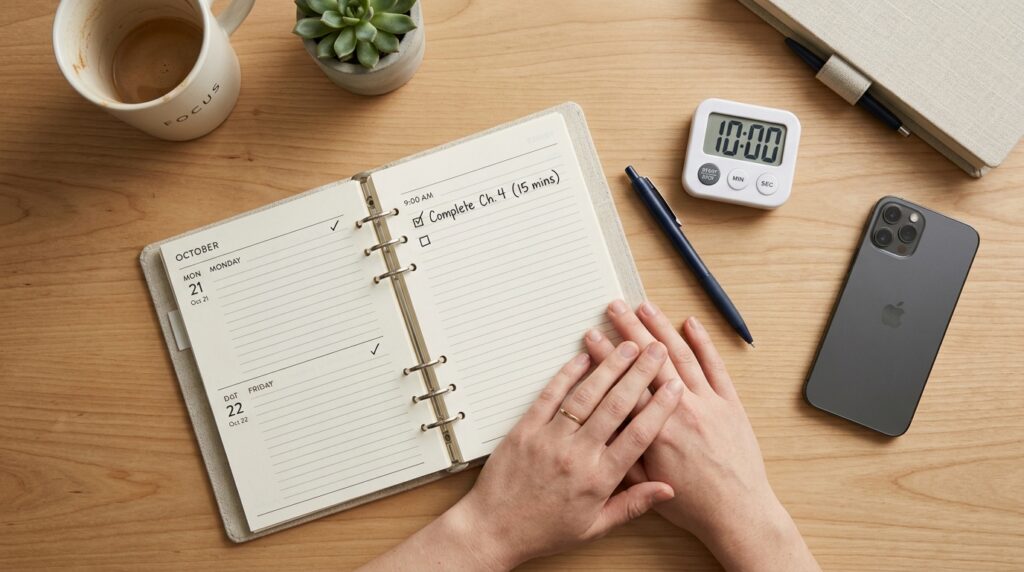
On days when you do not want to study at all, your goal is one 15‑minute block:
- 3 minutes: get to your desk and set up
- 10 minutes: focus on exactly one small task
- 2 minutes: write one line of notes and give yourself a tiny reward
You can always do more later, but the minimum success definition is:
“If I complete one 15-minute block today, I count today as a win.”
That shift—from “three perfect hours” to “one small, completed block”—reduces all‑or‑nothing thinking and makes it easier to keep your habit alive on rough days.
Step 1 – Prep (3 Minutes): Just Get to the Desk
The goal of this step is not to be productive. The goal is only to sit at your desk and make it possible to start.
1. Clear Just Enough Space (About 1 Minute)
Spend one minute doing the simplest possible tidy‑up:
- Remove anything that obviously does not belong in this study block
- Leave only today’s book or PDF, your notebook, and a pen or keyboard
You are not organizing your whole life. You are just making your desk look like it has one job for the next 15 minutes. A cleaner visual field gives your brain fewer reasons to wander and makes the block feel lighter.
If you often feel overwhelmed by digital clutter as well, you may like 15-Minute Time Blocking: How to Turn a Scattered Day into Focused Study Blocks, which shows how to plan short sessions across your calendar.
2. Write Today’s One-Line Task (About 1 Minute)
Now decide what you will do in your 10-minute block and write one short line in your planner or notes app. For example:
- “Review 20 vocabulary words.”
- “Do 2 pages of practice questions.”
- “Listen to 10 minutes of a lecture and jot key ideas.”
Make the task so small that you almost feel silly writing it down. That is the point: on low‑motivation days, you want something you are almost certain you can finish.
If you want help designing small, realistic study blocks for exam prep days, see 15-Minute Study Blocks: How to Plan a Whole Exam Day in 15-Min Chunks.
3. Set a 10-Minute Timer (About 1 Minute)
Use any timer you like:
- Phone timer with Focus/Do Not Disturb mode
- A simple study timer app
- A browser‑based timer on your laptop
Set it to 10 minutes and make a quiet deal with yourself:
“Until this timer rings, I will stay at my desk and work on only this one line.”
You are not promising to enjoy it or to do brilliant work—just to stay seated and try.
Step 2 – Focus (10 Minutes): One Task Only
Once you tap start on the timer, you enter a tiny sandbox: this is your 10 minutes of protected time.
1. Follow the One Line You Wrote
Focus on that single line and ignore everything else:
- Lecture day → listen to 10 minutes and take a few notes
- Problem‑solving day → work through 3–5 questions of the same type
- Memorization day → read and say today’s list out loud, then write it once
Close any browser tabs that are not needed for this task. Put your phone screen‑down or out of reach. If a new idea pops into your head, jot it in the margin and keep going instead of opening another app or tab.
Short, clearly defined bursts reduce decision fatigue. Your brain does not have to keep asking, “What now?” It only has to follow the small plan you already wrote.
If you find that your focus collapses even inside a 10-minute block, you might also like Can’t Focus? Try This 15-Minute Study Reset Routine for a quick reset you can run before starting again.
2. Treat This Like a Small Experiment
For these 10 minutes, you are not trying to prove you are a disciplined person. You are just running an experiment:
- “What can I actually do in 10 focused minutes?”
- “What happens to my mood if I stick with one thing until the timer rings?”
If your mind wanders, gently bring it back and remind yourself, “It’s only 10 minutes.” On many low‑energy days, finishing something small feels much better than promising yourself something huge and never starting.
Step 3 – Review and Reward (2 Minutes)
When the timer rings, you are not done yet. Use two more minutes to lock in the habit and trigger your tiny reward.
1. Write One Line About What You Actually Did
Take one minute to log the block in your planner, Notion page, or notes app:
- “May 10 – Reviewed 20 vocab words; marked 5 to review again.”
- “May 10 – Solved 2 pages of practice; 3 questions still unclear.”
This turns “I kind of studied” into a concrete record. Over days and weeks, these tiny lines become visual proof that you show up even when you do not feel like it.
If you enjoy tracking your progress, you can combine this with 15-Minute Study Routine: How to Make Short, Focused Blocks Actually Work, which explains how to chain multiple blocks across a week.

2. Leave One Line for Next Time
Now write one line for your next 10-minute block:
- “Next: review the 5 marked vocab words.”
- “Next: redo the 3 unclear questions and check solutions.”
Future you will thank you. When you sit down tomorrow, you will not have to decide what to do; you will simply follow the line you already wrote.
3. Give Yourself a Tiny Reward
This is the key to making the routine stick. After writing your two lines, choose one short, pleasant reward, such as:
- Watching 5–10 minutes of a favorite video
- Drinking a warm cup of tea while stretching or resting your eyes
- Doing a light 5‑minute stretch routine
The reward is not for getting the right answers or finishing a huge task. It is for showing up and staying for 15 minutes. Over time, your brain starts to associate “I finished my 15-minute block” with a small but reliable good feeling, which makes starting again tomorrow less painful.
Everyday Tips for Using This Routine
Use a Fixed Time Window as Your “Default 15 Minutes”
Pick one time that will be your default 15-minute slot:
- Morning: within 30 minutes after waking up
- Evening: 15 minutes before your shower
- Night: 30–60 minutes before bedtime
Studies on self‑regulated learning and time management find that students who study at regular times with clear routines tend to manage their time better and achieve more than those who study only when they feel motivated. Treat this time as non‑negotiable—the question is not if you study, only how much you do beyond the first block.
Use This as Your “Bad Day Minimum,” Not Your Maximum
On good days, you can stack 2–4 blocks and turn them into longer sessions. On bad days, you still count the day as a success if you complete one block.
This prevents zero‑days from piling up during busy or stressful periods. In the long run, a year of imperfect 15-minute blocks beats a few weeks of perfect three‑hour sessions followed by burnout.
Keep Tools Simple So You Cannot Procrastinate by “Setting Up”
To run this routine you only need:
- A place to write your one‑line task and log (paper planner, Notion, or notes app)
- A timer (phone, watch, or browser)
Optional: a simple habit tracker or calendar where you mark each day you complete at least one block. Avoid spending an hour configuring new apps; the tools are there to make starting easier, not to become the new way you procrastinate.
If you want a more structured way to combine multiple blocks into one focused hour, see 15-Minute Focus Blocks: How to Turn Four Short Sessions into One Hour of Real Work.
Related Routines You Might Like
- 15-Minute Study Routine: How to Make Short, Focused Blocks Actually Work – A deeper dive into building short study blocks and chaining multiple sessions together.
- 15-Minute Evening Study Routine for Busy Office Workers – A realistic evening routine for days when you come home tired but still want to keep learning.
- Why 15-Minute and 5-Minute Routines Feel Easier Than Pomodoro – Explains why micro‑blocks feel lighter than classic 25‑minute Pomodoro sessions.
Frequently Asked Questions
Q1. What if I only have 5 minutes, not 15?
Start with 5. On very hard days, set a 5‑minute timer, write one tiny task (“read one paragraph,” “review 5 words”), and do just that. If you feel better afterward, you can add another 5 or 10 minutes, but the goal is simply to show up.
Q2. Can I use this routine for work tasks, not just studying?
Yes. This structure works for email triage, writing reports, coding, planning tomorrow’s tasks, or reading research. Just write one clear 10‑minute work task, follow it until the timer rings, then log what you did and give yourself a small reward.
Q3. Which tools do I need to get started?
You only need three things: a timer, somewhere to write your one‑line task, and a simple way to reward yourself. A paper notebook plus your phone’s timer is enough. If you enjoy digital tools, you can use Notion or a notes app to track how many blocks you complete each week.
Q4. What if my lack of motivation feels overwhelming or constant?
If you feel persistently drained, hopeless, or unable to do even tiny tasks for weeks at a time, a 15‑minute routine alone might not be enough. Consider talking with a mental health professional or counselor—seeking support is a strength, and you can still use small routines alongside proper care.
Learn More
For more on focus, study habits, and building consistent routines, see:
- Quartz – A Stanford Researcher’s 15-Minute Study Hack
Describes how a short, structured reflection exercise can significantly improve students’ test performance, highlighting the power of brief, focused routines.
https://qz.com/978273/a-stanford-professors-15-minute-study-hack-improves-test-grades-by-a-third-of-a-grade - MoreCurricular – The Science Behind Bite-Sized Study Sessions
Explains why shorter, concentrated study sessions can be more effective than long, unfocused cramming, especially for busy students.
https://www.morecurricular.co.uk/post/the-science-behind-bite-sized-study-sessions-why-shorter-really-is-better - PMC – Self-Regulation of Time: The Importance of Time Estimation and Planning
Reviews how planning and managing study time relate to self‑regulated learning and performance.
https://pmc.ncbi.nlm.nih.gov/articles/PMC9639830/ - Sophy Dale Coaching – Build Your Habit by Building in Rewards
Discusses how small, immediate rewards can make it easier to repeat new habits and routines.
https://sophydale.com/blog/the-importance-of-rewards
Leave a Reply