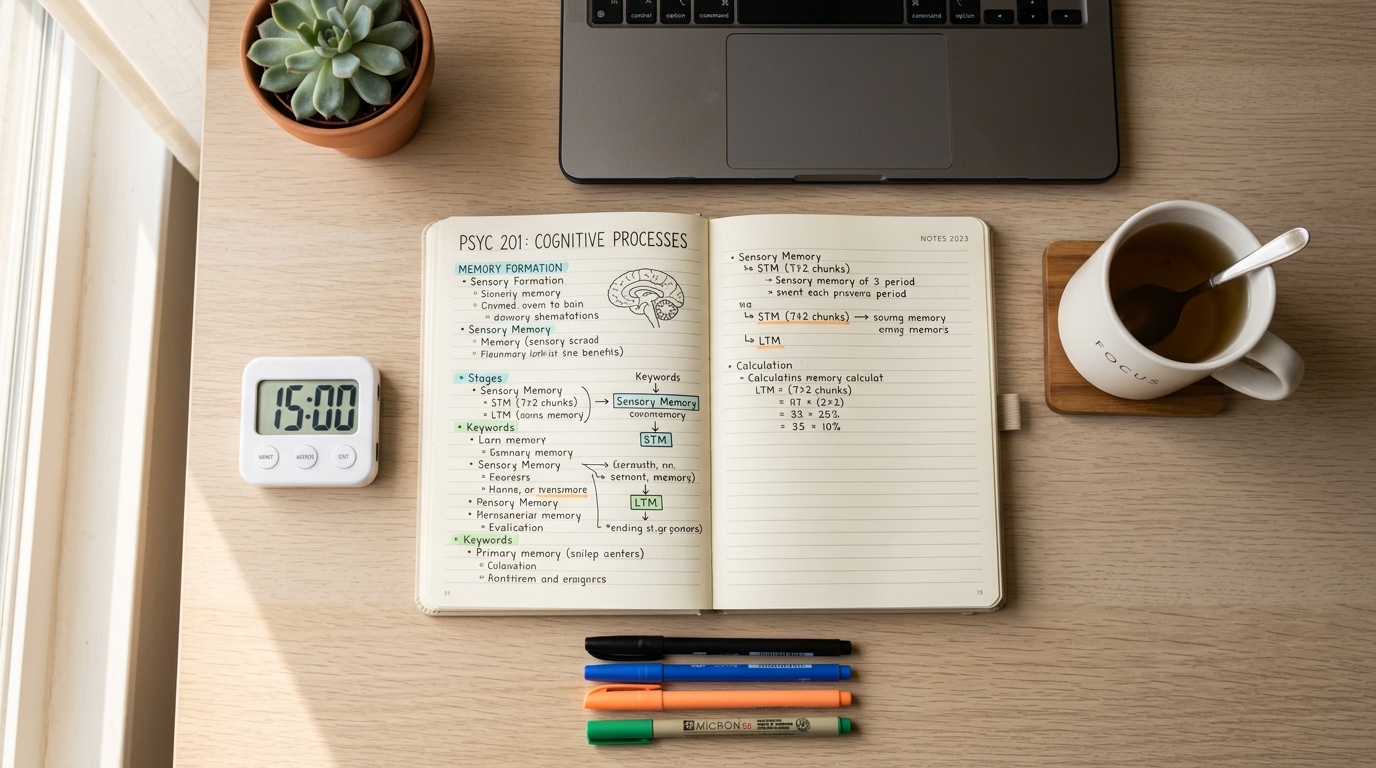
When You “Study All Day” but Don’t Remember What You Did
During exam season, it’s easy to spend hours sitting at your desk and still end the day wondering, “What did I actually get done?” You look back and realize your day was a mix of half‑focused reading, phone scrolling, and staring at the wall.
For high school seniors, repeat exam takers, and university students, the problem usually isn’t a lack of time. It’s that “study all day” is too vague. You need a plan that tells you exactly what to do in the next 10–15 minutes, not just “study for 8 hours.”
I started using 15-minute study blocks on days when my brain felt foggy and overwhelmed, and it turned my exam days from a blur into a clear list of small, finished pieces of work.
Why 15-Minute Study Blocks Work for Exams
A lot of focus and productivity advice still assumes you can sit and study deeply for long stretches at a time. In reality, our brains tend to give their best attention in short, focused bursts rather than in endless marathons.
Research on microlearning and bite‑sized study suggests that many learners focus best in blocks of around 10–20 minutes, and that short, repeated sessions often beat long cram sessions for both retention and motivation. After that window, your mind naturally starts to wander and your efficiency drops.
Self‑regulated learning research also shows that what matters is not just how many hours you sit, but how you plan, act, and review your learning. A 15-minute study block routine fits this pattern perfectly: you set a specific goal, do the work, and then leave a trace for the next block.
If you want a deeper explanation of why short routines feel easier than traditional Pomodoro, you might also like:
👉 Why 15-Minute and 5-Minute Routines Feel Easier Than Pomodoro.
Overview: One Exam Day in 15-Minute Study Blocks
Instead of planning an exam day as “8 hours of study,” we’ll break it into 15-minute study blocks, each made of:
- Prep: 3 minutes
- Focused work: 10 minutes
- Wrap‑up: 2 minutes
This might seem small, but:
- 8 blocks = 80 minutes of focused study
- 16 blocks = 160 minutes
- And you can spread these across your morning, afternoon, and evening.
You can insert short breaks between blocks (for example, 10 minutes study + 5 minutes break), and still build a lot of high‑quality study time without burning out.
Rather than starting with a perfect exam‑day schedule, set a realistic baseline:
“Even one 15-minute block today counts as success.”
If you want to understand the basic 15-minute study routine in more detail before planning your whole day, see:
👉 15-Minute Study Routine: How to Make Short, Focused Blocks Actually Work.
Step 1 – Prep (3 Minutes): Environment, One-Line Goal, Timer

Clear Your Space
In each block, start by preparing your environment.
- Keep only the textbook, notebook, and pen you need for this single block on your desk.
- Put your phone out of reach or at least on Do Not Disturb.
- Close all browser tabs except those you truly need for this short task.
The simpler your desk, the less your attention gets pulled away, and the easier it is to treat each 15-minute block as something you can start right away.
Write a One-Line Goal for This Block
Next, decide exactly what you will do in the upcoming 10 minutes and write it in one line.
Examples:
- Math: solve problems 3–5.
- English: review 2 pages of vocabulary.
- History: read pages 120–123 once.
Make it tiny and clear: subject + very small chunk of work. If you start listing multiple goals, your 10-minute block will break under the weight of your plan.
You can write these one-line goals in:
- A paper planner,
- A Notion page called “Today’s 15-Minute Study Blocks,” or
- A simple notes app.
If you’d like help building a digital place to hold all your study blocks, you can also check out our guide on Building a Notion Study Dashboard to keep your tasks and notes in one place.
Set a 10-Minute Timer
Finally, set a timer for 10 minutes:
- Use your phone’s timer in focus mode,
- A minimalist focus timer app, or
- A browser timer on your laptop.
Let the timer manage the time. Your job is just to stay with the task until the timer rings, not to keep checking the clock.
Step 2 – Focus (10 Minutes): One Block, One Task
Stick to the One Line You Wrote
The rule for your 10-minute focus block is simple:
“Do the one line I wrote. Nothing else.”
That means:
- Don’t switch to another subject because it suddenly feels more urgent.
- Don’t open other apps “just to check one thing.”
- Don’t aim for perfect understanding. Aim to move through the planned section.
Focus is not about never getting distracted; it’s about noticing distraction and coming back. During the block, if your mind wanders, tell yourself:
“I’ll just come back to this page or this problem until the timer rings.”
Short, repeatable blocks like this reduce the mental resistance to starting and make it easier to show up many times across the day.
If your focus tends to collapse partway through a session, you may also find this helpful:
👉 Can’t Focus? Try This 15-Minute Study Reset Routine.
Use Digital Tools Carefully (Optional)
Digital tools can support your focus, but they can also distract you. Use them with a clear purpose:
- Notes app or Notion – If you remember another task (“I should email the professor,” “I need to print something”), write it once and come back to it later instead of leaving your block.
- AI assistant – If you get stuck on a concept, ask for a quick explanation or example, then return to your main material. Don’t fall into a long chat.
The goal of each block is not to build the perfect system. It’s to complete one small, specific chunk of study.
Step 3 – Wrap-Up (2 Minutes): Leave a Trace for the Next Block
Write One Line About What You Did
When the timer rings, resist the urge to immediately open your phone or change tasks. Take 1 minute to write one line about what you just did.
Examples:
- “Math: solved problems 3–5 once.”
- “Vocabulary: reviewed pages 20–21.”
- “History: read pages 120–123 once.”
This turns your 10 minutes into visible progress instead of a vague memory. Over time, your planner or digital log becomes a record of your exam preparation.
Decide One Line for the Next Block
Then write one line for what you’ll do in the next block:
- “Next block: solve problems 6–8.”
- “Next block: vocabulary pages 22–23.”
This reduces the “What should I do now?” friction when you start your next 15-minute block. Future you just has to sit down and follow the next line.
Self‑regulated learning research highlights that short cycles of goal setting → doing → self‑monitoring help students take more control of their learning and improve academic outcomes. Your 3–10–2 structure is exactly that cycle in miniature.

Everyday Exam-Period Tips for Using 15-Minute Blocks
Fix One or Two Daily Time Windows
Choose specific times in your day when 15-minute blocks are non‑negotiable:
- One block before school or work
- Two blocks after 9 p.m.
- One block right after dinner
Articles on effective study habits often emphasize that studying at a consistent time and place helps your brain recognize, “This is study time now,” which makes starting easier.
Set a Minimum Exam-Period Routine in Advance
Some days your energy or mood will be low. To prepare for those days, decide in advance:
“On really hard days, one 15-minute block still counts as success.”
On better days, you can chain many blocks. But your baseline success metric is always one block. This prevents all‑or‑nothing thinking and reduces the number of days you give up entirely.
Think “Short and Often” Rather Than “Long or Nothing”
Several summaries of learning science point out that short, consistent study sessions can support understanding and exam performance more effectively than rare, very long cram sessions. When you build a habit of 15-minute blocks, you improve both your attention span and your confidence that “I can always do at least one block.”
Related Routines You Might Like
- 15-Minute Study Routine: How to Make Short, Focused Blocks Actually Work – A detailed guide to building individual 15-minute blocks you can plug into any exam day.
- 15-Minute Time Blocking: How to Turn a Scattered Day into Focused Study Blocks – How to map your whole day and place 15-minute blocks into your schedule without overload.
- 15-Minute Evening Study Routine for Busy Office Workers – If you’re working and studying, this shows how to use 15-minute blocks after work without burning out.
Frequently Asked Questions
Q1. What if I only have 5 minutes, not 15?
Use a micro‑block: 1 minute to write a one-line goal, 3 minutes to do a tiny piece of it, and 1 minute to write what you did. The key is to keep the habit of showing up, even when you can’t do a full 15-minute block.
Q2. Can I use this 15-minute block system for work tasks, not just studying?
Yes. You can use it to outline part of a report, process a few emails, review one document, or plan tomorrow’s tasks. Any work that feels overwhelming becomes more manageable when you slice it into one clear 10-minute task at a time.
Q3. Which tools do I need to get started?
You only need three things: a place to write your one-line goals, a timer, and somewhere to log what you did. A paper planner and your phone’s timer are enough. If you like digital tools, a simple Notion page or note can replace the paper.
Q4. How many 15-minute blocks should I aim for on an exam day?
Start by aiming for one or two blocks in each major part of your day (morning, afternoon, evening). Once that feels stable, you can add more. The number of blocks matters less than your ability to follow through on them consistently.
Learn More
For more on short study sessions, self‑regulation, and time‑blocked planning:
- MoreCurricular – The Science Behind Bite-Sized Study Sessions: Why Shorter Really Is Better
Explains why shorter, frequent study sessions improve focus, memory, and motivation compared with long, exhausting sessions.
https://www.morecurricular.co.uk/post/the-science-behind-bite-sized-study-sessions-why-shorter-really-is-better - YmetaConnect – Microlearning vs Marathon Study: The Surprising Winner
Overview of how microlearning supports engagement and knowledge retention by using small, focused learning units.
https://ymetaconnect.com/blogs/how-microlearning-outperforms-marathon-study-sessions - Structural Learning – Self-Regulated Learning: A Teacher’s Guide
Introduces the cycle of goal setting, performance, and reflection, and how students can use it to manage their own learning.
https://www.structural-learning.com/post/self-regulation-of-learning - Balanced Growth Tutoring – Time Blocking for Study Sessions: Step-by-Step Guide
Shows how to time‑block your calendar for study sessions and balance subjects across your week.
https://www.balancedgrowthtutoring.com/blog/time-blocking-for-study-sessions-step-by-step-guide