
Why Short, Fixed Routines Matter More Than Big Plans
You finish work, get home, and your brain feels foggy. You sit on the couch “just to check your phone,” and suddenly YouTube, social media, or news feeds have eaten your entire evening. Another day ends with the thought, “I failed my self-development again today.”
Many learners and office workers dream of new skills, certifications, better English, or reading more books—but in a busy life, finding one or two free hours every day is hard. Attention and learning resources often note that most people can sustain deep focus for about 10–20 minutes at a time, especially when they are tired or juggling multiple responsibilities, which means shorter, focused blocks can be more realistic than long marathons. Study habit and self-directed learning guides also emphasize that consistent routines at similar times each day are strongly linked with better performance and more stable study habits, even when each session is relatively short.
Instead of forcing yourself to “study three hours every day,” this routine helps you commit to something much smaller and more concrete: 15 minutes in the morning and 15 minutes in the evening—a total of 30 minutes you can actually keep.
Overview: A 30-Minute Morning and Evening Routine
This self-development routine splits your day into two short sessions:
- Morning 15 minutes – An “input and preparation” routine to open your day
- Evening 15 minutes – A “review and record” routine to close your day
Each 15-minute block follows the same simple structure:
- 3 minutes – Preparation: clear your space, set one-line goal, start your timer
- 10 minutes – Focus: do one task only
- 2 minutes – Wrap-up: record what you did and write the next step
Learning science frequently recommends distributed practice—breaking study into shorter sessions across the day—and simple review later, rather than cramming everything into one long block, because this pattern helps memory and habits stick better over time. If you want a deeper dive into how short study blocks work, you can also check our guide 15-Minute Study Routine: How to Make Short, Focused Blocks Actually Work for more examples of 15-minute study blocks.
Morning 15-Minute Routine: Open Your Day with Input and Preparation
Step 1 – Preparation (3 Minutes): Set Up Your Space and Goal
In the morning, your goal is to make it easy to start, not to create a perfect setup.
- Clear your desk or kitchen table so that only what you need remains: a notebook, a pen, and one book or tablet.
- On a sticky note or in your notebook, write a one-line goal for this morning’s 10-minute block. Examples:
- “Learn 5 new English expressions.”
- “Read 3 pages of a professional book.”
- Set your timer to 10 minutes and make a light promise: “I will focus only until this timer rings.”
You can use the same timer setup as in our 15-Minute Focus Timer Routine: How to Stop Checking Your Phone While You Study, so your morning session feels familiar instead of new every time.
Step 2 – Focus (10 Minutes): Do One Input Task Only
Think of the morning block as “input and preparation time” for your self-development.
- English: memorize 5–10 expressions or write them out by hand.
- Certification: read 2–3 pages of theory and underline key points.
- Reading: read 1–2 pages of a self-development or professional book with full attention.
The key is to choose one task and stay with it for the whole 10 minutes.
To protect your focus:
- Switch your phone to silent and place it face down, out of reach.
- If another idea or task pops into your head, jot a one-word note on a small memo and return to your main task.
- If you hit a difficult section, mark it and move forward instead of losing the whole block.
In a world full of digital distractions, many people find that their attention span shrinks, so practicing even short periods of single-task focus is a practical way to rebuild concentration.
Step 3 – Wrap-Up (2 Minutes): One-Line Record
When the timer rings, resist the urge to extend “just a little more.” End the block cleanly.
- At the top of your notebook, write “Morning 15-Minute Result:” and summarize in one line, such as:
- “Memorized 5 expressions, read 3 pages.”
- Add today’s date and keep these lines in the same notebook.
Over time, flipping through these notes builds visible proof that even on “small” days, you still did something. If you like using digital tools, you can also log these results in a simple Notion page or note app; our 15-Minute Reading and Notion Routine: How to Turn Scattered Book Notes into a Simple Reading System shows how to create a minimal Notion database for this kind of log.
Evening 15-Minute Routine: Close Your Day with Review and Planning
Step 1 – Preparation (3 Minutes): Signal “Review Mode”
In the evening, you use the same tools but shift your mental mode from input to review.
- Bring out the same notebook and pen you used in the morning.
- Clear your desk once more and set your timer for 10 minutes.
- Tell yourself, “This time is for review and recording,” to create a mental boundary between your day and your self-development routine.
Having a consistent start ritual at a similar time each day helps your brain recognize, “Now it’s time to study,” which many habit guides note as a simple way to reduce resistance and procrastination.
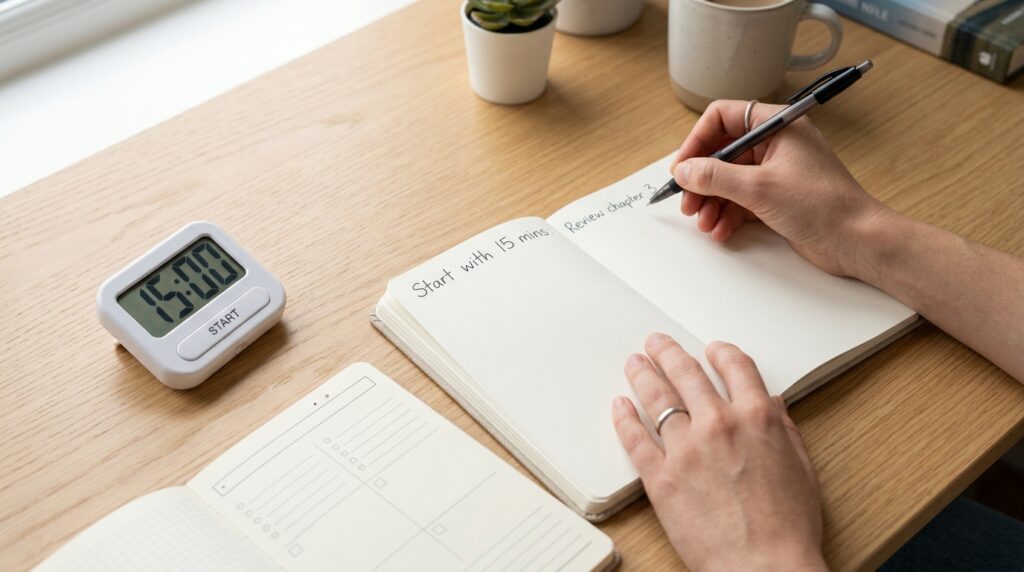
Step 2 – Focus (10 Minutes): Review Only What You Already Did
Instead of learning something new, use this 10-minute block to revisit today’s work:
- Rewrite or say aloud the 5 expressions you learned in the morning.
- Reread the most confusing parts of today’s theory notes.
- Copy one memorable sentence from today’s reading into your notebook and write a short comment.
By doing this, you turn “things you saw once” into material that starts to feel like your own. This pattern aligns with distributed practice and spaced review, which research shows help strengthen long-term memory more effectively than a single exposure.
Step 3 – Wrap-Up (2 Minutes): Write One Line for Tomorrow
Use the final 2 minutes to make tomorrow’s morning block easier.
- At the bottom of your page, write “Next 15 Minutes:” and add one simple, concrete task, such as:
- “Review expressions 6–10.”
- “Solve questions 4–6 from today’s practice.”
This one line reduces the friction of starting. Tomorrow morning, you will not waste energy thinking, “What should I do?”—you will already have the first step waiting.

Everyday Tips: How to Keep This Routine Realistic
Fix One Morning and One Evening Time
Try to anchor each 15-minute block to a specific time:
- Morning: 15 minutes after you wake up, before you fully start your day.
- Evening: 15 minutes before bed or right after dinner.
Study habit research and articles often highlight that starting at similar times each day helps your brain build a stable rhythm and improves self-directed learning more than irregular, long sessions.
Define a “Minimum Routine” for Hard Days
You will not be able to complete both morning and evening sessions every single day, and that is okay.
- On normal days: aim for both morning and evening 15-minute blocks.
- On very difficult days: allow yourself to do just one of the two.
Deciding in advance that “one 15-minute block is still success” prevents you from dropping the routine completely on rough days. The important part is not perfection, but staying connected to your self-development plan in some small way.
Related Routines You Might Like
- 15-Minute Study Routine: How to Make Short, Focused Blocks Actually Work – A deeper dive into building short study blocks and chaining multiple sessions together.
- 15-Minute Time Blocking: How to Turn a Scattered Day into Focused Study Blocks – How to plan your entire day around short focus sessions without feeling overwhelmed.
- 15-Minute Evening Study Routine for Busy Office Workers – A detailed evening-only routine that complements the morning block from this article.
Frequently Asked Questions
Q1. What if I cannot do both morning and evening 15 minutes?
A: Start with just one block per day and treat it as your minimum routine. Once that feels stable, you can add the second block on days when your schedule allows. It is better to keep one consistent habit than to keep starting and quitting a bigger plan.
Q2. Can I use this routine for work projects, not just study?
A: Absolutely. You can use the same pattern for work tasks, side projects, or creative work. Use the morning block to gather input—reading, outlining, or planning—and the evening block to review progress, tidy up notes, and decide the next step for tomorrow.
Q3. Which tools do I need to start?
A: At minimum, you only need a notebook, a pen, and a timer (a phone timer, a simple app, or a physical timer). If you enjoy digital tools, you can log your morning and evening sessions in a note app or build a simple Notion page to track what you did each day. Start simple and add tools only if they genuinely make the routine easier.
Q4. What if 15 minutes still feels too long?
A: You can shorten each block to about 5 or 10 minutes when you are just starting. For example, try a 5-minute morning input block and a 5-minute evening review block. The goal is to build the pattern of “prepare–focus–wrap-up,” even on a smaller scale, then gradually extend to full 15-minute sessions as it becomes more natural.
Learn More
For more on focus, study habits, and building consistent routines, these resources are a helpful next step:
- Jotverse – Time Blocking for Students: The Ultimate Productivity System
Practical guide to using time blocking to manage study sessions, reduce decision fatigue, and build realistic daily plans.
https://www.jotverse.com/time-blocking-for-students-the-ultimate-productivity-system-for-academic-success/ - Summit Learning Charter – 7 Benefits of Time Blocking Methods for Studying
Explains how time blocking can improve concentration, structure, and academic performance for students.
https://summitlearningcharter.org/resources/blog/benefits-of-time-blocking/ - Educational Technology and Mobile Learning – Self-Regulated Learning: What It Is, Why It Is Important and Strategies for Implementing It
Overview of self-regulated learning with strategies students can use to plan, monitor, and reflect on their study routines.
https://educationaltechnology.net/self-regulated-learning-what-it-is-why-it-is-important-and-strategies-for-implementing-it/