
Why a Weekend 15-Minute Study Routine Matters
You get to the end of the week and ask yourself, “What did I actually study?” You remember sitting at your desk, but you cannot quite recall which subjects you covered or how far you got, and planning the next week feels vague and heavy.
Research on study habits and self-regulated learning suggests that consistent, self-planned routines are more strongly linked to better grades and long-term success than occasional marathon study sessions. In other words, how regularly you show up and how clearly you structure your time often matters more than how many hours you log in one sitting.
This weekend 15-minute study routine helps you review the past week, choose your next three key targets, and block out realistic time slots—so your study plan actually fits your real life instead of staying in your head. I started using a simple weekend review like this when my study week felt chaotic, and even one 15-minute session on Sunday made the next week feel more intentional and less random.
Who This Weekend Routine Is For
This routine is designed for:
- Students and exam candidates who juggle multiple subjects and want a simple way to see the week as a whole.
- Busy office workers and knowledge workers studying after work or on weekends for certifications or self-development.
- Learners who use digital tools like Notion, AI assistants, or note apps, but still feel their study week lacks a clear structure.
If you already use short focus blocks, you might also like our 15-Minute Study Routine: How to Make Short, Focused Blocks Actually Work, which shows how to build individual 15-minute study sessions that pair well with this weekend planner.
Overview: What the Weekend 15-Minute Routine Looks Like
This routine takes about 15 minutes and is split into three simple parts:
- 5 minutes – Review the past week
- 5 minutes – Choose three key goals for next week
- 5 minutes – Turn those goals into weekly time blocks
You do not need a fancy setup to start. A weekly study planner or a simple notebook and pen is enough. Use your phone’s timer to set three 5-minute segments and commit to “just 15 minutes” as your minimum weekend planning session.
Short, recurring routines like this build the consistency that many studies associate with stronger self-directed learning skills and better academic outcomes.
Step 1 – Review the Past Week (5 Minutes)
1. Clear Your Desk and Gather What You Used
Start by clearing a small space on your desk. Bring together the textbooks, notebooks, and printouts you actually used during the week. You do not need to find every single item; just gather the main materials you remember touching.
Set a 5-minute timer. This alone gives the review a clear beginning and end and prevents you from getting lost in overthinking.
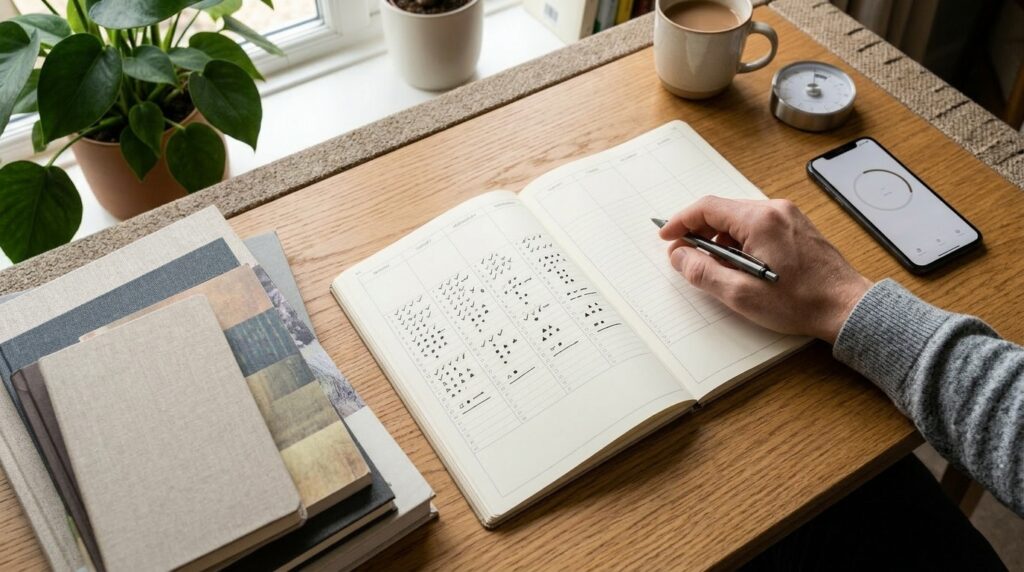
2. Write What You Actually Studied (Keywords Only)
On a blank page in your planner or notebook, quickly list what you actually did this week, using short, keyword-style notes rather than detailed logs. Examples:
- “Language arts – 2 reading sets, +1 extra practice.”
- “English – vocabulary 3 days, -1 day vs plan.”
- “Math – 10 past exam questions, progress slower than expected.”
You do not need exact page counts or minutes. The goal is to answer three questions in a glance:
- Which subjects did I touch?
- Roughly how much did I do?
- Where did I fall behind or move ahead?
Even a few lines like this give you a clearer mental map of how your week actually went, which is crucial for self-correction.
Step 2 – Choose Three Key Goals for Next Week (5 Minutes)
1. Limit Yourself to Three Core Study Targets
Now shift your focus to next week. Set another 5-minute timer and write down exactly three study goals you want to prioritize. Keeping the list short makes it far more likely you will follow through.
Examples:
- “Language arts – Complete 3 reading sets.”
- “English – Review 5 days’ worth of vocabulary.”
- “Math – Solve 15 past exam questions + review mistakes.”
Think in terms of specific tasks rather than vague wishes like “study more math.”
2. Add One Short “Why” to Each Goal
Under each goal, write a short reason—one line is enough.
- “Language arts – 3 reading sets (to keep my reading stamina and timing).”
- “English – 5 days of vocab review (to reinforce high-frequency words).”
- “Math – 15 past questions + corrections (to get used to test-level difficulty).”
Research on motivation and self-regulated learning shows that learners who connect their tasks to clear reasons are more likely to follow through, especially when they feel tired or busy.
By writing a short “why,” you build a small reminder you can read later when your energy is low.
Step 3 – Build a Weekly Time-Block Plan (5 Minutes)
1. Set Up a Simple Weekly View
For the final 5 minutes, decide when these three goals will happen.

- If you use a weekly planner, open the page where you can see Monday to Sunday at once.
- If you do not have one, draw a simple grid in your notebook with days of the week as columns or rows.
You can do this on paper, in a digital planner, or in a Notion page—choose the format you are most likely to use. If you want help building a digital weekly view, our 15-Minute Reading and Notion Routine: How to Turn Scattered Book Notes into a Simple Reading System shows how to build a simple Notion dashboard for recurring study tasks.
2. Break Each Goal into 15–30 Minute Time Blocks
Take each of your three goals and break it into small, realistic time blocks of about 15–30 minutes. Then assign those blocks to specific days.
Examples:
- “Mon/Wed/Fri evening – 1 reading set each (language arts).”
- “Every weeknight before bed – 15 minutes of vocabulary review.”
- “Saturday afternoon – 5 past exam questions + corrections.”
Time blocking (or timeboxing) like this is often recommended in productivity and study guides because it reduces decision fatigue and gives each task a clear place in your week. Instead of wondering “What should I study tonight?”, you simply follow the blocks you set on the weekend.
If you want a deeper dive into daily time-block planning, see 15-Minute Time Blocking: How to Turn a Scattered Day into Focused Study Blocks, which explains how to apply this idea to a full day.
3. Keep the Plan Light and Flexible
Avoid filling every hour of every day. Instead of trying to “maximize” your schedule, think “This time block is for this one thing.”
- Give yourself buffer space for unexpected tasks and rest.
- Treat your weekly plan as a draft you can adjust, not a strict contract.
Short, repeatable weekly planning sessions like this help you adjust your strategy over time without feeling stuck in a rigid schedule.
Tools That Make This Weekend Routine Easier
You can do this routine with just a notebook, but certain tools can make it smoother—especially if you already use digital platforms.
1. Weekly Study Planner or Notion Page
What it solves
- Keeps your whole week and all subjects visible at once.
- Reduces the chance of overloading one day and forgetting others.
Minimum setup
- On paper: Use a weekly planner or draw a simple week grid.
- Digital: Create a “Weekly Study Plan” page in Notion or your favorite note app with columns for each day.
If you want to see an example of how we combine reading, notes, and weekly planning, check our guide 15-Minute Reading and Notion Routine: How to Turn Scattered Book Notes into a Simple Reading System.
2. Simple Study Timer (Analog or App)
What it solves
- Helps you respect the 5-minute review and 15–30 minute study blocks instead of drifting.
- Makes short sessions feel more concrete and “official.”
Minimum setup
- Use your phone’s built-in timer for 5-minute and 15-minute chunks.
- Or use a visual or dial-style timer, where the remaining time is easy to see at a glance.
Our 15-Minute Focus Timer Routine: How to Stop Checking Your Phone While You Study shares practical ways to set up timers and apps so they help you focus instead of distract you.
3. Simple Grid or Sectioned Notebook
What it solves
- Makes it easier to separate subjects and weeks without everything blending together.
Minimum setup
- Use a notebook with a light grid or dotted pages, or draw simple boxes.
- Reserve one spread per week, with one page for “Review & Goals” and the other for “Time Blocks & Notes.”
You do not need a perfect system on day one. Start with the simplest setup that lets you review, choose three goals, and place them somewhere in your week.
Why Routine and Repetition Matter More Than Study Time
Many education and study habit guides emphasize that when and how you study regularly often has more impact than sheer study hours. Regular, self-planned sessions help you:
- Build a stable habit of showing up, even on busy days.
- Adjust your strategy each week based on what actually happened.
- Strengthen your identity as someone who studies consistently, not just occasionally.
Self-directed learners—those who plan, monitor, and reflect on their own study—tend to adapt better to new challenges and stay more motivated over the long term. This weekend 15-minute routine is a lightweight way to build that self-directed pattern without needing a full afternoon for planning.
Instead of aiming for the perfect weekly plan, treat this as an experiment you repeat and refine week by week.
Frequently Asked Questions
Q1. What if I cannot even spare 15 minutes on the weekend?
A: Start smaller. If 15 minutes feels unrealistic, try 10 minutes: 3 minutes to review, 3 minutes to choose goals, and 4 minutes to place a few time blocks. The key is to keep the habit of checking in once a week, even if the session is shorter, and gradually expand when your schedule allows.
Q2. Can I use this routine for work or side projects, not just studying?
A: Definitely. You can apply the same three-step structure to work tasks, side projects, or creative work. Just treat your “subjects” as project areas—for example, “report writing,” “portfolio update,” or “language practice”—and block them into your weekly plan the same way.
Q3. What tools do I need to start this weekend routine?
A: At minimum, you need a timer and a place to write: a notebook, planner, or digital page. Optional extras like a weekly time-block planner or a visual study timer can make the process smoother, but they are not required to begin.
Q4. How often should I update my weekly time-block plan?
A: Once per week is enough for most people—ideally on the same day each weekend, such as Saturday evening or Sunday afternoon. If your schedule changes midweek, you can do a quick 5-minute adjustment, but try to keep the main planning session anchored to one consistent time.
Related Routines You Might Like
- 15-Minute Study Routine: How to Make Short, Focused Blocks Actually Work – Learn how to make each 15-minute block effective and chain multiple blocks together without burning out.
- 15-Minute Time Blocking: How to Turn a Scattered Day into Focused Study Blocks – A deeper look at building a full day plan using realistic time blocks for study and work.
- 6-Hour Saturday Study Plan: How to Build a Realistic Schedule with 15-Minute Blocks – See how to scale your 15-minute blocks into a full-day weekend study plan when you need a long push.
Learn More
For more on time blocking, study habits, and self-directed learning, these resources are a helpful next step:
- Jotverse – Time Blocking for Students: The Ultimate Productivity System for Academic Success
Practical guide to using time blocking to organize study sessions, reduce decision fatigue, and keep a balanced schedule.
https://www.jotverse.com/time-blocking-for-students-the-ultimate-productivity-system-for-academic-success/ - Summit Learning Charter – 7 Benefits of Time Blocking Methods for Studying
Explains how time blocking can improve concentration, reduce procrastination, and make academic workload more manageable.
https://summitlearningcharter.org/resources/blog/benefits-of-time-blocking/ - Global Banking School – Using Technology to Enhance Your Learning and Study Routine
Offers ideas for leveraging apps and digital tools to support consistent study routines and track progress.
https://globalbanking.ac.uk/blog/using-technology-to-enhance-your-learning-and-study-routine/ - Bay Atlantic University – Innovative Study Habits for the Digital Age: Leveraging AI Tools for Education
Discusses how AI tools can help students plan, organize, and adapt their study strategies in a digital environment.
https://bau.edu/blog/leveraging-ai-tools-for-education/