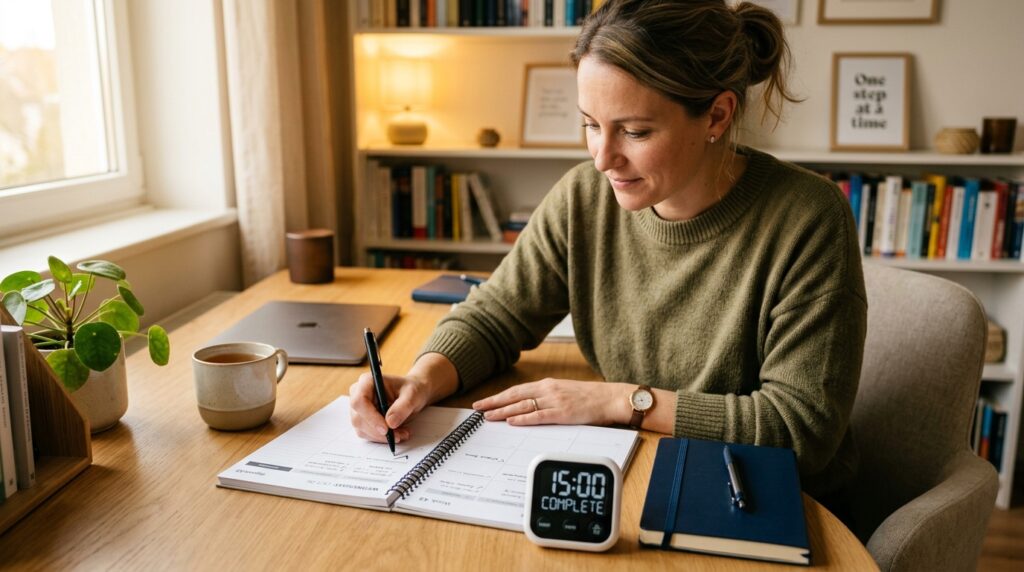
When Your Brain Is Awake but Not Logged In Yet
Some mornings you technically wake up, but your brain still feels like it is “not logged in” yet. You sit at your desk, open your laptop, and suddenly 20 minutes disappear into checking messages, scrolling, or staring at the wall.
If you are a working adult studying for exams, certifications, or a degree—or you use your mornings for self‑development projects—the way you spend your first 15 minutes can change how focused the rest of your day feels. A vague plan like “study more in the morning” is not enough; you need a small, concrete routine to switch your brain into study mode.
I started using this 15-minute morning study routine on days when my mind felt foggy, and it was just enough structure to turn sleepy mornings into one clear, finished block of study instead of a blurry warm‑up phase.
Why a 15-Minute Morning Study Routine Works
A lot of neuroscience‑inspired study advice points out that our brains tend to focus best in short, focused sessions, not in long, exhausting marathons. Many microlearning and study habit articles highlight that 5–20 minute blocks can be easier to start and repeat than hour‑long sessions, especially for busy adults.
Research summaries on microlearning describe how shorter sessions reduce cognitive overload, help you focus on one idea at a time, and are easier to fit around work and life. When you start your day with one small, focused block, you lower the barrier to entry and make “showing up” much more likely.
A 15-minute morning routine is not meant to replace all your deep work. It is an anchor that tells your brain, “We are the kind of person who studies today,” and it makes your later study blocks or evening learning sessions much easier to start. If you want a deeper dive into why short routines feel easier than classic Pomodoro, see:
👉 Why 15-Minute and 5-Minute Routines Feel Easier Than Pomodoro.
Overview: A 15-Minute Morning Study Starter
This routine is designed for:
- Exam students who also work
- Knowledge workers studying for certifications or graduate school
- Adult learners who want to protect a small slice of morning focus
The routine is simple:
- Prep: 3 minutes
- Focused study: 10 minutes
- Wrap‑up: 2 minutes
In those 15 minutes, you will:
- Clear your space just enough to reduce distractions
- Decide one tiny, specific task
- Set a timer
- Do that one task
- Capture what you did and what comes next
Even if you only run this routine once each morning, you will feel a clear difference between “a day where you never really started” and “a day where you already finished one meaningful block.”
If you want a more general guide to short study blocks before you tailor your mornings, you may also like:
👉 15-Minute Study Routine: How to Make Short, Focused Blocks Actually Work.
Step 1 – Prep (3 Minutes): Wake Up Your Space and Your Brain

Clear Your Study Space (About 1 Minute)
First, reset your physical environment.
- Put away books, papers, and random items that are not related to today’s first study task.
- Keep only today’s textbook or document, your notebook, and a pen on the desk.
- Close unrelated tabs and apps on your laptop.
Clutter is a decision magnet. The more visual and digital noise in front of you, the more your brain has to decide what to pay attention to. A simpler space makes your first 15 minutes feel lighter.
If you need help organizing your digital workspace so your notes and tasks live in one place, you can also check out our guide on Building a Notion Study Dashboard to create a simple home base for your learning.
Write One Line for Today’s First 10 Minutes (About 1 Minute)
Next, decide exactly what you will do in your first 10-minute block and write it in one line.
Examples:
- “Read vocabulary pages 3–5.”
- “Review 5 questions I got wrong yesterday.”
- “Outline the introduction paragraph for my report.”
Keep it tiny and concrete. One subject, one chunk. You can write this in:
- A paper planner
- A Notion page called “Morning 15-Min Blocks”
- A notes app like Apple Notes, Google Keep, or any simple memo app
Self-regulated learning research emphasizes that setting specific, manageable goals and tracking what you do each day helps learners take more control of their progress. Your one-line goal is a small but powerful version of that.
Set a 10-Minute Timer (About 1 Minute)
Finally, set a timer for 10 minutes:
- Use your phone’s timer in focus or Do Not Disturb mode.
- Use a minimalist focus timer app.
- Or use a simple browser‑based timer on your laptop.
Treat this 10-minute window as a small container: “From now until the alarm rings, I will just do this one thing.” Let the timer handle the time, so your brain can focus on the work instead of the clock.
Step 2 – Focus (10 Minutes): One Task Only
Remove Distractions Before You Start
Before you press “start” on the timer:
- Put your phone face down and slightly out of reach.
- Close messaging apps and any browser tabs not needed for this task.
- If you use an AI assistant, keep it open only if you need it for this specific block (for example, to clarify one concept or translate a short passage).
Microlearning guides often point out that short, focused sessions work best when you protect them from interruptions and context‑switching. Think of these 10 minutes as a mini deep‑focus window, not a time to multitask.
Stick to the One Line You Wrote
Once the timer starts, your only job is:
“Do the one line I wrote. Nothing else.”
That means:
- If you chose vocabulary, you do not switch to social media or email.
- If you chose practice problems, you do not suddenly change to reading an article.
- If you get stuck, you try a small step: reread the question, check one example, or ask an AI tool for a single clarification, then come back.
If your mind wanders, tell yourself:
“I’ll just come back to this page until the timer rings.”
One of the biggest advantages of 15-minute blocks is that they reduce the emotional resistance to starting. You know that even if you feel slow or sleepy, it is only 10 minutes of actual work.
If you notice that your focus crashes later in the day, you might also like:
👉 Can’t Focus? Try This 15-Minute Study Reset Routine – a short reset you can use when your brain feels drained.
Step 3 – Wrap-Up (2 Minutes): Capture Today and Prime Tomorrow
Write One Line About What You Did
When the timer rings, do not immediately pick up your phone or open another app. Take one minute to write down what you actually did.
Examples:
- “Read vocabulary pages 3–5, marked 12 new words.”
- “Reviewed 5 questions, 2 still unclear.”
- “Drafted introduction paragraph, needs a final edit.”
This simple log turns your 10 minutes into visible progress instead of a fuzzy memory. Over time, your notebook, Notion page, or notes app becomes a record of your effort, not just your intentions.
Articles on study skills and self‑regulated learning often highlight that students who regularly monitor what they did and what they will do next study more systematically and consistently.
Leave One Line for the Next Block
Then, write one line for what you will do next time:
- “Next: review vocabulary pages 6–8.”
- “Next: reread explanation for 2 difficult questions.”
- “Next: edit introduction and outline body paragraph 1.”
This removes the “What should I do today?” friction from your next morning. Future you just has to show up and follow the next instruction.

Everyday Tips for Keeping This 15-Minute Routine
Choose a Fixed Morning Window
Pick one clear window in your morning when this routine will live, for example:
- Within 30 minutes after waking up
- Right after breakfast
- Before you check email or messages
Guides on building study routines often suggest using a consistent cue—like a time of day or a specific action (making coffee, opening your planner)—to signal that “study time starts now.” Self‑regulated learning approaches also emphasize that routines built on structure and timing are easier to sustain than routines built on motivation alone.
Set a “Minimum Routine” for Hard Days
There will be days when you feel tired, stressed, or unmotivated. For those days, decide in advance:
“If today is really hard, one 15-minute block still counts as success.”
This removes the all‑or‑nothing pressure of “2 hours or nothing.” Research summaries and tutor guides often note that short, repeatable study cycles—like 15 or 20 minutes at a time—can improve focus and memory without overwhelming you. One small block is always better than zero.
Think “Short and Consistent” Rather Than “Long and Rare”
Microlearning articles consistently point out that several small, focused sessions across the week can lead to better retention, less stress, and more sustainable progress than rare, very long study marathons. Your morning 15-minute routine is not about doing everything; it is about building a foundation you can keep.
Once the morning routine feels solid, you can start adding more blocks later in the day or using time blocking to schedule longer sessions around work and life.
Related Routines You Might Like
- 15-Minute Study Routine: How to Make Short, Focused Blocks Actually Work – A detailed guide to building 15-minute blocks you can plug into any part of your day.
- 15-Minute Time Blocking: How to Turn a Scattered Day into Focused Study Blocks – How to map your whole day and place focused blocks for study and work without feeling overwhelmed.
- 15-Minute Evening Study Routine for Busy Office Workers – A realistic evening routine for people who come home tired but still want to move their learning forward.
Frequently Asked Questions
Q1. How many 15-minute blocks should I do in the morning?
Start with just one 15-minute block. Once that feels automatic, you can add a second block or place another block later in the day. The goal is to make “showing up” easy and repeatable, not to squeeze in as many minutes as possible right away.
Q2. What if I only have 5 minutes, not 15?
Use a micro‑block: 1 minute to clear your space, 1 minute to write one tiny goal, 3 minutes to do it, and then you are done. The key is to keep the habit of starting so that longer blocks feel more natural on better days.
Q3. Can I use this routine for work tasks, not just studying?
Yes. You can use the same 3–10–2 structure for writing reports, coding, reading research papers, preparing presentations, or even planning your day. Just write one clear work task for your 10-minute block and follow the same steps.
Q4. Which tools do I need to start this morning routine?
You only need three things: a place to write your one‑line goals, a timer, and somewhere to log what you did. A paper notebook and your phone’s timer are enough. If you like digital tools, a basic Notion page or a simple notes app is more than enough—no complex setup required.
Learn More
For more on short study sessions, self‑regulation, and building routines that stick:
- Tutor AI Solver – Why 15-Minute Study Sessions Beat Hour-Long Marathons
Explains why shorter, focused sessions align better with how our brains learn and how to apply microlearning to your study routine.
https://tutoraisolver.com/blog/microlearning-study-sessions - ShikshaNation – The 20-Minute Rule That Changed How Students Revise Forever
Introduces a 20-minute study + 5-minute break cycle and explains why this length improves focus and memory.
https://shikshanation.com/blog/20-minute-rule-revision-technique/ - Global Metacognition – A Self-Regulated Learning Approach to Study Skill Development
Describes how goal setting, planning, and reflection help students build effective, self‑regulated study routines.
https://www.globalmetacognition.com/post/a-self-regulated-learning-approach-to-study-skill-development - Snitchnotes – How to Build a Study Routine That Actually Sticks
Covers cues, anchor blocks, and consistent timing to create a study routine that lasts beyond the first burst of motivation.
https://www.snitchnotes.com/de/blog/how-to-build-a-study-routine