When Studying After Work Feels Impossible
You come home from work, sit down for a moment, and the first thought that comes to mind is: “Maybe I’ll just study tomorrow instead.” By the time you’ve made dinner, helped with family or housework, and checked a few messages, the idea of opening a book feels huge.
For many office workers in their 30s and 40s, it’s not a lack of motivation. It’s that your energy, attention, and time are fragmented. Long evening study plans—like “2 hours every night”—sound great in theory but collapse in real life. What you need is a routine that respects your limits and still moves you forward.
I started using this 15-minute evening study block on days when I could barely convince myself to sit at my desk, and it was just enough structure to keep learning without draining the little energy I had left.
Why a 15-Minute Study Routine Works for Busy Adults
A lot of productivity advice assumes you have long, uninterrupted blocks of time. Most working adults do not. Research on microlearning and study habits shows that short, focused sessions can often beat long, exhausting marathons in both retention and motivation.
Microlearning studies note that:
- Our ability to give full attention drops over time, often after 15–30 minutes.
- Short, focused sessions (5–15 minutes) create less resistance and are easier to repeat.
- Consistency—showing up regularly—is a stronger predictor of progress than occasional long sessions.
Adult learning research also points out that busy adults are more likely to use and benefit from bite‑sized learning that fits into small pockets of time in the evening or between responsibilities. A 15-minute study routine respects your current life while still building a real study habit.
15-Minute Routine Overview
In this article, we’ll build a realistic 15-minute evening study routine for office workers in their 30s and 40s who are studying after work.
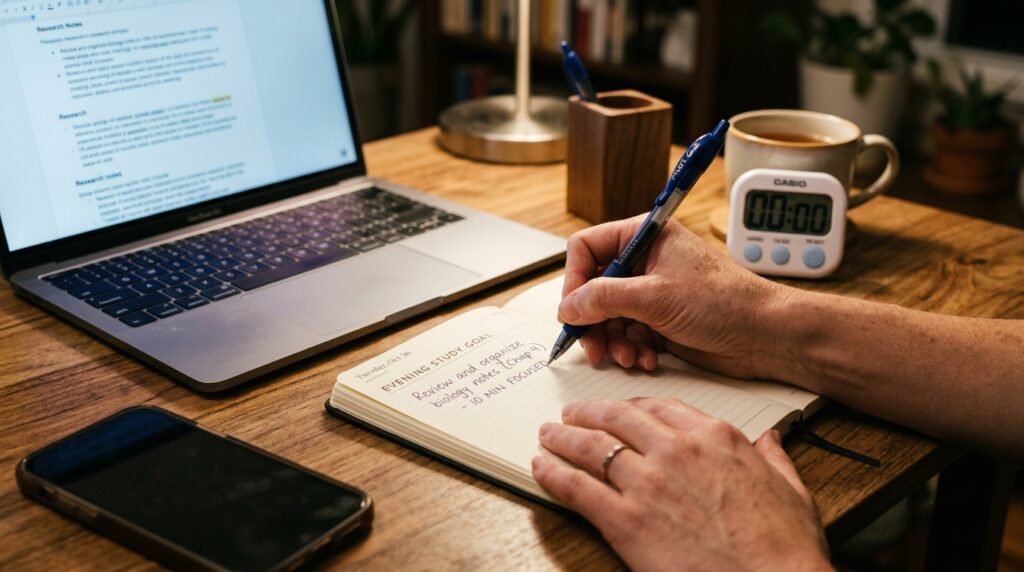
Each set is:
- Prep: 3 minutes
- Focused study: 10 minutes
- Wrap-up: 2 minutes
Prep is for clearing your space and choosing one specific mini‑goal. The 10-minute focus block is for doing only that one thing. The 2-minute wrap-up is for writing down what you did and what you’ll do next.
It looks small, but:
- 2 sets = 30 minutes of focused time
- 3 sets = 45 minutes
Rather than starting with an ambitious “2 hours every night,” we’ll set the baseline as:
“Even one 15-minute set today counts as success.”
If you want to understand why 15-minute blocks work so well for focus in general, you may also find this helpful:
👉 Why 15-Minute and 5-Minute Routines Feel Easier Than Pomodoro.
Step 1 – Prep (3 Minutes): Environment, One-Line Goal, Timer
Clear Your Space
After work, sitting at your desk is often the hardest part. Once you’re there, reduce friction:
- Put your phone face down or in another room.
- Close every browser tab that is not needed for this one study task.
- On your desk, keep only today’s book, notebook, and pen.
The aim is to make study feel less like a giant project and more like “something I can start immediately.”
If you prefer to manage everything digitally, you can keep today’s materials in a simple Notion page or note. For a deeper dive into short study blocks, see:
👉 15-Minute Study Routine: How to Make Short, Focused Blocks Actually Work.
Write a One-Line Goal
Next, write one line that describes what you will do in the upcoming 10 minutes.
Examples:
- “Scan 20 English vocabulary words.”
- “Read 4 pages of the certification textbook.”
- “Carefully read one article for my report.”
The key is to shrink the task until it feels almost too easy. If you start listing multiple goals, the 10-minute routine will collapse under its own weight.
You can write this one-line goal in:
- A paper planner,
- A simple “Today’s 15-Minute Goals” page in Notion, or
- A basic notes app.
Set a 10-Minute Timer
Finally, set a timer for 10 minutes:
- Use your phone’s timer in Do Not Disturb mode,
- A minimal focus timer app, or
- A small physical timer on your desk.
Let the timer take care of the time. Your brain does not need to keep calculating “How much longer?” and can focus entirely on the current task.
Step 2 – Focus (10 Minutes): One Thing Only
Stick to the One-Line Goal
The rule for these 10 minutes is:
“Do the one line I wrote. Nothing else.”
That means:
- Don’t switch to another textbook because it suddenly looks easier.
- Don’t open extra apps or tabs “just to check one thing.”
- Don’t aim for perfect understanding—aim to move through the planned section.
For someone who has already worked all day, perfect comprehension is less important than the feeling that “I still moved forward today.”
Microlearning research highlights that short, focused sessions reduce mental resistance and encourage daily consistency, which is critical for busy adults.
If your mind drifts:
- Gently bring your eyes back to the page or problem and tell yourself,“I’ll just stay with this line / this problem until the timer rings.”
Think of focus not as “never getting distracted” but as “noticing distraction and coming back.”

Use Digital Tools Lightly (Optional)
You can use digital tools to support your focus, but keep them simple:
- Notes app or Notion – Jot down ideas or tasks that pop into your mind so you don’t leave the study task to chase them.
- AI assistant – If you get stuck on a concept, ask for a quick explanation, then go back to your main material instead of falling into a long chat.
If you want to rebuild focus on days when your brain feels scattered, you might also like:
👉 Can’t Focus? Try This 15-Minute Study Reset Routine.
Step 3 – Wrap-Up (2 Minutes): Leave a Trail
Write One Line About What You Did
When the timer goes off, don’t immediately close everything and walk away. Use 2 minutes to leave a small trace.
Write one short sentence about what you did:
- “Reviewed 20 vocabulary words.”
- “Read pages 4–7 once.”
- “Read 1 article and highlighted key points.”
That is all you need for your 10 minutes to become visible progress instead of a vague memory.
You can log this in:
- A paper notebook,
- A simple “15-Min Study Log” in Notion,
- A daily note in your memo app.
Self‑regulated learning research shows that short cycles of planning, doing, and reflecting help learners take more ownership of their progress.
Decide One Line for Next Time
Then write one line for what you will do in the next set:
- “Next: read pages 8–11.”
- “Next: start article 2.”
This tiny cue lets “tomorrow you” sit down and start without spending energy on “What should I do now?”
Short, repeatable routines that include a goal, performance, and reflection are a practical way for busy adults to build self‑regulated learning habits.
Everyday Tips for Making This Routine Work in Your 40s
Fix One Time Window
Choose a time slot and treat it as your minimum:
- “Every night at 10:00 p.m., I do at least one 15-minute set.”
- “After my kids go to bed at 10:30 p.m., I do one set.”
Learning experts often emphasize that studying at a consistent time helps your brain recognize, “This is study time now,” which makes starting easier over time.
Set a Minimum Routine in Advance
Decide ahead of time:
“On really tired days, one 15-minute set is enough.”
On good days, you can do 2–3 sets. But your baseline success is always one set. This prevents all‑or‑nothing thinking (“two hours or nothing”) and makes it much easier to keep going for months.
Remember: Your Plan Might Be Too Heavy, Not Your Willpower Too Weak
When a 2-hour evening plan fails, it’s easy to blame your willpower. In reality, the plan often doesn’t match your current life as a working adult.
A 15-minute study routine acknowledges that you have limited energy after work, but still gives you a way to show up and move forward. When repeated at the same time every day, even this small unit can slowly change how familiar and natural it feels to sit at your desk.
Related Routines You Might Like
- 15-Minute Study Routine: How to Make Short, Focused Blocks Actually Work – A deeper dive into building short study blocks and chaining multiple sessions together.
- 15-Minute Time Blocking: How to Turn a Scattered Day into Focused Study Blocks – How to plan your day so your 15-minute sets fit naturally into your schedule.
- Can’t Focus? Try This 15-Minute Study Reset Routine – A gentle reset for days when your mind is too scattered to start working.
Frequently Asked Questions
Q1. What if I only have 5 minutes, not 15?
Use a micro‑version: 1 minute to clear your space, 3 minutes to do one tiny action, and 1 minute to write what you did. The goal is to stay connected to your study, not to hit a perfect number every day.
Q2. Can I use this routine for work tasks, not just studying?
Yes. You can use a 15-minute set to draft part of a report, read one research article, plan tomorrow’s priorities, or document code. Any task that benefits from focused progress fits this structure.
Q3. Which tools do I need to start?
You only need three things: a place to write a one-line goal, a timer, and somewhere to log what you did. A paper notebook plus your phone’s timer is enough. If you like digital tools, a simple Notion page or notes app can replace the notebook.
Q4. How many 15-minute sets should I aim for each day?
Start with one set as your non‑negotiable. Once that feels stable, add a second or third set on days when you have extra energy. Long-term consistency matters more than hitting a high number on any single day.
Learn More
For more on short study sessions, adult learning, and self‑regulated routines:
- Tutor AI Solver – Why 15-Minute Study Sessions Beat Hour-Long Marathons
Explains how microlearning and short study sessions improve focus, retention, and motivation compared to long, exhausting study blocks.
https://tutoraisolver.com/blog/the-rise-of-microlearning-why-15-minute-study-sessions-beat-hour-long-marathons - Taylor & Francis – Turning Coffee Time into Teaching Moments Through Bite-Sized Learning for Adult Learners
Research on how busy adult learners effectively use bite‑sized learning activities during small pockets of time in their schedules.
https://www.tandfonline.com/doi/full/10.1080/07377363.2021.2024000 - Structural Learning – Self-Regulated Learning: A Teacher’s Guide
Overview of self‑regulated learning, including the cycle of setting goals, performing tasks, and reflecting, and how short routines can build learner autonomy.
https://www.structural-learning.com/post/self-regulation-of-learning - Cambridge ELT – Little and Often: Bite-Sized Learning in ELT
Discusses how short, focused learning activities fit modern lifestyles and help learners who can’t commit to long study periods.
https://www.cambridge.org/elt/blog/2018/04/26/bite-sized-learning/