
When Your Commute Eats Your Study Time
This guide is especially for English learners and busy knowledge workers who want to turn dead commute time into a simple 15-minute focus routine.
If you work full-time or juggle classes with a job, you probably know this feeling: by the time you get home, your brain is fried and the last thing you want to do is open an English textbook. You tell yourself you will study “after dinner,” but somehow the evening disappears into chores, messages, and scrolling.
At the same time, your commute quietly takes up one to two hours every day. You sit on the bus or train, or drive the same route, again and again. That time feels “blocked” by default, but it is actually one of the most reliable, repeatable slots in your entire day. A simple 15‑minute commute English routine can turn that fixed block into steady listening and speaking practice without adding extra pressure to your evenings.
I started using this 15-minute commute routine on days when I was too tired to sit at my desk, and it helped me finally feel like I was moving forward in English again—even on my busiest weeks.
Why a 15-Minute Commute Routine Works
Many learning and habit experts point out that short, consistent study sessions done at the same time and in the same context—like your daily commute—are easier to maintain and more effective for long-term learning than occasional long sessions. A 15‑minute block is small enough that you can still relax during your commute, but big enough to create real exposure if you repeat it nearly every day.
If you use 15 minutes of your commute for English, five days a week, that becomes more than 75 minutes per week. Over a month, that is about 7.5 hours. Over a year, you quietly accumulate around 90 hours of listening and speaking practice, without needing extra desk time on top of your work or classes.
This routine is designed to be:
- Simple enough to run even when you are tired
- Flexible enough to adapt to different commute types (bus, train, rideshare, walking)
- Easy to track with basic digital tools such as a timer, notes app, or Notion page
Commute English Routine at a Glance
This 15-minute routine splits your commute into two parts:
- Morning (5 minutes) – focused listening
- Evening (10 minutes) – shadowing and speaking practice with the same content
You listen once in the morning to get familiar with the topic and expressions, then repeat and speak along in the evening to lock in what you heard. Because you work with the same episode twice in one day, your brain has a better chance of moving key phrases from short-term memory toward long-term memory.
Step 1 – Set Up Your Tools and Playlist (Once Per Week)
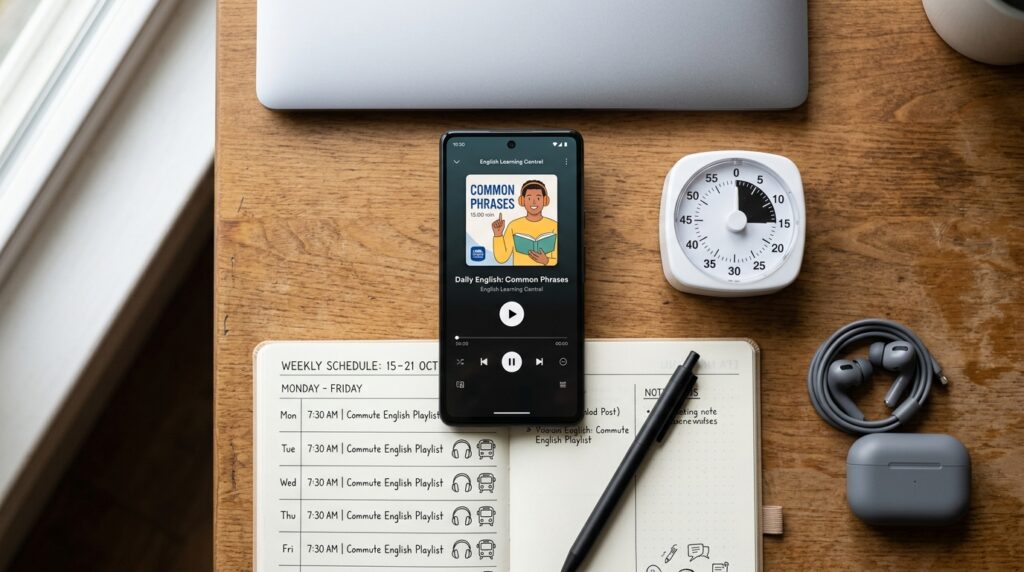
1. Choose Your Listening Sources
Pick a small set of English listening sources that match your level and interests. The goal is not to hunt for “perfect” content every morning but to have a ready-made list you can press play on.
You might use, for example:
- Short news or learning podcasts (3–10 minutes per episode)
- Simplified news shows
- Short TED-style talks or educational videos you can listen to without watching the screen
At the start, aim for episodes around 3–6 minutes so that you can comfortably listen and still repeat them later in the day.
If you want ideas for how to structure short focus blocks around specific content, you can also read 15-Minute Study Routine: How to Make Short, Focused Blocks Actually Work.
2. Build a Weekly Commute Playlist
To avoid wasting willpower on choosing content, set up a weekly playlist in your podcast app, music app, or YouTube “Watch Later”:
- On the weekend or one evening, collect 5 short episodes you want to use next week.
- Put them in order (Monday to Friday) and label them clearly, such as “Commute English – Week 1”.
- If you use a note-taking tool like Notion, you can create a simple “Commute English” database with fields for date, episode title, and key phrases.
Even a very simple table—Date, Morning Episode, Key Phrases—is enough. If you already use Notion for your study planning, this can sit next to your other routines. For more structure, you might connect this to a broader dashboard like the one in 15-Minute Study Routine with Tiny Rewards: What to Do on Days You Don’t Want to Sit at Your Desk.
3. Prepare a Minimal Note-Taking Setup
You do not need a full notebook. For this routine, a minimal note setup is enough:
- One notes app on your phone (Apple Notes, Google Keep, Notion, or any memo app)
- One simple template, for example:
- Date
- Episode title
- 2–3 key phrases you want to remember
Keep this template pinned or favorited so you can open it quickly. The entire goal is to reduce friction: tap once, type a phrase, done.
Step 2 – Morning Commute (5 Minutes): Listening Focus
1. Press Play on Today’s Episode (30 Seconds)
As soon as your commute starts and you are settled (on the bus, subway, or as a passenger in a car), put in your earphones and open your commute playlist:
- Choose the first episode in this week’s list.
- If you can, set your app to download episodes in advance so you do not have to worry about unstable network connections.
2. Listen Once Without Subtitles (4 Minutes)
Listen to the episode one time without subtitles or transcripts. Do not worry about understanding every word.
While listening, focus on:
- The overall topic and main point
- 1–2 expressions or sentences that catch your ear
If you feel lost, it is okay to reduce playback speed slightly or choose simpler content next time. The goal in the morning is exposure, not perfection or deep analysis.
If you are seated and it is safe to use your phone, you can quickly jot down 1–2 phrases in your memo app. If you are standing on a crowded train and cannot type comfortably, just remember one phrase and write it later.
3. Mark It for Evening Review (30 Seconds)
When the episode ends, do one small action to mark it for evening review:
- Add a simple tag like “To Shadow” or “Evening” in your app
- Or, in your notes, write one quick line such as “Evening: Shadow this episode again”
This tiny step helps your brain treat the morning listening as “part 1” and your evening commute as “part 2,” which supports spaced repetition across your day.
Step 3 – Evening Commute (10 Minutes): Speaking and Shadowing Focus
1. Replay the Same Episode (1 Minute)
On your way home, replay the same episode you listened to in the morning.
On the second listen, you will usually notice:
- The topic feels more familiar
- You catch more details and recognize repeated phrases
- Your brain spends less energy decoding and more energy noticing patterns
This “repeat within the same day” pattern is a practical way to add light spaced repetition, which helps move new expressions closer to long-term memory.

2. Shadowing Practice (7 Minutes)
As the episode plays:
- Wait half a second to one second after each phrase.
- Then repeat out loud (if possible) or silently move your mouth if you are shy in public.
- Do not pause the audio for every phrase; let it flow, and try to keep up with the rhythm.
Choose 2–3 key phrases that feel useful, and repeat them more deliberately:
- Shadow them 5–10 times during the episode.
- Pay attention to stress, rhythm, and intonation more than perfect grammar analysis.
Shadowing is effective because it combines listening and speaking at the same time, training your ear and mouth together instead of separately. Many learners find that after a few weeks of shadowing, they can recognize and produce common phrases more smoothly, even if their grammar is not perfect yet.
If you are driving and cannot safely speak out loud, you can:
- Focus on listening and “shadow in your head”
- Then do a quick 1–2 minute out-loud repetition once you arrive and park
3. Quick Review Note (2 Minutes)
Before your commute ends (or as soon as you arrive and step off the vehicle):
- Open your memo app or Notion page.
- Write today’s date, the episode title, and 2–3 key expressions you want to keep.
- Optionally, add a short native-language translation or small example sentence to remind yourself later.
Example:
- 2026‑05‑03 – “Climate Change and Our Future”
- “It’s crucial to…” – used to emphasize importance
- “In the long run” – talking about long-term effects
At the end of the week, you can skim all your commute notes once. That single pass acts as an extra, low-effort review session.
If you already track your study blocks in a system, you can also record this as a small block in your log. For instance, many readers like to combine this with the ideas in 15-Minute Focus Timer Routine: How to Stop Checking Your Phone While You Study to keep phone distractions under control during their commute blocks as well.
Step 4 – Everyday Tips to Keep the Routine Going
1. Fix the Time and Place
Habits stick more easily when they are tied to a specific context: “When X happens, I do Y.”
For example:
- “When I sit down on the bus in the morning, I immediately press play on my commute English playlist.”
- “When I get on the subway to go home, I replay today’s episode and shadow for 10 minutes.”
By linking your routine to the start of your commute, you avoid the need to “decide” every day whether to study or not. It simply becomes part of your commute identity.
2. Use Playback Speed Wisely
At first, the original speed might feel too fast. In that case:
- Start at 0.75x speed to let your ears adjust.
- Move to 1.0x once it feels comfortable.
- Eventually, you can try 1.25x for extra challenge without adding more time.
The goal is not to rush, but to find a speed where you can still shadow and catch patterns without feeling overwhelmed.
3. Plan Content Once, Enjoy All Week
Decision fatigue is real. If you have to choose episodes every morning, you will eventually skip days because you are tired.
Instead:
- Choose and queue five episodes once per week (for example, on Sunday night).
- Treat that planning as a separate mini-routine.
That way, your weekday routine becomes almost automatic: commute starts → earphones in → press play.
Step 5 – Simple Digital Tools That Make This Routine Easier
Notion or Notes App – Commute English Log
If you like digital organization, a basic “Commute English Log” can be very helpful:
- Create a table with columns: Date, Morning Episode, Key Phrases, Notes.
- Each day, add a row with your quick notes from Step 3.
This does not have to be perfect. Even one line per day is enough to see your progress and remind yourself that your commute blocks are adding up.
If you want a more complete study dashboard to manage multiple routines (15-minute blocks, exam prep, etc.), you might like the structure in 6-Hour Saturday Study Plan: How to Build a Realistic Schedule with 15-Minute Blocks.
Timer / Reminder Apps – Protect the 15 Minutes
Because commutes are full of distractions, you may want:
- A gentle reminder alarm set for the time you usually get on the bus or train.
- A 5‑minute and 10‑minute timer to help you stay within your planned block.
You can use any timer app, or even the default clock app on your phone. If you have a focus timer you already like from your desk study (such as a 15‑minute focus timer), simply reuse the same pattern here to keep your routine familiar.
Headphones and Offline Downloads – Reduce Friction
To prevent technical issues from breaking your habit:
- Use comfortable, easy-to-reach earphones.
- Turn on offline download for your commute playlist whenever possible.
The fewer steps between you and “press play,” the more likely you are to stick with the routine on busy or tired days.
Related Routines You Might Like
- 15-Minute Study Routine: How to Make Short, Focused Blocks Actually Work – A deeper dive into building short study blocks and chaining multiple sessions together.
- 15-Minute Focus Timer Routine: How to Stop Checking Your Phone While You Study – How to use a simple timer setup to keep your phone from stealing your focus.
- 15-Minute Time Blocking: How to Turn a Scattered Day into Focused Study Blocks – A practical guide to planning your whole day around short, focused sessions.
Frequently Asked Questions
Q1. What if I only have 5 minutes, not 15?
If your commute is very short, start with just 5 minutes of listening once a day. The priority is consistency, not hitting a perfect 15‑minute target. Over time, you can add a second small block in another part of your day, like a lunch walk or evening dishwashing, using the same “listen then repeat” structure.
Q2. Can I use this routine for work tasks, not just English?
Yes. The same structure—short morning exposure and a slightly longer evening review—works for many knowledge tasks. For example, you can listen to work-related podcasts, industry news, or training videos in audio form in the morning, then summarize or speak key points out loud in the evening to improve your understanding and retention.
Q3. Which tools do I need to get started?
You only need three things: a phone, a pair of earphones, and one simple place to write down 2–3 key phrases each day (any notes app is fine). Extra tools like Notion dashboards, spaced repetition apps, or advanced timers can help later, but your first goal is to complete a few weeks of basic commute blocks with a very light setup.
Q4. Is it okay if I do this only on some days, not every day?
Yes. Life happens, and some days will be too crowded or stressful. Aim for a realistic goal such as “3–5 days per week.” Missing a day does not break the system; just restart the next time you are on your commute. The real progress comes from returning to the routine regularly, not from being perfect.
Learn More
For more on focus, study habits, and building consistent micro-routines, see:
- Jotverse – Time Blocking for Students: The Ultimate Productivity System for Academic Success
Practical guide to using time blocking to manage study sessions, reduce decision fatigue, and make small blocks like 15 minutes more effective.
https://www.jotverse.com/time-blocking-for-students-the-ultimate-productivity-system-for-academic-success/ - Summit Learning Charter – 7 Benefits of Time Blocking Methods for Studying
Explains how time blocking and planned study slots can improve concentration, reduce procrastination, and support better academic performance.
https://summitlearningcharter.org/resources/blog/benefits-of-time-blocking/ - Frontiers in Psychology – Multiple Exposures Enhance Both Item Memory and Contextual Memory Over Time
Research article showing how repeated exposure to the same material can strengthen both the memory of items and their context, supporting the idea of revisiting the same content across multiple short sessions.
https://www.frontiersin.org/journals/psychology/articles/10.3389/fpsyg.2020.565169/full
Leave a Reply