When You Need an Emergency Study Plan
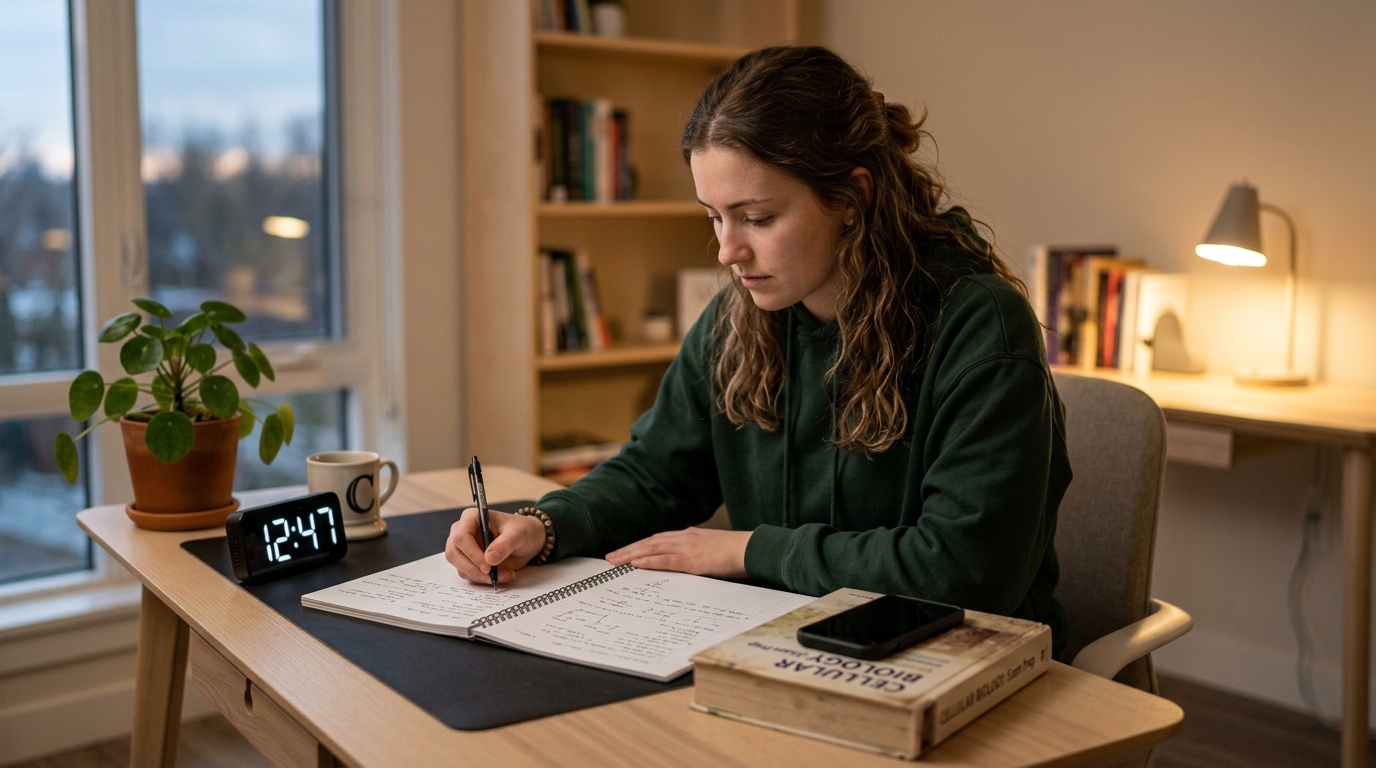
As exams get closer, your focus often starts to feel like a roller coaster. You sit at your desk, turn the pages of your book, but your mind is full of thoughts like “What if I fail?” and “I am already behind.”
On those days, it is easy to declare the whole day a “failure” and give up. Instead, having a small, 15-minute emergency study routine you can pull out—no matter how messy your day has been—gives you a way to do something small but complete. I started using a simple 15-minute emergency block on days when my brain felt scrambled, and it was just enough structure to keep me from throwing the entire day away.
Why a 15-Minute Emergency Study Routine Works
Many attention and learning guides suggest that most people can hold deep focus for about 10–20 minutes at a time before their concentration naturally drops, especially when they are stressed or anxious. Short, focused blocks fit better with how our brains actually work than trying to force two or three hours of nonstop effort.
Study habit and self-directed learning resources also emphasize that short, consistent sessions—especially at similar times each day—are often more effective than irregular long sessions for building stable habits and better performance. Small “wins,” like completing a single 10-minute block, help protect your sense of self-efficacy so you do not completely give up on hard days.
This 15-minute emergency routine is designed to be that small win: a quick reset when your mind spirals, so you can say, “Today was tough, but I still showed up once.”
Overview of the 15-Minute Emergency Study Routine
This routine has three simple parts:
- 3 minutes – Prepare your environment and your mind
- 10 minutes – Deep focus on one specific task
- 2 minutes – Quick wrap-up and next-step note
It is not meant to replace your full study schedule. Instead, it is your minimum routine for days when you feel like everything is falling apart. The goal is to avoid “all or nothing” thinking by keeping one small block you can still complete.
Step 1 – 3-Minute Prep: Switch into Study Mode
The goal of this step is not to create a perfect setup, but to tell your brain, “For the next 15 minutes, we are in study mode.”
1. Clear Your Desk for One Subject (About 1 Minute)
- Remove extra books, notebooks, and devices from your immediate workspace.
- Leave only what you need for the next 10 minutes: one textbook or problem set, one notebook, one pen.
The simpler your visual field, the clearer it is for your brain what to focus on.
2. Write One-Line Goal for This 15 Minutes (About 1 Minute)
On a sticky note, in your notebook, or in a note app, write one short, specific goal for this emergency block, such as:
- “Today’s 15-minute goal: memorize 20 English vocabulary words.”
- “Today’s 15-minute goal: solve 3 past exam math questions.”
- “Today’s 15-minute goal: read 1 reading passage and answer the questions.”
Avoid vague phrases like “study English” or “do math.” Instead, define a small, countable task that can realistically be completed in 10 minutes.
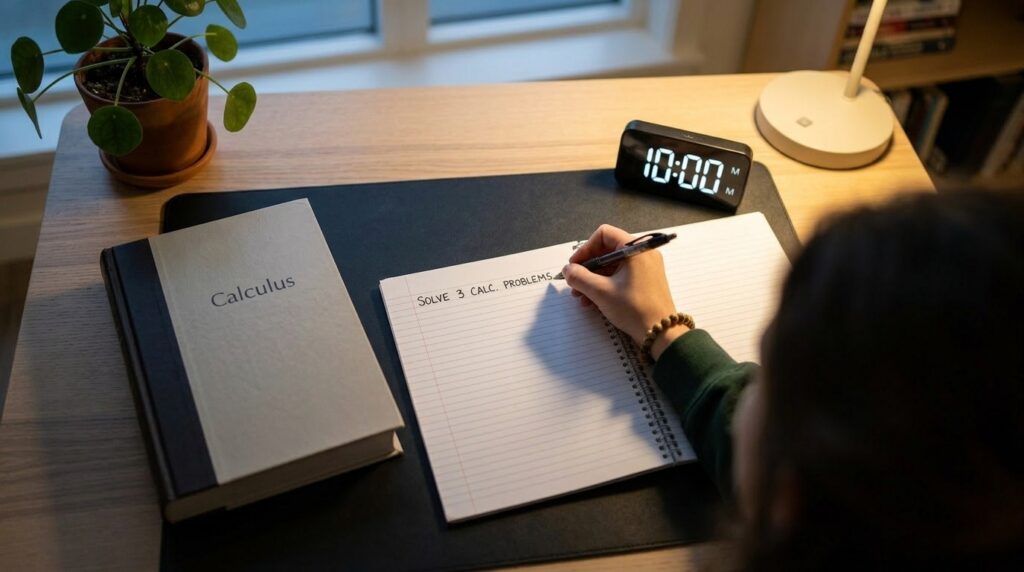
3. Set a 10-Minute Timer (About 1 Minute)
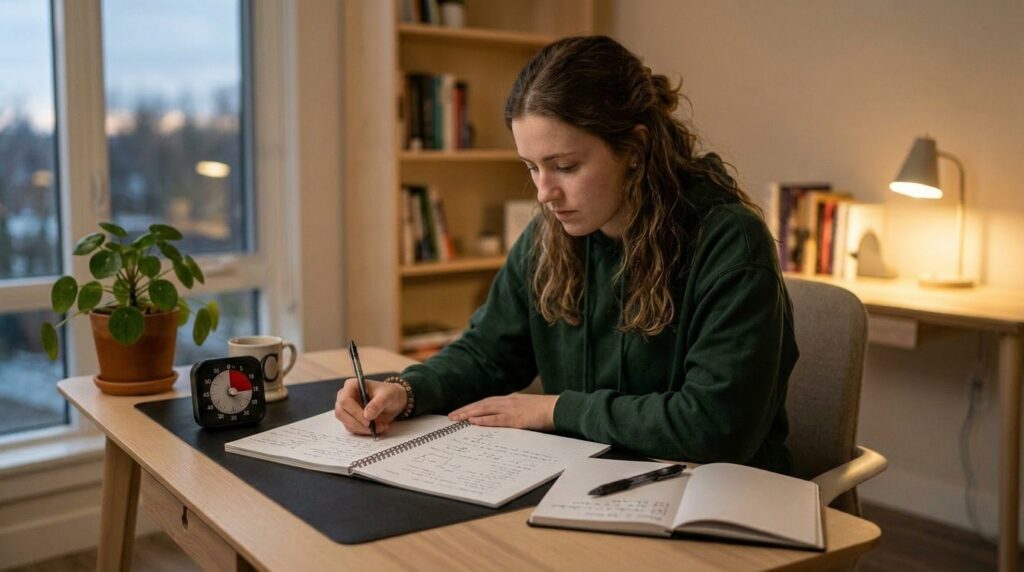
Use any simple timer: your phone’s built-in timer, a timer app, a visual timer, or a physical stopwatch.
- Set it to 10 minutes.
- Make a light promise to yourself: “For these 10 minutes, I will not do anything else.”
You can use the same timer setup you use in your 15-Minute Focus Timer Routine: How to Stop Checking Your Phone While You Study, so the emergency block feels familiar instead of new.
Step 2 – 10-Minute Deep Focus: Do One Thing Only
In this step, you commit to a single task and follow it through for the full 10 minutes. When your mental state is shaky, trying to juggle multiple tasks (“I have to catch up on everything”) only makes things worse.
1. Choose One Task and Stay with It
Pick one of the following types of tasks:
- Memorize today’s vocabulary list or a small set of key terms.
- Solve three past exam questions and check only the answers (not full explanations).
- Read one passage (for language arts or reading) and complete the associated questions.
The point is not to master everything in 10 minutes, but to fully complete the small chunk you chose. You can switch subjects in your next block, but not during this one.
2. Minimize Distractions for Just 10 Minutes
Practical rules for the 10-minute block:
- Set your phone to silent and place it face down, out of your immediate reach.
- Turn off messenger and app notifications for the next 10 minutes.
- If you get stuck on a problem, mark it and move to the next one instead of losing the entire block.
Ten minutes can feel surprisingly long when you are anxious, but the timer gives you a clear end point. Treat this as a short training session in holding focus under pressure.
3. Let “Good Enough” Be Enough for This Block
In an emergency routine, the goal is not perfection. It is completion.
- If you cannot understand every detail of a question, still finish the planned number of items.
- If you make mistakes, that is fine; the review can happen later.
Each successful 10-minute block becomes evidence that “Even when my mind is shaking, I can still do one small, focused thing.” That identity shift is more important than squeezing in a few extra minutes today.
Step 3 – 2-Minute Wrap-Up: Turn “I Tried” into “I Completed”
Do not grab your phone the second the timer rings. Give yourself 2 more minutes to close the loop. This step turns a random 10-minute effort into a complete unit you can track and repeat.
1. Write One Line about What You Did (About 1 Minute)
Right under your one-line goal, add one line for your result:
- “Today 15-minute result: memorized 20 words, completed up to question 3.”
- “Today 15-minute result: solved 3 math questions, Q2 still confusing.”
You can keep a small “Emergency Routine Log” at the front of your notebook or in a simple app, with one line per day. Over time, you will see a visible track record of, “On tough days, I still showed up.”
2. Write One Line for the Next Step (About 1 Minute)
Add one more line for what you will do in your next 15-minute block, for example:
- “Next 15 minutes: review words 21–40.”
- “Next 15 minutes: solve questions 4–6.”
This single line reduces the friction of restarting. Next time you sit down, you will not waste energy thinking, “What should I do?”—you will already know where to begin.
Everyday Tips: How to Use This Routine in Real Life
1. Treat This as Your “Minimum Routine” for Hard Days
This emergency study routine is not your full plan. It is your floor, not your ceiling.
- On normal days, you can study longer and do multiple blocks.
- On really bad days, this is the one small set you commit to finishing.
Having a clearly defined minimum routine reduces the number of days where you do nothing at all.
2. Fix One Time of Day for This Routine
If possible, anchor this 15-minute emergency plan to a consistent time:
- Right after waking up.
- Right before bed.
- Right after a specific event, like finishing dinner.
Starting at a similar time each day helps your brain automatically shift into “study mode” at that time. Many study habit guides highlight this kind of fixed start time as a simple way to stabilize your rhythm and reduce procrastination.
3. Use Simple Tools, Not Complicated Setups
You can run this entire routine with:
- One notebook or planner.
- One pen.
- One basic timer (phone, app, or physical).
If you like digital tools, you can keep your one-line goals and results in a note app or a simple Notion page. For a more structured digital setup, our 15-Minute Reading and Notion Routine: How to Turn Scattered Book Notes into a Simple Reading System shows how to build a minimal Notion dashboard that also works for tracking emergency blocks.
Related Routines You Might Like
- Can’t Focus? Try This 15-Minute Study Reset Routine – A gentle reset routine for days when your mind keeps drifting and you need to start over without guilt.
- 15-Minute Study Routine: How to Make Short, Focused Blocks Actually Work – A deeper look at building effective 15-minute study blocks you can use on normal days.
- 15-Minute Study Routine with Tiny Rewards: What to Do on Days You Don’t Want to Sit at Your Desk – How to pair small rewards with your sessions to keep going when motivation is low.
Frequently Asked Questions
Q1. What if I only have 5 minutes, not 15?
A: On truly chaotic days, you can compress the routine into about 5 minutes: 1 minute to clear your desk and write a one-line goal, 3 minutes of focused work on a tiny task, and 1 minute to write what you did. The important part is keeping the pattern of “prepare–focus–wrap-up,” even in a shorter form, so your brain learns that you always close the loop, no matter how small the session is.
Q2. Can I use this emergency routine for work tasks, not just exam study?
A: Yes. You can apply the same structure to work tasks or side projects. Treat your “subject” as a project area—for example, “report draft,” “slide deck,” or “code review”—and define a tiny, concrete 10-minute task for that area. This routine is especially useful for knowledge workers who feel frozen when deadlines pile up.
Q3. Which tools do I need to start?
A: At minimum, you only need a timer and somewhere to write your goals and results: a notebook, planner, or digital note. Optional tools—like a visual timer or a weekly planner—can make the routine smoother, but they are not required. You can gradually add tools as you discover what genuinely helps you, rather than trying to set up a perfect system from day one.
Q4. How often should I use this 15-minute emergency study routine?
A: Use it whenever your mental state feels unstable—on days when you feel like quitting or when anxiety makes it hard to start. Some people use it once a week, others a few times per week during exam season. You can also start some days with this emergency block as a “warm-up,” then move into longer sessions using our 15-Minute Study Routine: How to Make Short, Focused Blocks Actually Work.
Learn More
For more on focus, short study sessions, and building resilient study routines, these English-language resources are a helpful next step:
- Educational Technology and Mobile Learning – Self-Regulated Learning: What It Is, Why It Is Important and Strategies for Implementing It
Practical overview of self-regulated learning with concrete strategies teachers and students can use to plan, reflect, and adjust their study routines.
https://educationaltechnology.net/self-regulated-learning-what-it-is-why-it-is-important-and-strategies-for-implementing-it/
- Digital Promise – Ask the Cognitive Scientist: Distributed Practice
Explains why breaking study into shorter, spaced sessions (distributed practice) leads to better long-term retention than cramming, with classroom-friendly examples.
https://digitalpromise.org/2019/05/08/ask-the-cognitive-scientist-distributed-practice/
- ScienceDirect – The Effect of Distributed Practice: Neuroscience, Cognition, and Education
Review article summarizing over a century of research showing that repeated, spaced practice in shorter sessions produces stronger, longer-lasting learning than massed practice.
https://www.sciencedirect.com/science/article/abs/pii/S2211949315000022
- PMC – Self-Regulated Learning Strategies and Academic Achievement
Open-access paper discussing how planning, monitoring, and evaluating your own study (self-regulated learning) is linked to higher academic performance.
https://pmc.ncbi.nlm.nih.gov/articles/PMC10132645/