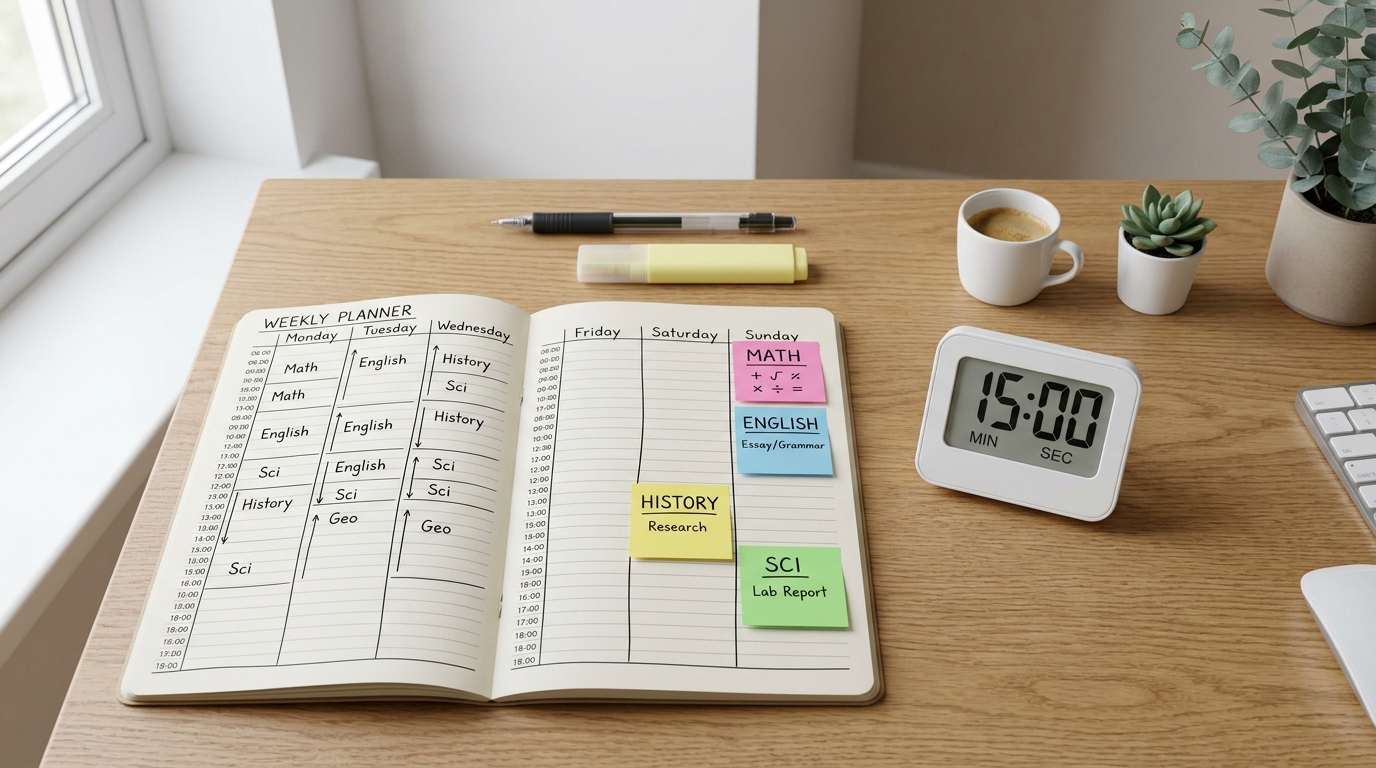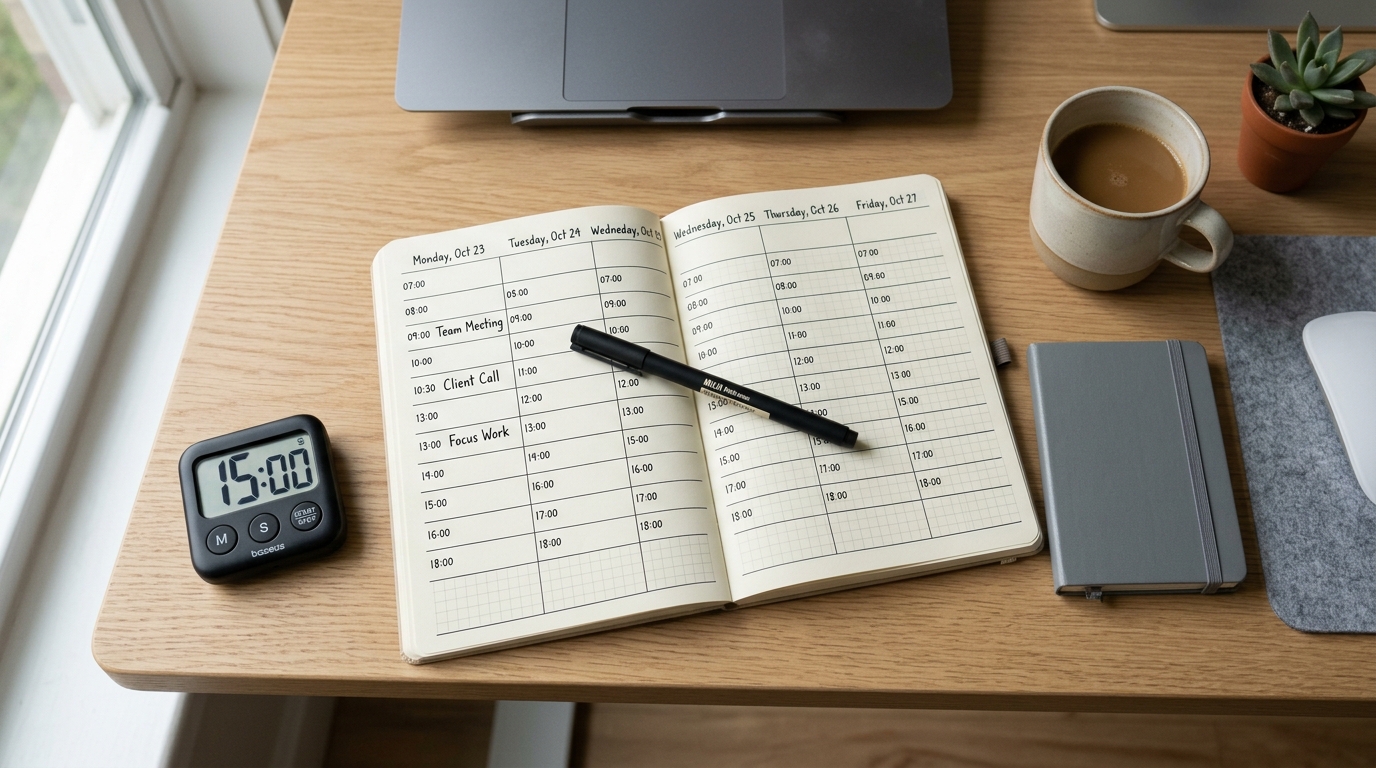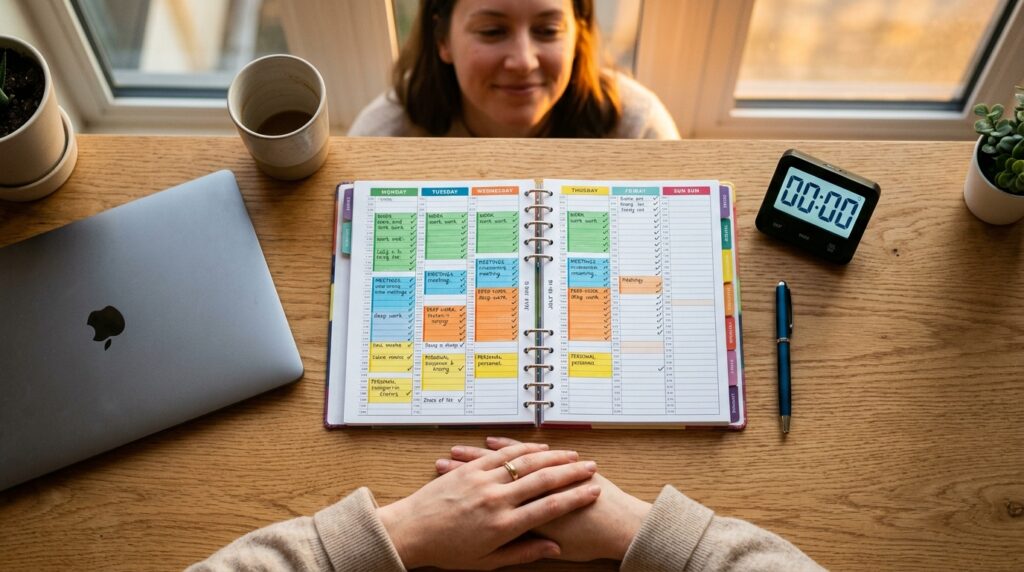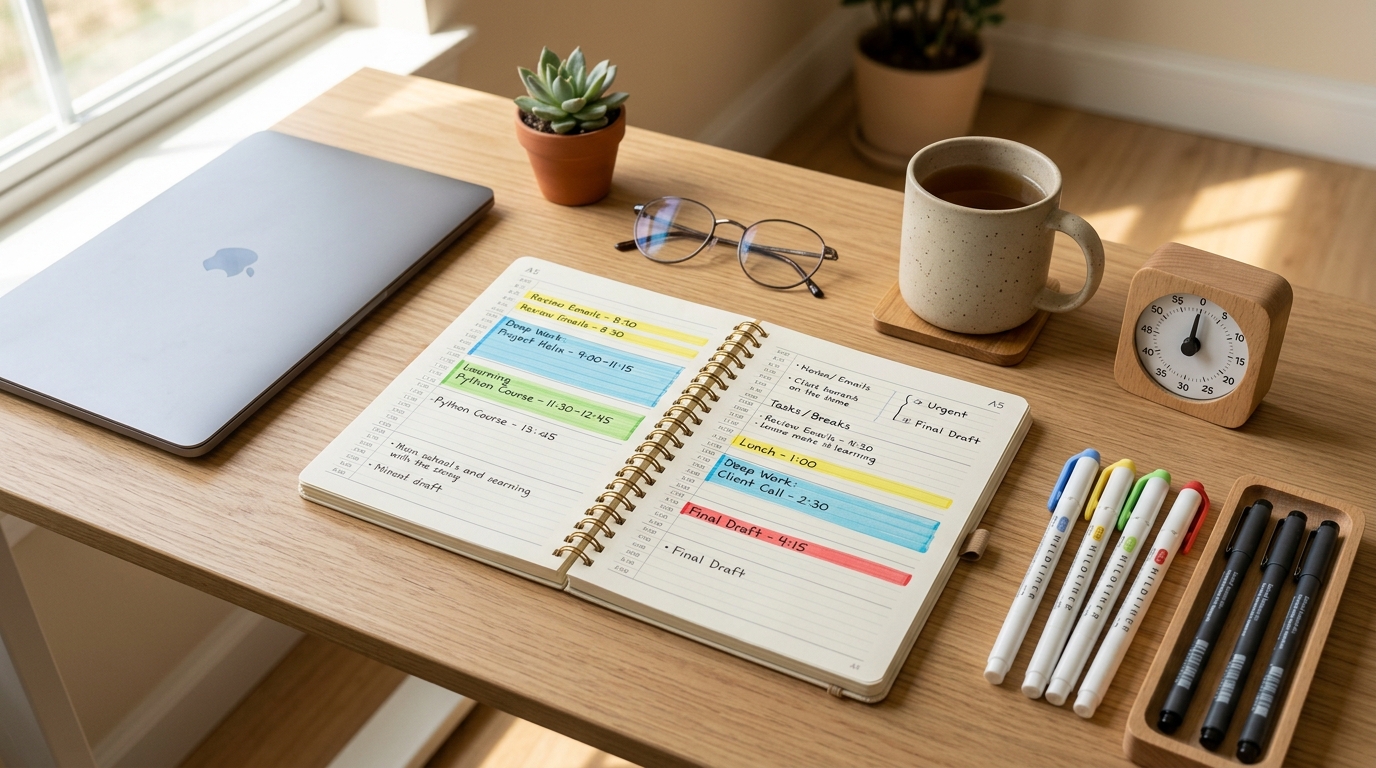
Tag: study routine

  • 15-Minute Routines Over 12 Weeks: How to Track Real Progress in 4-Week and 12-Week Cycles

    15-Minute Routines Over 12 Weeks: How to Track Real Progress in 4-Week and 12-Week Cycles

    Why 15-Minute Routines Feel Small but Add Up

    If you’re juggling work, study, and your own projects, a 60-minute “deep work” block can feel impossible on many days.
    But a 15-minute routine—one focused block for writing, studying, or planning—is usually small enough that your brain says, I can do that.

    Writers, developers, and students often find that once they start a 15-minute block, they either finish a meaningful micro-task or naturally continue into a second block.
    Productivity writers call this the 15-minute rule: you commit to a short, concrete block of time instead of an intimidating end goal, which lowers the friction to start and builds consistency.

    This article is for learners and knowledge workers in their 20s–40s who want to know what actually changes if they keep these 15-minute routines going for 4 weeks and then 12 weeks.
    I started tracking my own 15-minute blocks in a simple Notion database, and after 4 weeks the routine felt less like a struggle—by 12 weeks, it felt strange not to do it.

    Why 4 Weeks and 12 Weeks Matter

    Habit research suggests that new behaviors don’t become automatic in 21 days for everyone.
    One well-known study that followed adults building everyday habits found that it took an average of about 66 days to reach a stable “automatic” level, with huge variation between people.

    That’s why it helps to think in phases instead of all-or-nothing:

    • Around 4 weeks: your routine usually shifts from effortful to familiar.
    • Around 12 weeks: the routine has had enough repetitions to feel close to automatic.

    Systems like the “12-Week Year” also treat every 12 weeks as a mini-year, arguing that shorter cycles create urgency and make weekly tracking simpler than annual plans.
    For your 15-minute study or work routine, using 4-week and 12-week checkpoints gives you clear points to review progress and adjust without waiting a whole year.

    If you’re also building a broader weekly or monthly study plan with short blocks, you may find our guide on How to Build Weekly and Monthly Study Plans with 15-Minute Blocks helpful to pair with this article.

    Step 1: Define One 15-Minute Routine to Track

    A person writing a 15-minute focus routine into a planner beside a laptop and study timer on a tidy desk.

    Before you think about 4 or 12 weeks, choose one specific 15-minute routine you want to measure.
    Trying to track five new routines at once usually scatters your attention.

    Pick one core routine, such as:

    • 15 minutes of focused reading or problem-solving after work.
    • 15 minutes of thesis or report writing every morning.
    • 15 minutes of language study on your commute.
    • 15 minutes of planning your next day in a digital planner at night.

    Write it as a simple rule:

    • When? (time of day or trigger, like “after dinner” or “after I open my laptop”)
    • What? (one main type of work, e.g., “study problems” or “write 200 words”)

    You can log this in any tool—a paper notebook, a notes app, or a Notion database.
    If you’d like a simple structure for logging your blocks, see our post 15-Minute Study Tools Routine: How to Actually Use Your New Timer and Planner Every Day.

    Step 2: Set Up a Simple Digital Log (Takes 5–10 Minutes)

    You don’t need a complex system to track your routine; what matters is consistency, not design.
    Pick one place where you’ll log every 15-minute block.

    Option A: Notion or note-taking app

    Create a minimal table or list with three columns:

    • Date
    • Did I complete today’s 15-minute block? (Yes/No)
    • Quick notes (what you worked on, how focused you felt)

    This could be a Notion database, a dedicated page in your note app, or even a simple Google Sheet.
    For more visual planning of your study day in blocks, you might like 15-Minute Time Blocking: How to Turn a Scattered Day into Focused Study Blocks.

    Option B: Timer or habit app + weekly summary

    If you prefer apps:

    • Use a focus timer or habit tracker to mark each 15-minute block.
    • Once a week, quickly total how many blocks you completed and jot down a sentence about how it felt.

    The key is to avoid overbuilding the system; your tracking should take under 2 minutes a day.
    If you feel yourself spending more time tweaking your system than actually doing the 15-minute routine, scale the setup back.

    Step 3: What to Look For at 4 Weeks (The “Starting to Stick” Phase)

    Around week 4, your routine is no longer brand new, but it may not feel automatic yet.
    This is the perfect time to check whether it’s starting to stick.

    Use these three metrics:

    1. Completion rate

    Look at the past 4 weeks:

    • How many days did you complete your 15-minute routine each week?
    • Has your completion rate improved compared to week 1?

    For example:

    • Week 1: 2 out of 7 days
    • Week 4: 4 out of 7 days

    Even if the blocks are still short, that jump in completion rate is a real win.
    Habit research emphasizes that habits grow through repetition, not intensity, so frequent small wins matter more than a few heroic long sessions.

    2. Start resistance

    Think about how it feels right before you begin:

    • Do you still feel heavy resistance (“I really don’t want to do this”), or is it more neutral?
    • How long do you procrastinate before starting compared to the first week?

    If your internal dialogue has shifted from “I can’t face this” to “It’s only 15 minutes, I’ll just start,” that’s a strong sign the routine is moving from effortful to familiar.

    3. Focus quality inside the 15 minutes

    Review your notes for the last 2 weeks:

    • Are you checking your phone less during the block?
    • Can you stay with one task instead of bouncing between tabs?

    You don’t need perfect focus to pass this checkpoint.
    If 2 out of these 3 dimensions (completion rate, start resistance, focus quality) show clear improvement at 4 weeks, your 15-minute routine is on track.

    If phone checking is still a big problem, you might pair this with our guide 15-Minute Focus Timer Routine: How to Stop Checking Your Phone While You Study.

    Step 4: What to Look For at 12 Weeks (The “Automatic and Effective” Phase)

    By week 12, you’ve had roughly three months of practice with your 15-minute routine.
    This is where deeper changes show up—not just in how it feels, but in what you’ve actually produced.

    Use these four checkpoints:

    1. Automation level

    Ask yourself:

    • Do I still need to remind myself to do this, or does it feel strange not to?
    • On days I skip, do I notice something feels “off”?

    In habit studies, the point where a behavior feels automatic is when you start doing it with minimal conscious decision-making.
    If your 15-minute block now feels like brushing your teeth—small, predictable, and part of the day—that’s a major milestone.

    2. Total accumulated time

    Add up your total focused time for the past 12 weeks.
    For example, if you did:

    • 15 minutes × 5 days a week × 12 weeks
    • That’s 900 minutes, or 15 hours of focused work.

    Those 15 hours might be:

    • 15 hours of exam practice questions.
    • 15 hours of thesis or report drafting.
    • 15 hours of building a portfolio or learning a new skill.

    A lot of people underestimate how much 15 minutes a day can add up over 12 weeks.
    Seeing the actual total in hours can be very motivating when your daily blocks feel small.

    3. Changes in performance and energy

    Look at “before vs after” over 12 weeks:

    • Is your reading speed or problem-solving speed better?
    • Do you find it easier to get into focus once you start?
    • Does studying or working feel a bit less exhausting than it used to?

    Research on short, daily reflection routines shows that even 15 minutes a day of deliberate practice or review can improve performance and effectiveness over time.
    Your 15-minute block is a small but consistent injection of intentional practice into your day.

    4. Expansion potential

    Finally, ask:

    • Does 15 minutes now feel manageable, even on bad days?
    • On good days, do you naturally extend to 25–30 minutes?

    If 15 minutes feels stable and you’re sometimes choosing to extend, it might be time to add a second 15-minute block on certain days.
    If it still feels fragile, keep the block at 15 minutes but protect it as your “minimum viable habit.”

    A digital study room desk with a Notion-style dashboard tracking weeks of completed 15-minute focus sessions.

    Step 5: How to Track Your Progress Without Overcomplicating It

    Simple tracking beats perfect tracking.
    Here’s a minimal way to review your 4-week and 12-week progress using any digital tool.

    Weekly review (2–5 minutes)

    Once a week, check:

    • How many days did you complete your 15-minute routine?
    • How often did you get distracted?
    • One sentence: what helped or hurt this week?

    You can jot this in:

    • A Notion page called “15-Minute Routine Weekly Review.”
    • A recurring note in your note app.
    • A small section in your planner.

    If you already use a weekly review for your study or work, you can integrate this into that process—see 15-Minute Monday Study Review: How to Check Your Monthly and Weekly Plan Without Feeling Overwhelmed for ideas.

    4-week and 12-week snapshots

    At week 4 and week 12:

    • Calculate your average completion rate per week.
    • Estimate your total focused time (in hours).
    • Write 3–5 bullet points about what has changed in your behavior and results.

    The goal is not to judge yourself but to notice trends:

    • Are you moving from “all or nothing” to “small but consistent”?
    • Are you less dependent on motivation and more on structure?

    These snapshots give you data to tweak your routine instead of guessing.

    Everyday Tips to Make Your 15-Minute Routine Stick

    Small design choices often decide whether your routine survives busy days.
    Use these practical tips to make your 15-minute block easier to keep.

    • Fix a time slot: morning commute, after work, or before bed works better than “sometime today.”
    • Prep the “entry point”: a specific document, problem set, or app that you open immediately when the timer starts.
    • Set a minimum: on the worst days, allow yourself just 5 minutes. If you do more, great; if not, you still kept the habit alive.
    • Pair it with an existing habit: right after making coffee, after closing work apps, or after brushing your teeth at night.

    Short routines are powerful because they reduce decision fatigue and give you one small, non-negotiable anchor in your day.
    Over weeks and months, that anchor can change how you see yourself—from someone who “tries to study” to someone who shows up consistently.


    Related Routines You Might Like


    Frequently Asked Questions

    Q1. What if I only have 5 minutes, not 15?

    A: That’s okay—start with 5.
    If 15 minutes feels too long on certain days, treat 5 minutes as your “emergency minimum” block and still log it as a success.

    The goal is to protect the identity of “I show up, even briefly,” not to hit the perfect duration every time.
    Many people find that once they start a 5-minute block, they naturally extend it when they have the energy.

    Q2. Can I use this system for work tasks, not just studying?

    A: Absolutely.
    You can use the same 4-week and 12-week check-ins for writing reports, coding, learning new tools, or building a portfolio.

    Define one 15-minute “work upgrade” routine—like learning a new feature in your main software or doing deep work on a long-term project—and track it the same way.
    Knowledge workers often underestimate how far 15 focused minutes a day can move a long project over 12 weeks.

    Q3. Which tools do I really need to start?

    A: You only need three things: a timer, a place to work, and a simple way to log your blocks.
    That could be your phone’s timer, your usual study spot, and a single note where you mark Y/N each day.

    Digital tools like Notion, task managers, or habit apps can make tracking smoother, but they’re optional upgrades, not prerequisites.
    If you find yourself spending more time configuring tools than doing the 15-minute routine, simplify your setup.

    Q4. How many 15-minute routines can I run at the same time?

    A: If you’re just starting, focus on one core routine for at least 4 weeks.
    Once your completion rate and resistance look good, you can experiment with adding a second block on some days or introducing a different 15-minute routine.

    Trying to launch several new routines at once often dilutes your focus and makes all of them harder to keep.
    It’s better to have one deeply ingrained 15-minute habit than five fragile ones.


    Learn More

    For more on habits, focus, and short daily routines, see:

  • 15-Minute Study Routine by Subject: How to Build a High-Score Study Schedule Without Burnout

    15-Minute Study Routine by Subject: How to Build a High-Score Study Schedule Without Burnout

    You sit down after work or late in the evening during exam season, ready to study—but before you even open your textbook, you already feel exhausted.

    You think, “I should study for at least two hours tonight,” but then the moment your plan shifts even slightly, the whole schedule collapses, and you end up doing nothing.

    This guide is for exam students, certification learners, and working adults who need to juggle multiple subjects without burning out.

    We’ll walk through how to design a 15-minute study routine by subject—how to divide your limited study time across different courses, how to decide which subjects get more blocks, and how to build a schedule that actually sticks.

    I started using this 15-minute block system on evenings when my brain felt too scattered to commit to a two-hour session, and it was just enough structure to actually finish one small but meaningful task in each subject.


    Why Long Study Plans Often Fail

    When you sit down to study multiple subjects—whether it’s for high school exams, college finals, or professional certifications—the biggest challenge isn’t finding time. It’s deciding how much time to give each subject.

    You might think, “I’ll do two hours of math, one hour of English, and squeeze in some science,” but that plan often falls apart the moment something unexpected happens.

    Research on focus and mental fatigue suggests that most people can sustain deep concentration for about 10 to 20 minutes at a time before their attention starts to drift.

    Instead of trying to power through two-hour marathons, building short, high-density 15-minute blocks and repeating them across subjects is more realistic—and often more effective.


    The 15-Minute Study Block Structure

    Before you divide your time by subject, you need a basic template for what one 15-minute block looks like.

    Here’s the structure I recommend:

    • Prep (3 minutes)
    • Focus work (10 minutes)
    • Wrap-up (2 minutes)

    This becomes your unit of measurement. Instead of saying “I’ll study for two hours,” you say, “I’ll complete 8 blocks today—3 for math, 2 for English, 2 for history, and 1 for science.”

    Let’s break down each phase.


    Step 1: Prep (3 Minutes) – Clear Your Space and Set a One-Line Goal

    The prep phase isn’t about studying—it’s about lowering the barrier to starting.

    Clear your desk
    Push aside anything unrelated to the subject you’re about to study. If you’re doing math, clear everything except your math textbook, notebook, and pen.

    Put your phone out of sight
    Not just face-down—actually out of the room, or in a drawer. Turn off notifications if possible.

    Write a one-line goal for this block
    Don’t write “study math.” Write something specific:

    • “Math: Solve 3 practice problems from Chapter 5”
    • “English: Read and underline key points in one essay prompt”
    • “History: Review today’s lecture notes and highlight 3 main events”

    The more specific your one-line goal, the easier it is to stay on track during your 10-minute focus window.

    This preparation step is backed by research on reducing decision fatigue—when you remove ambiguity from “what to do,” you can start working faster.

    Person organizing study materials by subject and clearing desk space to start a focused 15-minute study session

    Step 2: Focus (10 Minutes) – One Subject, One Task

    Now you have 10 minutes. During this time, focus on one thing only for the subject you selected.

    If it’s a math block, solve problems. If it’s an English block, read and annotate. If it’s a history block, review notes and write one summary sentence per section.

    What if another subject pops into your head?
    Jot it down on a sticky note and return to your current block. Don’t switch mid-block.

    Why 10 minutes?
    Because focus peaks around 10 to 20 minutes, then gradually declines. By keeping blocks short, you’re working with your brain’s natural attention cycle, not against it.

    How to distribute blocks by subject

    • Strong subjects: 1 block every 2–3 days (maintenance only)
    • Weak subjects: 2–3 blocks per day (needs improvement)
    • Required subjects: At least 1 block daily (non-negotiable)

    For example, a high school student preparing for exams might allocate:

    • Math: 3 blocks
    • English: 2 blocks
    • History: 2 blocks
    • Science: 1 block

    A working adult studying for a certification might use:

    • Core subject: 2 blocks
    • Supplementary subject: 1 block
    • Review: 1 block
    Active 15-minute study session with notebook textbook and timer showing focused work time for subject-based learning

    If you’re using digital tools like Notion or a study timer app to track your blocks, you might find our guide on 15-Minute Time Blocking: How to Turn a Scattered Day into Focused Study Blocks helpful for setting up a visual tracker.


    Step 3: Wrap-Up (2 Minutes) – One Line for Today, One Line for Tomorrow

    When your 10 minutes are up, don’t immediately jump to the next subject.

    Take 2 minutes to write two lines:

    Today’s line:
    What did you just finish?

    Example:

    • “Math: Solved 3 problems, got stuck on #2”
    • “English: Read one essay prompt, underlined 5 key arguments”
    • “History: Reviewed lecture notes, highlighted 3 events”

    Tomorrow’s line:
    What’s the next step?

    Example:

    • “Math: Review solution for #2, then do 2 similar problems”
    • “English: Write a rough outline for the essay”
    • “History: Rewrite the 3 events in my own words”

    This two-line habit creates continuity between blocks. When you sit down for your next 15-minute session, you won’t waste time asking, “What should I do now?”

    Studies on self-regulated learning suggest that students who regularly set short-term goals and review their progress tend to perform better academically.

    If you want a step-by-step guide on building review habits into your routine, check out 15-Minute Study + 5-Minute Review: A Simple Routine for Days You Can’t Stick to Your Plan.


    How to Distribute 15-Minute Blocks Across Subjects

    Not all subjects need the same amount of time, and trying to split everything equally is inefficient.

    Here’s a simple framework:

    1. Required subjects (e.g., math, English)
    → At least 1 block per day, no exceptions.

    2. Weak subjects (subjects where you’re struggling)
    → Add 1 extra block compared to required subjects.

    3. Strong subjects (maintenance only)
    → 1 block every 2–3 days is enough.

    Example: High school exam student

    • Math (weak): 3 blocks daily
    • English (required): 2 blocks daily
    • History (required): 2 blocks daily
    • Science (strong): 1 block every other day

    Example: Working adult studying for certification

    • Core subject: 2 blocks daily
    • Elective subject: 1 block daily
    • “Minimum viable routine” on busy days: 1 block total (core subject only)

    This distribution method is supported by research on spaced practice and interleaving, which show that distributing study time across subjects improves retention more than massed practice (studying one subject for hours at a time).


    Tools That Make This Easier

    Notion
    Create a simple “15-Min Study Log” database with columns for Date, Subject, Block Count, and Notes. At the end of each week, review which subjects got the most attention.

    For a detailed tutorial on setting up Notion for study tracking, see How to Build Weekly and Monthly Study Plans with 15-Minute Blocks.

    Physical timer
    A simple kitchen timer or desk timer works better than a phone app because it removes the temptation to check notifications.

    If you’re deciding between timers and apps, our guide How to Choose a Planner, Timer, and App for Your 15-Minute Study Routine: 5 Simple Criteria breaks down the pros and cons.

    Google Calendar or time-blocking app
    Block out your 15-minute sessions by subject at the start of each week. Treat these blocks like appointments.


    Practical Tips for Daily Use

    Fix one time slot per day
    Choose a consistent time—9 PM every evening, or 6 AM before work—and dedicate that slot to 2–3 study blocks. Consistency builds habits faster than intensity.

    Set a “minimum viable routine”
    On days when you’re exhausted or your schedule falls apart, decide in advance: “If I can only do one thing today, it’s one 15-minute block for [subject].”

    This prevents your routine from collapsing completely when life gets messy.

    Review and adjust weekly
    At the end of each week, look at your block distribution. Did you overcommit to one subject? Did another subject get neglected? Adjust next week’s plan accordingly.


    Related Routines You Might Like


    Frequently Asked Questions

    Q1. What if I only have 5 minutes, not 15?

    A: Do a 5-minute block. The structure still works—just skip the 2-minute wrap-up and use 5 minutes for focus work. The goal is consistency, not perfection.

    Q2. Can I use this routine for work tasks, not just studying?

    A: Absolutely. This works for anything that requires focus—writing reports, learning new software, reading research papers, or creative projects. Just replace “subject” with “project.”

    Q3. How do I decide which subject gets more blocks?

    A: Prioritize based on three factors: (1) upcoming deadlines, (2) your current proficiency (weaker subjects get more blocks), and (3) importance (required subjects get at least 1 block daily).

    Q4. What if I finish my task in 7 minutes?

    A: Use the remaining 3 minutes to review what you just did, or preview the next task. Don’t end early—use the full 10 minutes to deepen your focus.


    Learn More

    For more on time blocking, study schedules, and building consistent routines, see:

    Jotverse – Time Blocking for Students: The Ultimate Productivity System
    Practical guide to using time blocking to manage study sessions and reduce decision fatigue.
    https://www.jotverse.com/time-blocking-for-students-the-ultimate-productivity-system-for-academic-success/

    Summit Learning Charter – 7 Benefits of Time Blocking Methods for Studying
    Explains how time blocking can improve concentration and academic performance.
    https://summitlearningcharter.org/resources/blog/benefits-of-time-blocking/

    Schoolhouse World – How to Create a Study Schedule
    Step-by-step guide to building a realistic study schedule using time-blocking principles.
    https://schoolhouse.world/blog/how-to-create-a-study-schedule

  • After-Work 15-Minute Study Routine: How to Build a Minimum Viable Habit That Prevents Burnout

    After-Work 15-Minute Study Routine: How to Build a Minimum Viable Habit That Prevents Burnout

    You get home from work, and your brain feels like mush.

    You know you want to study—maybe for a certification exam, a language course, or just to keep learning—but the moment you sit down, you end up scrolling your phone for an hour instead.

    This guide is for office workers, graduate students, and anyone juggling a full-time job with the goal of learning something new.

    We’ll break down a 15-minute study routine that actually sticks—not because it’s heroic, but because it’s small enough to start and structured enough to build on.

    Research on attention suggests that most people can sustain focused attention for about 12 to 20 minutes before needing a break. That’s why short, dense study blocks often work better than forcing yourself to sit for hours when your mind is already tired.

    I started using this 15-minute block on evenings when my brain felt scattered after meetings, and it was just enough structure to actually finish one small but meaningful task—without the guilt of giving up entirely.


    Why a 15-Minute Study Routine Works

    The barrier to studying isn’t usually lack of ability—it’s the resistance to starting.

    Especially for people with unpredictable schedules—office workers, freelancers, parents—committing to a long block of study time every day feels impossible.

    Studies on habit formation, including research by behavioral scientist BJ Fogg at Stanford, show that starting with the smallest possible commitment (what he calls a “minimum viable habit”) reduces resistance and increases consistency over time.

    The goal isn’t to study perfectly for hours. The goal is to show up today, and then again tomorrow.

    When you repeat a 15-minute routine daily, your brain starts to recognize the pattern. Over weeks, this becomes automatic—not because you forced it, but because you made it easy enough to sustain.


    The 15-Minute Study Routine: 3-Step Framework

    A 15-minute study routine breaks down into three phases:

    Prep (3 minutes) → Focus (10 minutes) → Review (2 minutes)

    This structure might sound minimal, but when you repeat it at the same time each day, it becomes a habit loop that reduces decision fatigue and makes studying feel less like a chore.


    Step 1: Prep (3 Minutes) – Lower the Barrier to Start

    The purpose of the prep phase is to make starting feel effortless.

    A professional clearing their desk and preparing a notebook and timer to start a 15-minute study block after work.

    In these 3 minutes, you’re not studying yet—you’re creating a mental and physical environment that tells your brain, “This is study time now.”

    Clear your desk.
    Remove anything unrelated to your study goal—notebooks from work, random papers, your phone (if possible).
    Leave only what you need: your textbook, a notebook, or your iPad.

    This simple act of clearing space signals to your brain that you’re shifting modes.

    Write down one task.
    Don’t write a long to-do list. Write one thing you’ll do in the next 10 minutes.

    Examples:

    • “Review 20 vocabulary words”
    • “Solve 3 practice problems”
    • “Read and summarize 4 pages”

    Being specific reduces the mental load of figuring out what to do once the timer starts.

    Set a timer for 15 minutes.
    Use a physical timer, your phone’s timer, or a Pomodoro app.
    The act of setting a timer creates a clear boundary—you’re committing to 15 minutes, not an endless session.

    For more on creating a simple digital workspace to track your study sessions, see our guide on Building a Notion Study Dashboard.


    Step 2: Focus (10 Minutes) – Do One Thing Without Distraction

    This is where the actual studying happens.

    The goal here isn’t to “study as much as possible”—it’s to stay focused on one thing for 10 minutes without switching tasks.

    Turn off notifications.
    Put your phone in another room, or use Do Not Disturb mode.
    Close all browser tabs except the one you need.

    Research from the University of California Irvine found that office workers switch tasks roughly every 3 minutes when surrounded by digital distractions. By intentionally removing those distractions for just 10 minutes, you’re giving your brain a rare chance to focus deeply.

    Stick to your one task.
    If a random thought pops up (“I should check that email”), jot it down on a separate piece of paper and return to your task.

    Don’t try to multitask. Don’t switch to “just one quick thing.”

    The 10-minute block is sacred.

    People often underestimate how much they can accomplish in 10 focused minutes—especially when it becomes a daily habit.

    If you’re struggling with distraction even during short blocks, try our 15-Minute Focus Timer Routine: How to Stop Checking Your Phone While You Study.


    Step 3: Review (2 Minutes) – Connect Today to Tomorrow

    The final 2 minutes aren’t about cramming in more content—they’re about making tomorrow easier.

    Write down what you did.
    One sentence is enough:
    “Reviewed 20 vocab words, marked 5 as difficult.”

    Hands writing a quick review note after completing a focused 15-minute study session with a timer on the desk.

    Write down what you’ll do next.
    One sentence:
    “Tomorrow: Review the 5 difficult words + add 10 new ones.”

    This tiny step of leaving a “next action” note drastically reduces the mental friction of starting again tomorrow.

    You won’t waste time tomorrow figuring out where you left off—you’ll just pick up the thread and continue.

    Over time, these small notes create a study log that shows your progress, which can be surprisingly motivating.

    For a deeper dive into how to turn these 15-minute blocks into a longer study session, see 15-Minute Focus Blocks: How to Turn Four Short Sessions into One Hour of Real Work.


    Everyday Tips: How to Make This Routine Stick

    First: Anchor it to a fixed time.

    Don’t leave your study time to chance.

    Pick a specific time slot and defend it:

    • Right after dinner, before you relax for the evening
    • Before bed, with a timer set as a reminder
    • First thing in the morning, before checking your phone

    The more consistent your timing, the easier it becomes to show up.

    Second: Create a backup “minimum routine” for tough days.

    Some days, 15 minutes will feel impossible.

    On those days, have a 5-minute version ready:
    Prep 1 minute + Focus 3 minutes + Review 1 minute.

    Research on learning habits shows that maintaining the rhythm (even at a smaller scale) is more important than the duration. By doing even 5 minutes, you keep the habit alive instead of letting it collapse entirely.

    For more on how to adjust your routine when life gets chaotic, see 15-Minute Study + 5-Minute Review: A Simple Routine for Days You Can’t Stick to Your Plan.


    What Happens When 15 Minutes Becomes a Habit

    Fifteen minutes doesn’t sound like much.

    But when you do it every day:

    • In one month, that’s over 7 hours of focused study.
    • In three months, it’s over 22 hours.

    More importantly, research on spaced repetition—the practice of revisiting material at intervals—shows that frequent, short study sessions lead to better long-term retention than cramming.

    You’re not just accumulating hours. You’re training your brain to recall and reinforce what you’ve learned over time.

    And beyond the metrics, there’s a quieter shift: You start to see yourself as someone who studies consistently.

    That identity change—”I’m the kind of person who shows up”—is often more powerful than any single marathon study session.


    Related Routines You Might Like


    Frequently Asked Questions

    Q1. What if I only have 5 minutes, not 15?

    A: Do the 5-minute version. Prep 1 minute, Focus 3 minutes, Review 1 minute. The goal is to keep the pattern alive, not to be perfect. Even 5 minutes reinforces the habit and prevents complete collapse.

    Q2. Can I use this routine for work tasks, not just studying?

    A: Absolutely. This framework works for any focused work—writing reports, coding, reading research papers, even creative projects. The structure is the same: Prep → Focus → Review.

    Q3. Which tools do I actually need to start?

    A: You don’t need much. A timer (phone or physical), a notebook or note app, and whatever material you’re studying. If you want to track your progress digitally, a simple Notion page or Google Doc works fine.

    Q4. How do I stay motivated when progress feels slow?

    A: Track small wins. Write down each completed session. After two weeks, you’ll have a visible log of consistency, which becomes its own motivation. Also, remember: slow progress is still progress. The goal is sustainability, not speed.


    Learn More

    For more on focus, study habits, and building consistent routines, see:

    High Focus Centers – Understanding Attention Spans: What’s Happening to Our Focus?
    Research-based overview of how attention spans vary by age and context, including why sustained attention typically lasts 15-20 minutes for adults.
    https://www.highfocuscenters.com/2025/06/18/understanding-attention-spans-whats-happening-to-our-focus/

    NPR Life Kit – A Proven Method to Make a Habit Stick (with BJ Fogg)
    Interview with Stanford behavioral scientist BJ Fogg on starting small, the role of positive emotion in habit formation, and why “tiny habits” work.
    https://www.npr.org/2026/01/13/nx-s1-5675362/a-proven-method-to-make-a-habit-stick

    SAGE Journals – Spaced Repetition Promotes Efficient and Effective Learning
    Academic review of how spaced repetition improves long-term retention compared to cramming, with practical applications for learners.
    https://journals.sagepub.com/doi/10.1177/2372732215624708

  • How to Build Weekly and Monthly Study Plans with 15-Minute Blocks

    How to Build Weekly and Monthly Study Plans with 15-Minute Blocks

    You just got home from work, opened your planner, and… stared at the blank page for five minutes. You want to plan the week ahead. You have good intentions about building a monthly study plan. But when you try to fill in every hour with detailed tasks, the plan feels overwhelming before you even start.

    And two days later, when life doesn’t go exactly as planned, the whole thing falls apart.

    If you’re a working professional studying for exams, a graduate student juggling research and classes, or someone trying to build a consistent self-development routine, you’ve probably been there. You know you should plan ahead—but traditional weekly and monthly planning often feels like setting yourself up to fail.

    Research on time blocking and productivity shows that breaking work into defined time intervals significantly reduces decision fatigue and improves focus. The key isn’t making a perfect plan—it’s creating a sustainable structure built from small, repeatable blocks.

    I started using 15-minute study blocks to build my weekly plan on days when my brain felt scattered, and it was just enough structure to actually finish one small but meaningful task—and stack it into a week, then a month.


    Why 15-Minute Blocks Work Better Than Hour-Long Plans

    Most people think planning means blocking out entire evenings or weekends for study. But neuroscience and focus research suggest that sustained deep focus typically lasts 10–20 minutes before attention begins to drift. That’s why 15 minutes is often described as the sweet spot: light enough to start without resistance, long enough to create real focus.

    When you plan your week or month using 15-minute blocks instead of vague “study sessions,” you’re working with how your brain actually functions—not against it.

    Time blocking psychology also shows that assigning specific time slots to tasks makes them feel more official and non-negotiable, which reduces procrastination. Instead of thinking “I need to study this week,” you’re thinking “I have five 15-minute blocks scheduled for vocabulary review.”

    That shift—from intention to allocation—is what turns a plan into action.

    Person looking at blank weekly planner before starting time blocking routine at home office desk

    The Basic 15-Minute Study Block Structure

    Before you plan a week or month, you need to understand what one 15-minute block looks like. Here’s the breakdown:

    Prep (3 minutes)

    • Clear your desk of unrelated items
    • Write down one thing you’ll focus on during this block
    • Set a timer for 15 minutes

    Focus (10 minutes)

    • Work on that one thing only
    • No switching tasks, no checking notifications
    • If something else pops into your mind, jot it down for later

    Wrap-up (2 minutes)

    • Write one line summarizing what you finished
    • Add a checkmark (✓) next to it in your planner
    • Write one line for what comes next

    This structure makes each 15-minute block self-contained. You’re not leaving tasks half-finished or wondering “what did I even do today?”

    For a deeper dive into how to run a single 15-minute study block effectively, see our guide on 15-Minute Study Routine: How to Make Short, Focused Blocks Actually Work.


    How to Build a Monthly Plan with 15-Minute Blocks

    Monthly planning isn’t about filling every day with tasks. It’s about estimating how many 15-minute blocks you want to allocate to each subject or project this month.

    Step 1: List Your Priorities

    Write down the 2–4 main things you want to work on this month. Keep it simple.

    Examples:

    • English vocabulary review
    • Certification exam prep
    • Work-related reading (reports, industry articles)
    • Personal writing project

    Step 2: Assign Block Counts

    For each priority, estimate how many 15-minute blocks you’d like to complete this month.

    Example:

    • English: 20 blocks
    • Certification prep: 30 blocks
    • Reading: 10 blocks
    • Writing: 15 blocks

    Total: 75 blocks for the month

    At this point, don’t worry about when you’ll do them. You’re just setting a rough target.

    Step 3: Spread Blocks Across Weeks

    Now break the monthly total into weekly chunks.

    If you have 30 certification blocks for the month and 4 weeks, that’s about 7–8 blocks per week. Some weeks you might do more, some less—but you have a baseline.

    This approach aligns with productivity research showing that linking daily tasks to long-term goals through intermediate milestones (weekly targets) improves follow-through and reduces overwhelm.


    How to Build a Weekly Plan with 15-Minute Blocks

    Weekly planning is where monthly targets become daily actions.

    Step 1: Review Your Monthly Allocation

    Look at your monthly plan and pull this week’s portion.

    Example:

    • English: 5 blocks this week
    • Certification: 7 blocks
    • Reading: 2 blocks

    Step 2: Assign Blocks to Specific Days

    Open your planner or digital calendar and place each block on a specific day and time.

    Example:

    • Monday 7:00 AM – English (1 block)
    • Monday 10:00 PM – Certification (1 block)
    • Tuesday 10:00 PM – Certification (1 block)
    • Wednesday 7:00 AM – English (1 block)

    You don’t need to fill every day. Some days might have zero study blocks, and that’s okay.

    Step 3: Use a “Minimum Viable Week” Mindset

    Instead of planning for the ideal week where you have perfect energy and zero distractions, plan for the realistic week.

    Ask yourself: “What’s the minimum number of blocks I can commit to, even if this week goes sideways?”

    Maybe that’s 3 blocks instead of 10. That’s still progress.

    Research on habit formation and micro-goals shows that starting with small, achievable targets builds consistency and reduces the likelihood of abandoning routines entirely.

    For more on how to stay consistent with minimal commitment, see 15-Minute Study Routine with Tiny Rewards: What to Do on Days You Don’t Want to Sit at Your Desk.


    Tools That Make Weekly and Monthly Planning Easier

    You don’t need fancy software to plan with 15-minute blocks, but a few simple tools can help you stay organized.

    1. Notion

    Create a simple database to track your blocks. Add columns for:

    • Subject/Project
    • Date
    • Status (To-do / Done)
    • Next action

    Notion lets you filter by week or month, so you can see how many blocks you’ve completed at a glance.

    For a step-by-step tutorial on setting up a study tracker in Notion, see 15-Minute Reading and Notion Routine: How to Turn Scattered Book Notes into a Simple Reading System.

    2. Google Calendar

    Use Google Calendar to visually time-block your week. Create separate calendars for different subjects (color-coded), and add 15-minute events.

    This gives you a clear visual of where your blocks are and prevents overbooking.

    3. Paper Planner

    If you prefer analog, use a weekly spread with hourly slots. Mark each 15-minute block with a color or symbol. At the end of the week, count your checkmarks.

    The key is visibility. You should be able to quickly see:

    • How many blocks you planned
    • How many you completed
    • What’s coming next

    Linking Daily Blocks to Weekly and Monthly Goals

    The magic happens when you connect the dots between today’s 15-minute block and this month’s bigger picture.

    Daily Review (2 minutes)

    At the end of each day, check:

    • How many blocks did I complete today?
    • What subject did they cover?
    • What’s my next block tomorrow?

    Weekly Review (10 minutes)

    Every Sunday or Monday, check:

    • Did I hit my target block count for the week?
    • Which subjects fell short?
    • Do I need to adjust next week’s plan?
    Completed weekly study planner with checkmarks showing finished 15-minute focus blocks and progress tracking

    Monthly Review (15 minutes)

    At the end of the month, total up your blocks by subject. Ask:

    • Did I meet my monthly block targets?
    • Which areas need more attention next month?
    • What worked? What didn’t?

    This cascading review structure ensures that your daily actions are always connected to your longer-term goals—a principle supported by productivity research on goal alignment.

    For a detailed guide on weekly reviews, see 15-Minute Monday Study Review: How to Check Your Monthly and Weekly Plan Without Feeling Overwhelmed.


    Everyday Tips for Staying on Track

    1. Anchor Blocks to Fixed Times

    Pick one or two time slots each day and reserve them for 15-minute blocks.

    Examples:

    • Every morning at 7:00 AM: English vocabulary
    • Every evening at 10:00 PM: Certification study

    When you pair a time with a routine, your body starts to expect it. This is called habit stacking, and research shows it’s highly effective for building consistency.

    2. Allow “Minimum Days”

    On days when you’re exhausted, sick, or swamped, give yourself permission to do just one block.

    That’s your minimum. If you do it, the day counts as a success.

    This prevents the all-or-nothing mindset that kills most study plans.

    3. Track Completion, Not Perfection

    Don’t worry if a block takes 12 minutes instead of 15, or if you got distracted halfway through. What matters is that you showed up.

    Mark it complete, write what’s next, and move on.


    How This Differs from Other Planning Systems

    vs. Pomodoro (25-minute blocks)

    Pomodoro works great for deep work, but 25 minutes can feel like a commitment when you’re tired or scattered. 15-minute blocks are easier to start, especially on low-energy days.

    You can always chain two 15-minute blocks together if you’re in a flow state.

    For more on why 15-minute blocks feel easier than Pomodoro for some learners, see Why 15-Minute and 5-Minute Routines Feel Easier Than Pomodoro.

    vs. Daily To-Do Lists

    To-do lists tell you what to do. Time blocking tells you when to do it.

    By scheduling your 15-minute blocks in advance, you eliminate decision fatigue and reduce the chance of procrastination.

    vs. Vague “Study More” Goals

    “I’ll study more this week” is a wish. “I’ll complete 5 blocks of certification prep by Friday” is a plan.

    When you count blocks instead of hours, progress becomes concrete and measurable.

    Ready to start? Open your planner right now and write down three 15-minute blocks you’ll complete this week. Pick one subject, set a timer, and begin. Your first block counts as success.


    Related Routines You Might Like


    Frequently Asked Questions

    Q1. What if I can only do 5 minutes, not 15?

    A: Do the 5 minutes. Seriously. If 15 feels too long, scale it down. The goal is to show up consistently, not to be perfect. Over time, 5-minute blocks often naturally expand to 10 or 15 as the habit strengthens.

    Q2. Can I use this system for work tasks, not just studying?

    A: Absolutely. Time blocking with 15-minute intervals works for any focused work—writing reports, coding, research, creative projects, even admin tasks. The structure is the same: prep, focus, wrap-up.

    Q3. How do I handle weeks when I miss most of my planned blocks?

    A: Review your plan and ask: “Was my target realistic?” If you planned 15 blocks but only completed 3, scale back to 5 blocks next week. It’s better to consistently hit a smaller target than to repeatedly miss a big one. Adjust and keep going.

    Q4. Should I track blocks in a digital tool or on paper?

    A: Use whichever system you’ll actually look at every day. Digital tools (Notion, Google Calendar, Todoist) are great for filtering and automation. Paper planners give you a tangible sense of progress. Test both and stick with what feels easier.


    Learn More

    For more on time blocking, study planning, and building consistent routines, see:

    Jotverse – Time Blocking for Students: The Ultimate Productivity System
    Practical guide to using time blocking to manage study sessions and reduce decision fatigue.
    https://www.jotverse.com/time-blocking-for-students-the-ultimate-productivity-system-for-academic-success/

    FlowSavvy – The Psychology Behind Time Blocking: Why It Works
    Explores the cognitive benefits of time blocking, including reduced decision fatigue and improved focus.
    https://flowsavvy.app/the-psychology-behind-time-blocking

    We360.ai – The Benefits of Time Blocking: Mastering Your Productivity
    Overview of time blocking benefits, including enhanced work-life balance and reduced procrastination.
    https://we360.ai/blog/time-blocking

    Griply – How to Align Daily Tasks with Long-Term Goals
    Explains how to link daily tasks to weekly and monthly goals using structured planning systems.
    https://griply.app/faq/align-daily-tasks-with-long-term-goals

  • 96 Blocks a Day: How to Use Color-Coded Time Blocking to Balance Study, Work, and Rest

    96 Blocks a Day: How to Use Color-Coded Time Blocking to Balance Study, Work, and Rest

    You finish the workday, get home, collapse on the couch, scroll through your phone for “just five minutes”—and suddenly it’s 9 PM.

    “I was going to study tonight,” you think. “Where did all the time go?”

    If you’re juggling meetings, deep work, study sessions, and breaks, your day can feel like a blur. You worked hard, but when you try to remember exactly how much time you spent studying, reading, or resting, it’s hard to reconstruct.

    That’s where splitting your day into 96 fifteen-minute blocks and color-coding them by activity type can help. Instead of vague feelings like “I didn’t get much done,” you see a visual map of where your time actually went.

    Research on study habits and self-directed learning consistently shows that consistency beats marathon sessions—it’s not about how many hours you cram in one day, but how regularly you show up for short, focused blocks.

    Personal note: I started using this color-coded 96-block planner on days when my brain felt scattered across too many tabs and tasks, and it was the first time I could actually see that I wasn’t as unproductive as I felt—I just needed to rebalance my blocks.


    What This Routine Is (and Isn’t)

    This method is for mild time chaos and everyday scheduling overwhelm, not for clinical productivity disorders or severe executive function challenges. If you find that even basic daily planning causes significant distress or your schedule is consistently derailed by factors outside your control, consider working with a coach or therapist who specializes in time management and focus.


    Routine Overview

    The core structure:

    • Plan (5 min) – Color-code 2–4 blocks for today
    • Execute (10 min per block) – Focus on one task per block
    • Review (5 min at end of day) – Check your color ratio and adjust tomorrow

    You don’t need to fill all 96 blocks. The goal is to intentionally choose 2–4 blocks per day and see the pattern over time.

    Person preparing a color-coded daily planner with timer and pens to organize 15-minute focus blocks for study and work

    Step 1: Prep – Choose Your Planner and Color Code (5 Minutes)

    Pick Your Tool

    You can use:

    • A paper planner or notebook
    • A blank A4 sheet divided into 15-minute rows
    • Notion, Google Calendar, or a time-tracking app
    • Any tool where you can visually mark blocks

    The key is one central place where you can see the whole day at a glance.

    Define Your Color Code

    Pick 3–4 colors (or symbols if you’re using plain text):

    • Blue: Study, self-development, focused learning
    • Red: Work, assignments, meetings, client tasks
    • Green: Rest, meals, walks, breaks
    • Yellow: Commute, errands, housework, admin

    If you don’t have colored pens or highlighters, use symbols: ●, ▲, ■, ◆.

    Mark Today’s Must-Do Blocks

    Don’t try to plan all 96. Instead, mark 2–4 blocks you want to protect today.

    Examples:

    • “7:00–7:15 PM = Study (Blue, 1 block)”
    • “12:15–12:30 PM = English vocab (Blue, 1 block)”
    • “9:00–9:30 PM = Walk + rest (Green, 2 blocks)”

    This gives you anchor blocks—the non-negotiable pieces you want to hit no matter how the rest of the day unfolds.

    If you want a physical planner designed for tracking streaks and daily blocks, a 10-day or 100-day study planner can help you see patterns over weeks. But a plain notebook works just as well.


    Step 2: Execute – 10-Minute Focus + 5-Minute Log

    Each 15-minute block follows this rhythm:

    Focus for 10 Minutes

    Set a timer for 10 minutes (phone timer, kitchen timer, smartwatch—anything works).

    If it’s a Blue (study) block, pick one tiny goal:

    • Review 10 vocab words
    • Read 3 pages
    • Solve 2 practice problems
    • Write one paragraph

    If it’s a Red (work) block, pick one task:

    • Reply to 3 emails
    • Draft one meeting agenda item
    • Finish one report section

    One task. One block. No multitasking.

    If other thoughts pop up (“I should also check that deadline”), jot them in the margin and return to your one task.

    Log What You Did (Last 5 Minutes)

    When the timer rings, write one line in that block:

    • “Vocab 1–10 done”
    • “Report intro drafted”
    • “10-min walk”

    Then add a next-step note:

    • “Next: vocab 11–20”
    • “Next: proofread intro, then send”

    This next-step note eliminates the “What was I doing?” question when you return to that block type tomorrow.

    Person working during a timed 15-minute study block with color-coded planner and timer on desk showing active focus session

    Step 3: End-of-Day Review – See Your Color Ratio (5 Minutes)

    Before bed, scan your planner.

    Count your colors:

    • How many Blue (study) blocks today?
    • How many Red (work) blocks?
    • How many Green (rest) blocks?

    The goal isn’t perfection. The goal is noticing the pattern.

    If you see:

    • 10 Red, 0 Blue, 1 Green → “Tomorrow I’ll protect 2 Blue blocks before dinner.”
    • 6 Blue, 2 Green, 1 Red → “I’m burning out. Tomorrow I’ll add 2 more Green blocks.”

    Studies on learning habits consistently show that daily routines beat sporadic marathon sessions—even 15 minutes a day, repeated consistently, builds stronger long-term retention than cramming.

    This visual feedback loop helps you adjust, not guilt yourself.


    Tools That Make This Easier

    Notion – Color-Coded Block Database

    Create a simple Notion database with these columns:

    • Time Block (text): e.g., “7:00–7:15 PM”
    • Type (select): Study, Work, Rest, Other
    • What I Did (text): one-line log
    • Next Step (text): what to do in the next block of this type

    Set each Type to a different color. Your day becomes a visual timeline.

    For a step-by-step tutorial on building a Notion study tracker, see 15-Minute Study Routine: How to Make Short, Focused Blocks Actually Work.

    Google Calendar – Time Block View

    Create 4 recurring “event types” (Study, Work, Rest, Other) with different colors. When you finish a block, log it as a 15-minute event.

    At the end of the week, your calendar shows a color-coded heatmap of where your time went.

    Paper Planner + Color Pens

    If digital tools feel like friction, a paper planner with 3–4 colored pens or highlighters works just as well. The act of coloring in a block creates a satisfying “done” marker.


    Everyday Tips for Sticking with This

    Morning 5, Evening 5

    • Morning: Mark 2–4 blocks you want to protect today.
    • Evening: Check your color ratio and adjust tomorrow’s blocks.

    That’s it. No hour-long planning sessions.

    Set a Minimum Standard

    Define your floor:

    • “Every day, 1 Blue block = success.”
    • “On exhausted days, 1 Blue + 1 Green = enough.”

    This minimum standard keeps you from the all-or-nothing trap. For more on building a sustainable minimum routine, see 15-Minute Study Blocks: How to Plan a Whole Exam Day in 15-Min Chunks.

    Track Streaks, Not Perfection

    If you hit your minimum 3 days in a row, that’s a streak. Celebrate it. The goal is consistency, not filling all 96 blocks every day.


    Frequently Asked Questions

    Q1. What if I only have 5 minutes, not 15?

    A: Log it anyway. Even a 5-minute Blue block counts. The goal is to see the pattern, not to achieve perfect 15-minute increments every time.


    Q2. Can I use this for work tasks, not just studying?

    A: Absolutely. Red (work) blocks follow the same structure: 10 minutes of focus, 5 minutes to log what you did and set the next step. This method works for any focused task.


    Q3. How do I avoid feeling guilty when I see too many Green (rest) blocks?

    A: Rest is necessary, not lazy. If you see a lot of Green blocks, ask: “Was I recovering from burnout?” or “Did I genuinely need this?” Often the answer is yes. Guilt doesn’t help—adjustment does.


    Q4. Do I need a special planner or app to start?

    A: No. A blank notebook, a Google Doc, or a piece of paper divided into 15-minute slots is enough. Tools are helpful but not required.


    Final Thoughts

    A day has 96 fifteen-minute blocks. You won’t fill them all intentionally—and that’s not the point.

    The point is to choose a few blocks consciously and see where the rest of your time goes.

    Research on focus and attention shows that most people can sustain deep focus for 10–20 minutes at a time—which is exactly why this 15-minute structure works. It matches your natural attention span instead of fighting it.

    Instead of “I need to study for 2 hours tonight,” try: “I’ll do 2 Blue blocks (30 minutes total) and 1 Green block (15-minute walk). That’s enough.”

    When you repeat this daily—even just 2 blocks a day—you’ll start to notice:

    • “I thought I had no time to study, but I actually have 6 empty blocks between 6 PM and 9 PM.”
    • “I’m spending 12 blocks on work and 0 on rest—no wonder I’m exhausted.”

    That awareness is the first step toward rebalancing.

    Don’t aim for perfection. Just color in 2–4 blocks today and see what happens.


    Learn More

    For more on time blocking, focus strategies, and building consistent routines, see: