
You sit down after work, open your laptop, and tell yourself: “I’ll study for at least an hour tonight.”
But 20 minutes in, your mind wanders.
You check your phone.
You open another tab.
By the time you look at the clock, an hour has passed—and you’ve barely finished one page.
Office workers juggling evening self-study, exam students trying to stay consistent, and knowledge workers learning new skills after hours all face the same problem: starting feels overwhelming, and sustaining focus for long stretches feels impossible.
What if the problem isn’t your willpower—but the length of your study blocks?
Research on sustained attention shows that most people can maintain focused concentration for 10–20 minutes before mental fatigue begins to build.
That’s why 15-minute study blocks work: they sit right at the edge of your brain’s natural focus window—long enough to get meaningful work done, short enough to start without resistance.
This guide explains the science behind 15-minute study blocks, how to structure them into a simple 3-stage routine, and how to use tools like timers, planners, and Notion to make them stick.
I started using 15-minute blocks on days when my brain felt scattered after meetings, and it was just enough structure to actually finish one small but meaningful task.
The Science: Why 15 Minutes?
Your Brain Has a Natural Focus Limit
Our brains operate in ultradian rhythms—cycles of roughly 90–120 minutes where alertness, focus, and energy rise and fall.
Within each cycle, peak focus typically lasts 15–25 minutes before cognitive fatigue starts to accumulate.
Studies on attention span confirm this: most people can sustain deep focus on a single task for 10–20 minutes before their mind begins to drift, error rates increase, and comprehension drops.
This is why cramming for 3 hours straight often feels exhausting but produces little retention—you’re fighting your brain’s natural rhythm.
Spaced Repetition Beats Cramming
Research on spaced repetition shows that learning distributed across multiple short sessions leads to better long-term retention than cramming information in one long block.
A 15-minute study block followed by a break (even just 5 minutes) allows your brain to consolidate what you just learned before moving to the next chunk.
This is why four 15-minute blocks spread across a day often outperform one 60-minute marathon session—even though the total study time is the same.
Lower Activation Energy = Higher Consistency
Starting with a 15-minute routine lowers the activation energy required to begin.
It’s easier to convince yourself to sit down for “just 15 minutes” than to commit to a 2-hour study session from day one.
Over time, this small commitment builds into a consistent daily habit—and consistency beats intensity in the long run.
The 3-Stage 15-Minute Study Routine
Overview: How to Structure Your 15 Minutes
Break your 15 minutes into three parts:
- 3 minutes: Preparation (set up your space, define your goal, start your timer)
- 10 minutes: Focused work (one task, no distractions)
- 2 minutes: Review and log (write what you did, note what’s next)
Total: 15 minutes, no multitasking, no phone.
This structure works because it gives your brain a clear “start signal” (preparation), a focused work window (10 minutes), and a clean “end signal” (review)—which makes it easier to chain multiple blocks together or stop cleanly after one.
Stage 1: Preparation (3 Minutes)
Goal: Tell your brain “This is focus time.”
Step 1 – Clear Your Physical Space
Remove everything from your desk except what you need for the next 15 minutes: one notebook, one textbook, or one laptop screen.
Put your phone face-down or in another room.
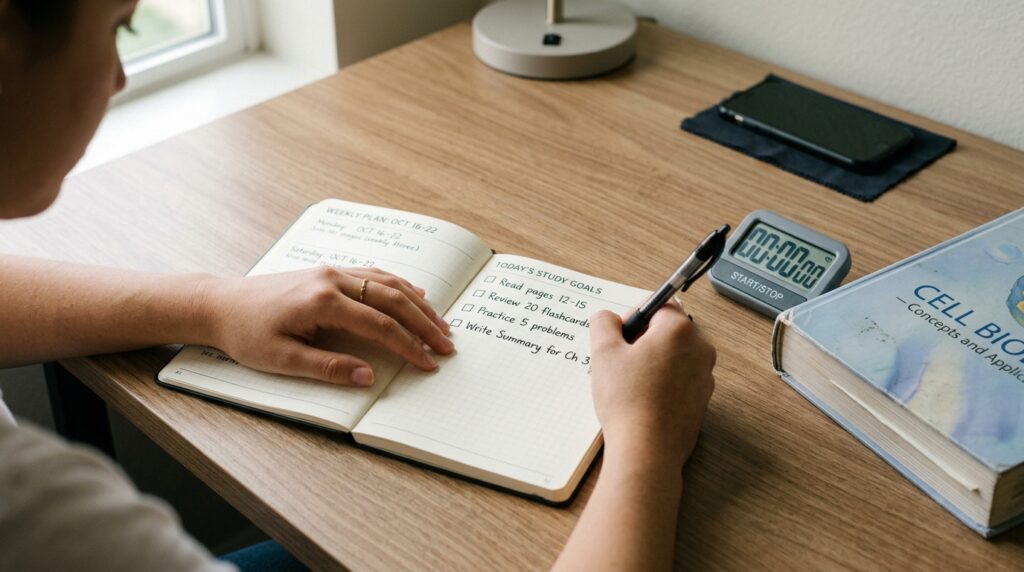
Step 2 – Define One Micro-Goal
Write down exactly what you’ll do in the next 10 minutes.
Examples:
- “Read pages 12–15 and highlight key terms”
- “Write 3 bullet points summarizing today’s lecture”
- “Review 20 vocabulary flashcards”
Make it small enough that you can realistically finish it in 10 minutes.
Step 3 – Set a Timer for 10 Minutes
Use a physical timer, phone timer (in Do Not Disturb mode), or a Pomodoro app.
The timer creates a psychological boundary: “I will not check anything else until this timer goes off.”
If you want to build a simple digital workspace to track your study blocks, see our guide on 15-Minute Study Routine: How to Make Short, Focused Blocks Actually Work.
Stage 2: Focused Work (10 Minutes)
Goal: Do one thing. Nothing else.
The One-Task Rule
For 10 minutes, you work on one task only.
If you’re reading, you read.
If you’re writing, you write.
You don’t switch tabs, check definitions, or watch explainer videos.

Why This Matters
Every time you switch tasks—even for “just a second”—your brain needs 5–10 minutes to fully re-engage with the original task (a phenomenon called attention residue).
In a 10-minute block, one distraction can cut your effective focus time in half.
Digital Boundaries
- Close all browser tabs except the one you’re using
- Turn off notifications (email, Slack, messaging apps)
- If you’re working on a laptop, use full-screen mode or a distraction-blocking app like Freedom or Cold Turkey
Research on cognitive load shows that your working memory can hold about 4 chunks of information at once—trying to juggle more than that (reading + checking notes + Googling + texting) overloads your system and reduces retention.
If you need help managing digital distractions during study sessions, see our guide on 15-Minute Offline Study Routine: How to Cut Phone Notifications and Finally Focus.
Stage 3: Review and Log (2 Minutes)
Goal: Close the loop so you can start fresh next time.
Step 1 – Write What You Did (30 seconds)
In one sentence, record what you finished:
- “Pages 12–15, highlighted 8 terms”
- “Finished 3 bullet points on lecture summary”
This creates a small sense of completion—and gives you a visible record of progress.
Step 2 – Note What’s Next (30 seconds)
Write one sentence about what you’ll do in your next block:
- “Next: pages 16–18”
- “Next: expand bullet point 1 into full paragraph”
This eliminates the “What should I do now?” friction when you start your next session.
Step 3 – Close or Save Everything (1 minute)
Close your books, save your document, clear your desk.
This physical reset signals to your brain: “This session is complete.”
If you’re using Notion to track your study sessions and want to build a simple habit tracker, see our guide on 15-Minute Reading and Notion Routine: How to Turn Scattered Book Notes into a Simple Reading System.
Tools That Make This Easier
Timer Apps
- Forest – Gamifies focus time by growing a virtual tree during your session
- Be Focused (iOS/Mac) – Simple Pomodoro-style timer with customizable intervals
- Toggl Track – Tracks time spent on each study block for weekly review
Digital Workspace
- Notion – Create a simple “15-Min Study Log” database to track what you did each session
- Obsidian – For note-takers who want to link ideas across study sessions
- Google Calendar – Time-block your day visually and schedule 15-minute focus sessions in advance
For a step-by-step tutorial on setting up a Notion study dashboard, see our guide on Building a Notion Study Dashboard: The Complete Setup Guide.
Distraction Blockers
- Freedom – Blocks websites and apps across all devices
- Cold Turkey – Desktop app that locks you out of distracting sites during focus time
- One Tab (browser extension) – Collapses all open tabs into one list so you can focus on a single window
Everyday Tips for Making 15-Minute Blocks Stick
Fix One Time Slot Per Day
Pick one time each day—morning, lunch break, or evening—and reserve it for one 15-minute block.
Example:
- “Every weekday at 9 PM, I do one 15-minute study block”
Studies on habit formation show that context cues (same time, same place) make it easier to build consistency than willpower alone.
Set Your Minimum at “One Block”
Instead of saying “I’ll study for 2 hours tonight,” set your baseline goal at one 15-minute block.
If you do more, great.
If not, you still showed up.
This mindset shift prevents the all-or-nothing thinking that leads to skipping study days entirely.
Chain Blocks with 5-Minute Breaks
If you want to study for longer, chain multiple 15-minute blocks together with 5-minute breaks in between:
- 15 min: Study block 1
- 5 min: Stand up, stretch, drink water
- 15 min: Study block 2
- 5 min: Walk around
- 15 min: Study block 3
This creates a sustainable rhythm without burning out.
If you want to learn how to plan a full study day using 15-minute blocks, see our guide on 6-Hour Saturday Study Plan: How to Build a Realistic Schedule with 15-Minute Blocks.
When 15-Minute Blocks Work Best
Best for:
- Evening study after work – When your energy is low but you want to stay consistent
- Exam prep – Breaking large topics into small, manageable review sessions
- Learning new skills – Language practice, coding tutorials, reading research papers
- Days when focus feels impossible – When long sessions feel overwhelming
Not ideal for:
- Deep creative work that requires 60+ minutes of uninterrupted flow (writing a thesis chapter, solving complex proofs)
- Tasks requiring constant context switching (answering emails, administrative work)
For deep work days, consider using 15-minute blocks as warm-up sessions before longer focus periods.
Related Routines You Might Like
15-Minute Study Routine: How to Make Short, Focused Blocks Actually Work
A deeper dive into building short study blocks and chaining multiple sessions together for extended focus.
15-Minute Time Blocking: How to Turn a Scattered Day into Focused Study Blocks
How to plan your entire day around short focus sessions without feeling overwhelmed.
Can’t Focus? Try This 15-Minute Study Reset Routine
A step-by-step routine for resetting your focus when distractions have already derailed your day.
Frequently Asked Questions
Q1. What if I only have 5 minutes, not 15?
Do a 5-minute block.
The goal is consistency, not perfection.
A 5-minute block still beats zero minutes—and often, once you start, you’ll find yourself continuing past the timer.
Q2. Can I use this routine for work tasks, not just studying?
Absolutely.
This works for anything that requires focus: writing reports, coding, reading research papers, planning projects, or learning new tools.
The only difference is your micro-goal in the preparation stage.
Q3. Why not just use the Pomodoro Technique (25 minutes)?
You can—Pomodoro and 15-minute blocks are cousins.
15-minute blocks work better for people who find 25 minutes too long to start, or who want to fit quick study sessions into lunch breaks, commutes, or evenings after work.
If 25 minutes feels natural for you, use that instead.
Q4. Do I need a special app or tool to start?
No.
You can do this with:
- A phone timer
- A piece of paper
- One notebook
Apps and tools make tracking easier, but they’re optional.
Start with the basics, then add tools as you need them.
Learn More
For more on focus, study habits, and building consistent routines, see:
Jotverse – Time Blocking for Students: The Ultimate Productivity System
Practical guide to using time blocking to manage study sessions and reduce decision fatigue.
https://www.jotverse.com/time-blocking-for-students-the-ultimate-productivity-system-for-academic-success/
Summit Learning Charter – 7 Benefits of Time Blocking Methods for Studying
Explains how time blocking can improve concentration and academic performance.
https://summitlearningcharter.org/resources/blog/benefits-of-time-blocking/
NIH/PMC – Applying Cognitive Learning Strategies to Enhance Learning and Retention
Research-based guide on five evidence-based learning strategies including spaced retrieval and interleaving.
https://pmc.ncbi.nlm.nih.gov/articles/PMC6946583/
Leave a Reply